Western Crop Innovations’ breeding program is producing high-performance lines with the data to back them up.
At Western Crop Innovations (WCI), researchers are rewriting the triticale playbook — and the implications go well beyond the farm gate.
From a distance, the plots near Lacombe, Alta. — which were on display yesterday at the WCI Field Day — may resemble a typical cereal trial. But a closer look reveals the hallmarks of a breeding program that’s doubling down on functional diversity: wide variation in canopy structure, plant height, head shape, and disease response — all traits reflecting the diverse markets and agroecological zones of Western Canada.
“We’re breeding triticale for everything from swath grazing to grain production,” says Mazen Aljarrah, lead researcher on the program. “Different markets and regions need different things, but there are core traits we want in all of them — high forage yield, strong grain performance, and improved digestibility.”
A New Generation of Lines That Perform
Among the standout performers is T336, a grain triticale line that outpaced the top check by 10% in multi-location trials across 15 Western Canadian sites last year. Its test weight hit 75 — a mark triticale hasn’t reached in more than a decade. That’s a major advance in grain quality for a crop often pigeonholed as second-tier.
T336 also brings moderate resistance to fusarium head blight (FHB), while delivering 10% more dry matter forage yield than the current standard. According to Aljarrah, digestibility metrics are now rivaling — and in some cases surpassing — wheat.
“There are a lot of farmers who prefer wheat for its digestibility,” he says. “But I can confidently say we’ve made serious progress — and some of our new triticale lines rival wheat on that front.”
Leveraging Wheat Genetics, Without Sacrificing Triticale Strengths
WCI is building on triticale’s established agronomic strengths — drought tolerance, disease resistance, and lodging resilience — while strategically pulling in wheat traits to meet emerging market demands. One recent candidate features wheat in its parentage to capture early maturity, ergot resistance, and improved palatability.
“We’ve also started crossing spring triticale with winter triticale,” Aljarrah says. “Our best performing plot this year came from a cross between a spring type and a Dutch winter line known for sky-high yield potential.”
The result: lines with large heads, reduced awns, and a leafy architecture that’s ideal for forage.
A Deeper Advantage — Literally
While much of the buzz around new triticale lines has focused on above-ground yield and quality, researchers are also exploring what’s happening underground — and the findings could further differentiate triticale in the marketplace.
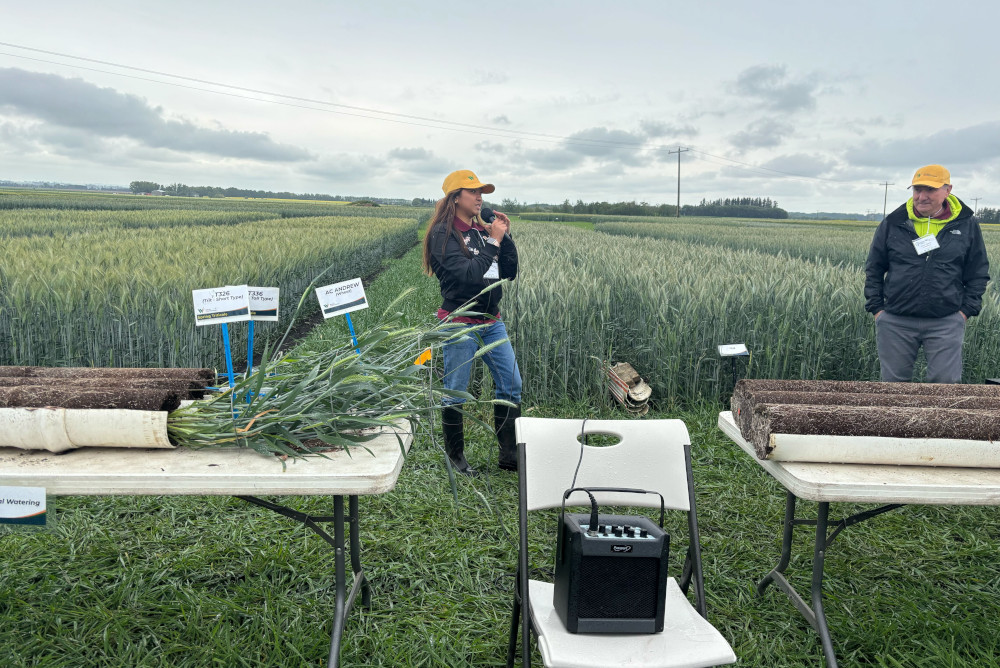
In a root comparison trial led by research assistant Darlene Abando, T336 showed significantly more robust development under drought-like conditions than two wheat lines.
“Even under reduced watering, triticale showed a dense, deep, and wide root system,” Abando says. “Wheat roots were thinner and less developed.”
This root structure improves not only plant resilience, but also soil health — boosting organic matter, infiltration, and microbial activity.
“There’s literature showing triticale keeps growing roots all the way to harvest,” she adds. “Wheat, in contrast, tends to stop after heading.”
Traits That Meet Market Demands
With a growing focus on climate-smart cropping and dual-purpose traits, triticale’s positioning is improving — and seed companies are taking notice.
“It’s less reliant on fungicides, more tolerant to drought and moisture extremes, and it doesn’t lodge,” Aljarrah says. “And when you get 10% more grain yield and 10% more forage yield than wheat — that’s a win.”
Ergot resistance and reduced awn expression — two traits critical to livestock producers — have also been priorities.
“We’ve been targeting those too,” Aljarrah says. “Most of our new lines are reduced-awn, and we’ve significantly improved our ergot resistance.”
Turning Heads in the Industry
Adoption has historically lagged behind triticale’s potential — but that may be shifting. WCI registered three new lines last year, including T318, now the new benchmark check for triticale according to the Prairie Recommending Committee for Oats and Barley (PRCOB).
“They said it offers a unique combination of agronomic strength, yield, forage quality, and disease resistance,” says Aljarrah. “It’s time triticale got its due.”