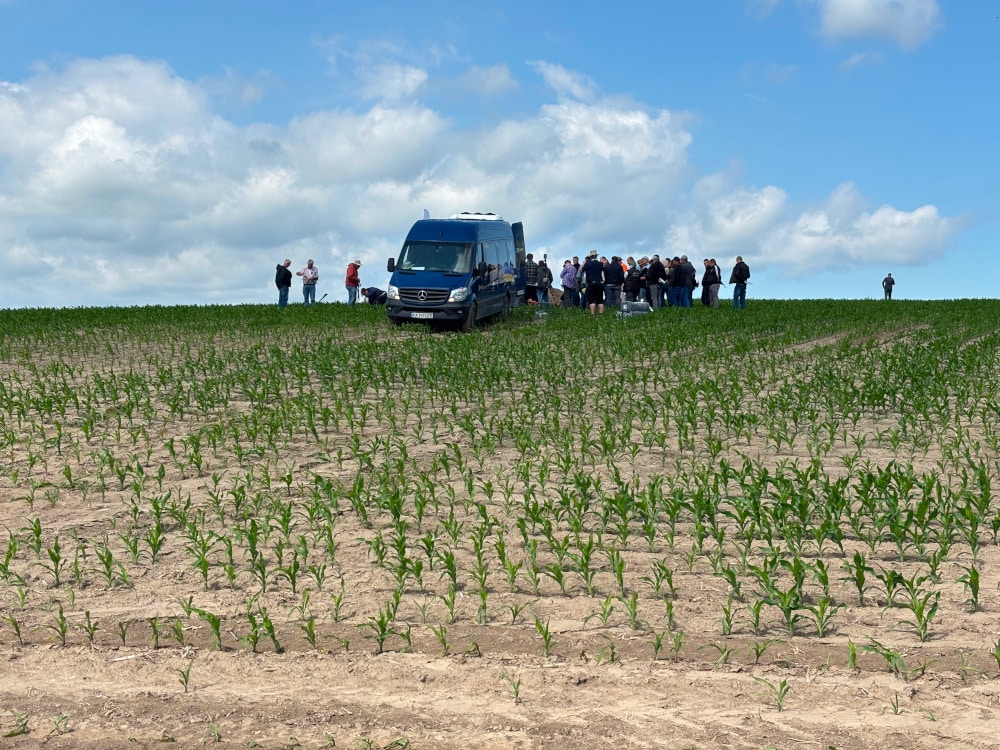
In June I was invited by Roman Grynyshyn from Travelite Agro, in conjunction with World to Rebuild Rural Ukraine, to join a team of agronomists and researchers from New Zealand, Germany, and the United States. The main goal while travelling across Ukraine was to visit fields, view soil pits, and offer our opinions on potential changes in management to help Ukrainian corporate farms to improve their production practices.
We landed in Warsaw then travelled to Lutsk, Ukraine by van. The first day was south of Lutsk near Verbs’ka. Highly calcareous soils, where soybean and corn were the main crops grown. Ploughing and deep ripping were a common practice which resulted in soil compaction, poor water infiltration, erosion, low biological activity, and a heavy reliance on fertilizer, herbicides and fungicides.
Next stop was Zaluzka and Mykhyrynetska where corn, winter barley, and soybean fields were encountered. Beautiful soil profile with an A horizon that would make any farmer jealous, but the soil structure was destroyed by the deep and frequent tillage. The main highways were beautiful, but the secondary highways were very rough.
Looking through a handheld microscope, it was rare to find any saprophytic fungi growing on any of the crop residue. Between the intense tillage, overuse of fungicides and lack of cover crops, the residue had nothing to feed on.
Hvardiis’ka was the next stop, which was made up of all corn fields. More weed and disease concerns with thick black soils. Compaction was limiting root growth creating nutrient uptake issues. York Bayer, a German agronomist, wanted to show the importance of soil cover. As a demonstration a bale of straw or hay was spread over the soil, then he watered both the bare ground and the straw cover ground. This way we could discuss the soil armour cooling the soil and reducing the evaporation. Results were quick and dramatic.
Zhyhalivska was the location of the next soil pit, then to Ivanivska for two more corn fields, similar condition and issues. Zhyhalivska was the first of the sunflower fields. Fields were nice to look at from the road, but the disease and nutrient issues were compounded by the tillage and lack of cover crops.
Our first winter wheat field was in Baikivska, a quite sandy area, but the first that utilized shelter belts. Fragile soils really showed the damage done by tillage. The corn field was on better textured soil with a beautiful A horizon, but without much for biological activity. In the next corn field, plants were showing water stress under a warm day. Too much water was being wasted by evaporation and not enough water was being infiltrated.
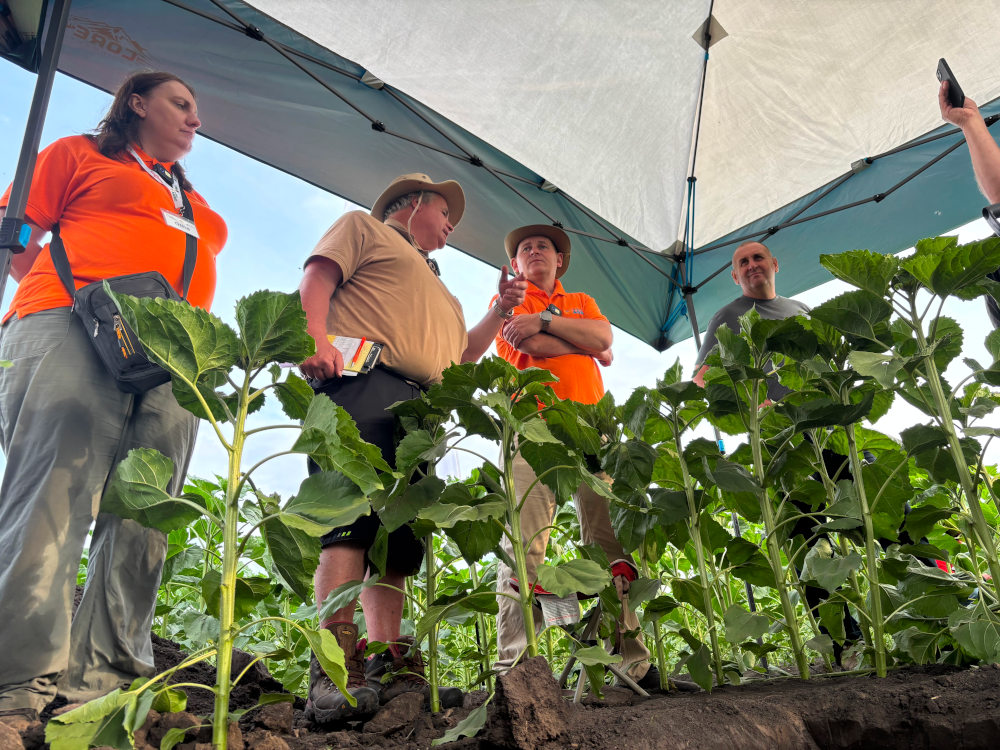
In Fedorivka, the farm had a machinery manufacturing division, Technopol, where they manufactured seeding, crimping and liquid injection equipment. This is the only field where they had a post-harvest cover crop the previous year, and it showed. Better soil armour, improved soil aggregation, and healthier plants. The sunflowers were more robust and saw more predatory insects. Still had compaction concerns, but they were created over decades of management so one year will not fix the issue. The next couple of fields were of winter wheat and winter rape seeded with some winter barley. Since rape and canola are non mycorrhizal fungi friendly, having the winter barley helped support the mycorrhizae fungi for a longer period of time.
The story is the same as we travelled to Chornukhynska, Kurinkivska, and Netrativka. A soil pit in Senkivska showed better root rhizosheath development. Because this area was reclaimed wetland it showed a different soil profile, creating a few new issues such as excessive moisture in the root zone, the soil pit had moisture push up overnight filling the bottom of the pit. It was one of the few areas, if we dug enough in the field, we found earthworms. Three earthworms is not a big number, but it showed that they could exist. At the Velykooleksandrivska site, there was algae on the soil surface, once again indicating good soil moisture and good phosphate availability from years of manure application.
When we travelled to Starosokolivska, 55 kilometers away from Chernobyl, the soil pits showed more challenging soils. Very sandy with much higher rainfall developed under forest conditions, much like grey wooded soils look like in Western Canada. Past erosion events, nutrient retention, and growing season heat were more problematic here for the winter wheat and corn. In the corn fields closer to the river we saw a layer of a rubbery layer in the soil profile high in iron, apparently formed under a high water table.
Heading back toward Lutsk, we stopped at Romanivska where in the corn field, surface soil aggregation was better but the subsoil was fairly compacted. In the sunflower field, the cracks in the soil profile from the deep ripping were still visible. Some hydrolyzed fish, humates and a cover crop at the time of ripping would have made a big improvement on the stability of the rip. The soybean field at Pochuikivska had a history of manure applications, 100 metric tonnes per hectare per year. The pit had a manure smell even after being open for a day before we arrived. There were not much for nodules on the soybeans, and the soil was highly compacted.
The two-day conference at Myrnenska featured the agronomists and researchers along with a few other speakers. Minus the thunderstorm and plough wind it was a great event. There were numerous great conversations and getting follow up feedback on operations implementing aerial seeding of cover crops into their crops already.
Dr. Lyudmyla Sharma was gracious enough to help coach me on Ukrainian agronomic practices and introduce me to some very successful soil health stewards that were family businesses. Building soil resilience with minimal or no synthetic reliance and minimum or zero till, while maintaining profitability. True inspirational operations no matter the location.
Travelling around central and western Ukraine, there was very little indication from the public that there was a war going on. Town squares had memorials set up for fallen soldiers, checkpoints where we needed to provide our passports, and air raid warnings were the only reminders that something was going on.
What Ukraine needs is our support, especially financial and equipment to keep their citizens safe and get the intruders out of their country. For our group, there was no shortages of fuel, food, safe lodging, or safe transportation. The people were friendly and happy, food was plentiful and delicious, and getting around was seamless. I look forward to seeing Ukraine rise from this stronger and more resilient, regaining its place as the bread basket of the world.