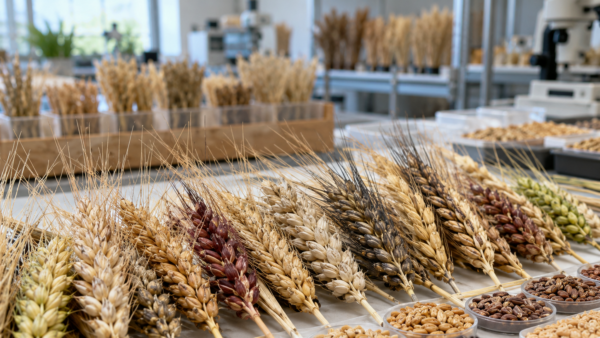
A multidisciplinary team from CONICET is working to genetically improve one of Argentina’s most widely cultivated barley varieties, Andreia. The goal is to enhance the barley’s degradable starch content, making fermentation easier and improving malting efficiency. This is achieved by introducing a gene from the seaweed Ostreococcus tauri. While the primary aim is to benefit brewer’s barley production, the research also holds promise for producing higher-quality fodder for animal nutrition.
The project began at the Center for Photosynthetic and Biochemical Studies (CEFOBI, CONICET-UNR), where researchers transferred the OsttaSBE gene from O. tauri into Arabidopsis thaliana—a model plant used in genetic studies. The genetically modified Arabidopsis plants showed higher starch content, more fermentable glucose units, and smaller starch granules. Building on these promising results, CONICET doctoral researcher Amanda Rosario Gómez Ibarra began exploring how to transfer the seaweed gene into barley, a crop of significant agricultural importance.
To achieve this goal, an inter-institutional team was formed, led by CONICET researchers María Victoria Busi of CEFOBI and Hugo Permingeat of the Institute of Research in Agricultural Sciences of Rosario (IICAR, CONICET-UNR). The group includes scientists from the Agrobiotec Platform at the Faculty of Agricultural Sciences and the Faculty of Biochemical and Pharmaceutical Sciences of the National University of Rosario (UNR). While transgenic barley already exists, this project is novel in being the first to modify barley using algae-derived enzymes.
Busi explains that barley was chosen because its cultivation has grown significantly in Argentina, driven both by the brewing industry and other agricultural uses. She adds that moving from Arabidopsis trials to a crop like barley required access to specialized genetic transformation tools, which led them to the Agrobiotec-FCA platform, directed by Permingeat.
“The platform is a structure, where we have a laboratory of cellular and molecular biology, and we have chambers to grow plants all year round in very controlled conditions,” comments Permingeat, and highlights that this is an advantage, since barley is a winter growing cereal, with which in a space like the platform you can work during any season. He also maintains that by generating transgenic plants, it forces the entire system to be very controlled so that that seed does not disperse, according to a press release.
Gómez Ibarra’s work to develop the new barley variants began with creating an in vitro cultivation system for the crop. The algae gene was introduced into the barley genome using a gene gun. Before this, the gene was engineered to be expressed exclusively in the endosperm of the barley grain, avoiding expression in the entire plant. Once the seedlings reached the appropriate size, they were transplanted into pots and moved to growth chambers, where they were nurtured to maturity. This allowed researchers to harvest seeds and analyze the next generation.
Not all barley varieties respond well to in vitro culture, and this project stood out by working with a variety different from the widely used Golden Promise, which dominates the scientific literature for such studies. Instead, the researchers focused on Andreia, a variety grown in Argentina, which demonstrated a stronger response to the process than Golden Promise.
The work was recognized in 2024 at the International Barley Congress for addressing a largely overlooked area of research. While most studies concentrate on improving yield and disease resistance, this project focused on the industrial enhancement of barley, offering a new direction for the crop’s development.
A Contribution to Industrial Barley
In the process of making an alcoholic beverage, the role of starch is fundamental. In this regard, Busi explains: “Starch is composed of assembled glucose chains, with a complex morphology. If I can make them more flexible, I would have those glucose units available for a yeast to ferment them and produce alcohol. That is, we modify the structure so that the important substrate for the manufacture of the alcoholic beverage is accessible. This is a fundamental contribution of this development since it can ensure malting times, sacharification and allows to regulate the taste to obtain a better beer,” summarizes the scientist.
In this sense, Gómez Ibarra specifies that, by decreasing the size of the granule and increasing the content of degradable starch and the released glucose units, fermentation is facilitated, which would also increase the efficiency of malting for industrial applications.
Current State of Research
The project has already achieved eight independent transgenic events, a critical step because the location of a transgene in the genome can affect its expression and overall outcome. Developing multiple independent events ensures a robust evaluation of results. Of these eight events, five have demonstrated higher starch content, and their phenotypes are being studied through second and third generations.
An important milestone was the identification of a homozygous transgenic line, meaning the introduced gene is stable and reliably passed to future generations. This stability is essential for long-term application.
Beyond improving malting barley, the project has potential benefits for forage production. Increased degradable starch could enhance biomass fermentation, providing more energy for animal feed, which could translate into higher yields of meat or milk.
The researchers see the project as confirming their initial hypotheses. For the innovation to make a real impact in Argentina, they stress the need for a strategic partner to adopt and scale the technology for practical use.