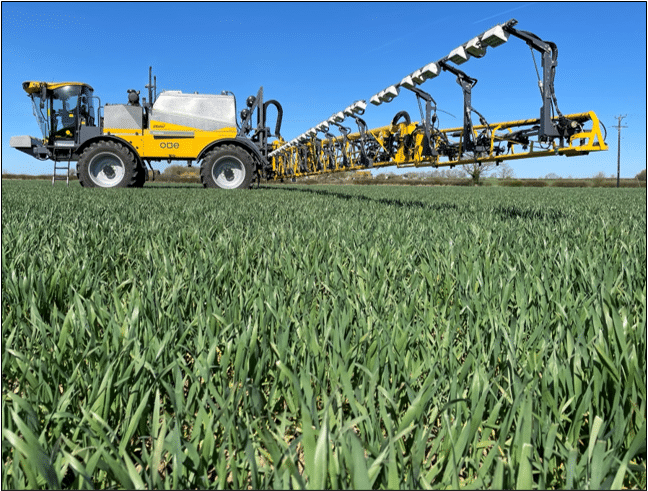
A collaboration between Rothamsted Research and industry partners Bosch, Chafer Machinery, and Xarvio has resulted in an innovative new approach to tackling black-grass (Alopecurus myosuroides), one of the most persistent weeds in UK arable farming.
Using artificial intelligence, cameras mounted on a spray boom can identify black-grass at various stages of its growth. The system then automatically adjusts herbicide application, ensuring that only the affected areas of the field are treated with the appropriate amount of spray.
This precision technique offers multiple benefits: it reduces herbicide costs by limiting spraying to smaller, targeted areas, and it helps to curb the overall prevalence of black-grass across fields, according to a press release.
Rothamsted Research played a key role in developing the AI system by training Bosch’s cameras to recognise black-grass. Researchers captured thousands of images of both crops and weeds from a fixed height, covering a range of growth stages. These images were then used to train an AI algorithm to interpret data collected by cameras mounted on moving machinery across entire farms. Rather than targeting individual plants, the technology identifies and maps zones of infestation, allowing the sprayer to treat those specific areas.
Field trials using a Chafer Machinery sprayer tested various camera configurations and boom heights, ultimately identifying an optimal setup of 28 cameras positioned 1.1 metres above the ground.
Each partner contributed its expertise to bring the system to life: Xarvio focused on agronomic decision-making and chemical selection, Chafer adapted its machinery for precision spraying, and Bosch led the technological development and AI integration.
Peter Frankland of Bosch said, “Rothamsted gave us the understanding of types of cultivation that farmers use and some methods of solving the black-grass problem without using chemicals. Farmers are increasingly adopting no-till or low-till methods and so weed control becomes a more significant challenge. Unlike ploughing, which buries black-grass seeds and prevents germination, these practices leave seeds closer to the surface.”
Rothamsted’s Dr David Comont added that black-grass is a particularly troublesome weed, and growers have had to resort to increasingly complex and expensive mixtures of herbicides to control it. “The strength of this approach is that by targeting herbicides only where they are needed, we can both redece the amount of herbicide being used and the cost to the grower, while still mainitaining control of this weed. This project allowed us to bring the knowledge we have acquired over many years of studying the black-grass problem and combine it with Bosch’s state-of the art technology and the specialist knowledge of the other partners, to make significant progress towards this precision-spraying solution.”
Rothamsted Research played a central role in training the weed-detection algorithms by working directly with the field images captured by Chafer. Over many hours, Rothamsted’s skilled field team meticulously annotated nearly 5,000 images, identifying more than 12,000 black-grass plants and 10,000 other weed species.
The team then supported validation by mapping black-grass infestations across the entire farm area surveyed by the Chafer sprayer — covering more than 100 hectares — and repeating this process over three consecutive years to ensure accuracy and consistency.
The project received funding from DEFRA’s Farming Innovation Programme and UKRI’s Transforming Food Production Challenge.