NordGen is in Lima, Peru this week, joining delegates from around the world and representatives of numerous organisations for an international meeting on the conservation and sustainable use of plant genetic resources. The goal is to ensure that the benefits derived from the world’s most important crop diversity are shared fairly and equitably.
Peru, a country with exceptionally rich crop diversity, offers a fitting backdrop. As global demand grows for higher yields, improved nutrition and crops that can withstand climate change, the genetic resources of both cultivated and wild plants have never been more important. But access to these resources must be properly regulated and fairly shared. For this reason, delegates and organisations have gathered in Lima for the Eleventh Session of the Governing Body (GB 11) of the International Treaty on Plant Genetic Resources for Food and Agriculture.
This marks the first time the Governing Body has met in Latin America — and the first session co-hosted by two countries, Switzerland and Peru. The International Treaty is a legally binding global agreement that ensures the conservation, sustainable use and fair, equitable benefit-sharing of the world’s crop diversity. Its Governing Body, made up of all Contracting Parties, meets every two years to coordinate international efforts on agricultural biodiversity, review progress, strengthen partnerships and support countries in building resilient, diverse and food-secure farming systems.
“The International Treaty ensures that countries share and protect the genetic resources on which our crops depend. These negotiations help enable researchers and plant breeders to access the diverse plant material urgently needed to develop more resilient, climate-strong, and productive crops — an effort that is crucial for future food security,” says Lene Krøl Andersen, NordGen’s Executive Director.
As the Nordic region’s joint genebank and knowledge centre for genetic resources, NordGen participates in the Governing Body of the International Treaty as an observer. Alongside attending the formal sessions, NordGen co-hosted a well-attended side event on the Svalbard Global Seed Vault together with the Crop Trust, the Norwegian Ministry of Food and Agriculture and the International Treaty Secretariat. The event featured speakers from multiple organisations and covered topics ranging from practical guidance for seed depositors to the Seed Vault’s mission and real-world examples of why secure back-ups of seeds are essential, according to a press release.
A Symbol of Peace and Global Cooperation
Among the speakers was Alwin Kopse, Head of International Affairs at the Swiss Federal Office for Agriculture, current Chair of the Treaty’s Governing Body, and Chair of the International Advisory Panel (IAP) for the Svalbard Global Seed Vault. In his presentation, he described the role of the IAP in providing strategic advice and recommendations for the operation of the Seed Vault. As part of their review work, IAP members also have the rare opportunity to inspect the Seed Vault from the inside.
“I felt honoured but also touched to be inside the Seed Vault. For me personally, it is very much a peace project. In these ice-cold chambers, you can see genetic resources from all over the world, and countries that are in conflict with each other may have their boxes next to each other. My conclusion of the visit was also that the Seed Vault deserves the trust of the genebanks,” said Alwin Kopse.
Another speaker at the side event was Kent Nnadozie, Secretary of the International Treaty. In his presentation, he talked about the connection between the Seed Vault and the International Treaty, not least in terms of conservation of plant genetic diversity and international cooperation.
Conserves 1,367 Native Potato Varieties
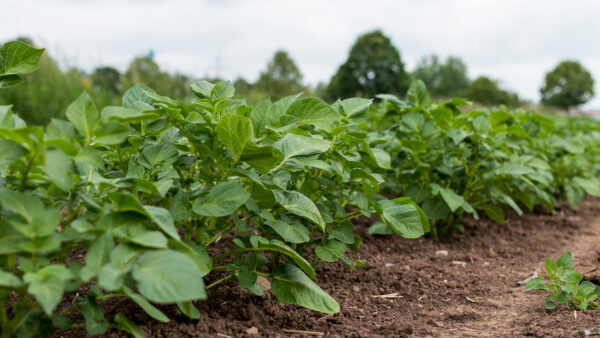
Peru was represented by Ricardo and Ricardina Pacco from Parque de la Papa (the Potato Park) near Cusco. Managed by five Indigenous Quechua communities, the park safeguards 1,367 native potato varieties. Their presentation opened with a screening of UYWAY (“The Seed”), a film depicting the journey from Parque de la Papa to Svalbard in 2015, when the park deposited potato seeds in the Seed Vault.
“We felt like scientists, but we did not just carry a bag of germplasm to Svalbard; we carried our ancestors and the spirit of the Andes. We made this journey because the mountains of Peru told us that everything is changing,” said Ricardo Pacco.
NordGen also took part in the opening of the educational exhibition The Infinite Loop, showcased during GB 11. This unique co-production by the International Treaty, the International Potato Center (CIP), the CGIAR Genebanks, the Crop Trust, and NordGen offered a visual and informative exploration of the journey of plant genetic resources. Visitors could follow these resources from farmers’ fields to genebanks and research centers — where they are conserved, studied, improved, and shared — and then back again to the farmers who cultivate the future of our food systems.
Facts – Key priorities at GB 11
- Strengthening the Multilateral System of Access and Benefit-Sharing
- Advancing Farmers’ Rights and community stewardship
- Enhancing global cooperation on conservation and sustainable use of plant genetic resources for food and agriculture (PGRFA)
- Supporting climate adaptation and crop resilience
- Mobilizing resources and partnerships for greater global impact
- Source: The International Treaty