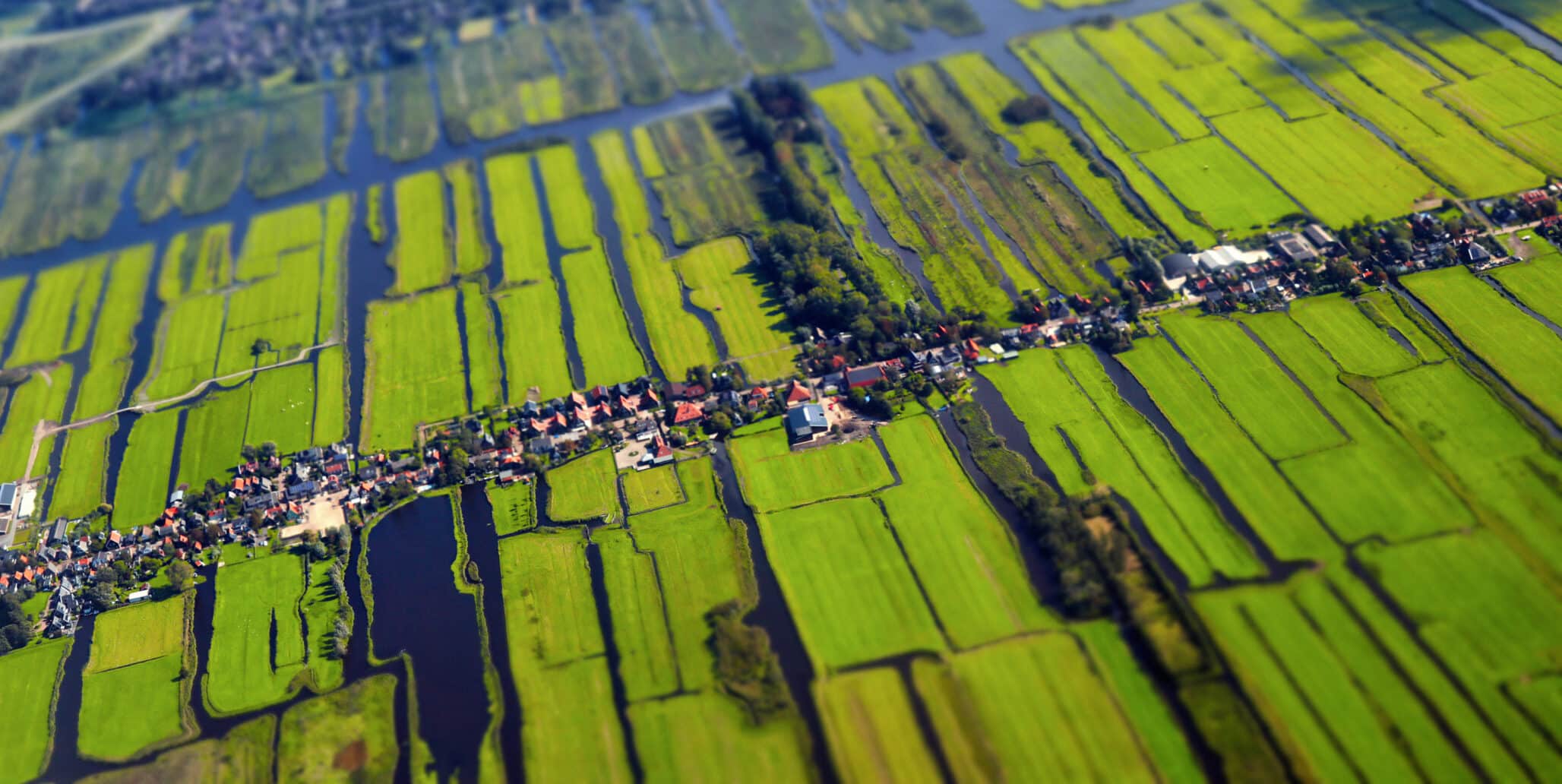
The Dutch agricultural sector remains strong, generating €77 billion in added value. Exports of agricultural goods have also continued to grow, rising by 4.8%. At the same time, the structure of the sector is changing: the number of small agricultural and horticultural businesses is declining, while large and very large operations are becoming more prevalent.
Discover more developments in the latest edition of the State of Agriculture, Fisheries, Food and Nature.
Since 2010, the total number of agricultural and horticultural businesses has dropped by nearly one third — and compared with 2000, it has roughly halved. Between 2023 and 2024 alone, around 700 farms and greenhouses closed, a decline of 1.4%, leaving 49,900 agricultural and horticultural holdings in the Netherlands. The steepest decreases are seen in dairy farming and intensive livestock sectors, including pigs, poultry, and veal calves. This trend is driven by generational succession, stricter environmental requirements, and voluntary termination schemes.
In contrast, the share of very large farms is rising. In 2024, 17% of farms are classified as small and 27% as large, compared with 30% and 17% in 2010. Very large farms now account for 62% of the added value generated by the Dutch agricultural complex, according to a Wageningen University & Research (WUR) press release.
“The figures show that Dutch agriculture continues to adapt to changing circumstances,” says Allard Jellema, project leader at Wageningen Social & Economic Research. “We see ongoing scaling-up, and at the same time a growing attention to sustainability and innovation. ‘The State’ helps to make these trends visible, enabling policy and practice to align more effectively.”
The State at a Glance
The Wageningen University & Research (WUR) snapshot of key figures highlights a sector in the midst of profound transition.
- The agricultural complex accounts for 7.5% of total employment in the Netherlands.
- At the end of 2023, the average agricultural or horticultural business held more than €4.4 million on its balance sheet.
- The livestock population is declining, with 1.9% fewer cattle, 3.1% fewer pigs, and 4.1% fewer chickens.
- One quarter of all investments in agriculture, horticulture, and fisheries can be classified as sustainable.
- The number of organic farms has decreased, even as the area of organically certified land has expanded.
- Around 37% of farms generate additional income through activities such as agri-environmental management, on-farm sales, or care farming.
- The fishing fleet contracted from 578 vessels in 2022 to 502 in 2024.
- Supermarkets account for 61% of all food sales in the Netherlands.
- Dutch consumers spend €14.3 billion annually on food carrying a sustainability label.
- Food waste continues to decline, from 137 to 127 kilograms per person per year.
- Supermarkets are increasingly offering hybrid meat products to help shift the protein balance toward the 50:50 target between animal- and plant-based sources.
- The poultry sector is the largest emitter of fine particulates within agriculture.
- Sales of chemical crop protection products have fallen by almost 25% since 2020.
- Nitrogen production from the Dutch livestock population was 3.1% lower in 2024 than in 2023.
- In 2024, 31% of dairy and veal calves were permanently housed indoors, an increase of 12% compared with 2023.
- Since 2009, sales of antibiotics for use in animals have declined by more than 75%.
- In 2024, 40 agricultural collectives managed agrarian nature across nearly 123,000 hectares.
About The State of Agriculture
The State of Agriculture, Fisheries, Food and Nature is published annually by Wageningen Social & Economic Research and Statistics Netherlands, with contributions from other Wageningen institutes. The publication offers policymakers, researchers and professionals an up-to-date overview of facts and figures on the Dutch agricultural, food and nature sectors. The data is drawn from sources including the WSER Farm Sustainability Data Network and the CBS Agricultural Census.
View all figures and trends at www.staatvanlandbouwnatuurenvoedsel.nl