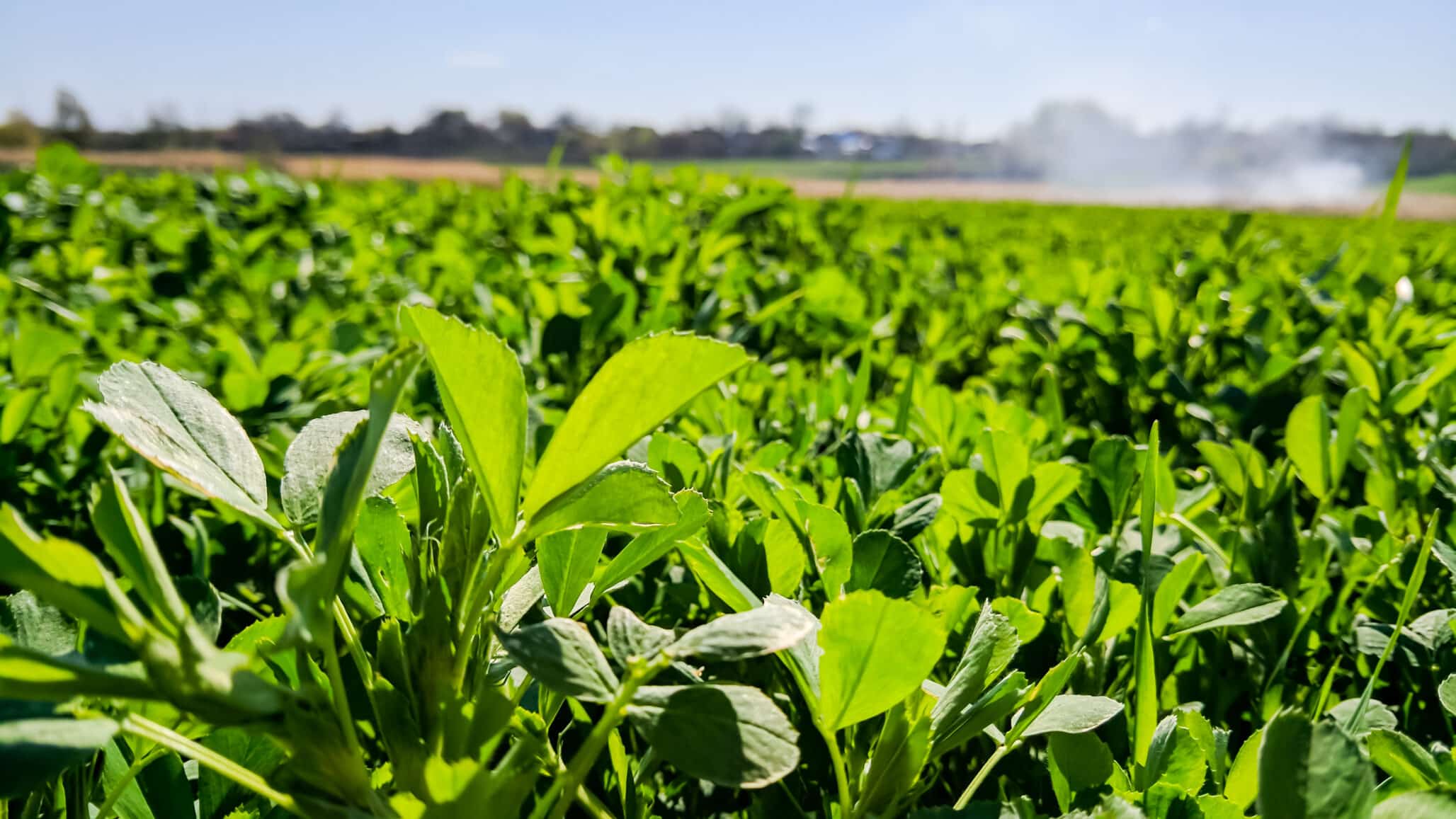
After more than a decade of collaboration, INTA and Palo Verde introduced three new alfalfa varieties in Oncativo, Córdoba, developed under a technological partnership agreement launched in 2009. The release brings forward materials designed to meet key livestock-system needs: improved hay quality, greater tolerance to salinity, and a lower risk of bloat.
“We show the last three varieties, the result of 13 years of research and development,” said Ariel Odorizzi, alfalfa breeder at INTA Manfredi and coordinator of the agreement, highlighting a process focused on combining productivity, persistence and adaptation to specific environments and uses.
Among the releases is Amaya PV INTA, a highly winter-dormant alfalfa developed to produce high-quality hay; Kumen PV INTA, dormancy group 9, bred to perform and yield in saline soils; and Maltetén PV INTA, dormancy group 8, with a lower tendency to cause bloat under direct grazing, according to a press release.
Amaya and Kumen were registered with the National Seed Institute (INASE) in 2019, while Maltetén completed registration in 2023. In all cases, INTA serves as the variety’s breeder and submits the official descriptions of its distinctive traits to the agency.
After selection and registration, and under the technological linkage agreement, INTA transfers the material to the seed company for multiplication and subsequent commercialization, enabling innovations from the breeding program to reach the market and livestock production systems.
Amaya PV INTA is positioned as a variety focused on producing high-quality hay. Its key distinguishing trait is its strong multi-leaf expression, which enhances the leaf-to-stem ratio and increases crude protein content without compromising digestibility, in a material with extremely low winter dormancy.
“This variety was developed for quality hay proposals, because the selection premise was to increase the raw protein and the leaf/stem ratio, increasing the number of leaflets per leaf,” Odorizzi explained.
In the selection process, the team started from the traditional trifoliated alfalfa and advanced towards materials with a greater number of leaflets. “Through four selection cycles we arrived at a variety with about 80% of multifolio,” he said.
That attribute, added to the degree of winter rest 10, gives Amaya PV INTA an unprecedented profile. “It gives it those higher quality characteristics in an extremely winter-free variety,” he remarked, and highlighted its potential to supply demanding hay markets.
An alfalfa with a lower risk of filling
Maltetén PV INTA is a synthetic, non–winter-dormant alfalfa (dormancy group 8) developed to address one of the main challenges of using alfalfa under direct grazing: bloat. Its slower initial rate of ruminal breakdown reduces its bloat potential, while maintaining an upright growth habit, strong stem density, and a well-balanced production profile.
In the presentation, Valeria Arolfo, researcher at INTA Manfredi and coordinator of the National Network of Alfalfa Cultivars, explained that “the fundamental characteristic of this cultivar is its lower tympanizing potential, designed to help mitigate the problem of filling in grazing systems.”
The selection work began in 2010, based on a previous program material. “We started on a group of plants of the ProINTA Carmina cultivar, which already had this same characteristic, with the idea of advancing in reducing the tympanism,” he explained.
After two selection cycles, the team made concrete progress. “We were able to reduce the tympanizing potential by 10.6%,” said the researcher. “We hope it will be available in the market to be able to collaborate with the livestock producer,” he said.
Alfalfa to produce in saline soils
Kumen PV INTA is a synthetic, non–winter-dormant alfalfa (dormancy group 9) developed to tolerate salinity and maintain production in saline environments. It is intended to meet the needs of livestock systems in semi-arid regions and challenging soils, where alfalfa persistence and yield are often constrained.
The variety we present, Kumen PV INTA, was created and improved to produce and tolerate difficult environments, such as saline soils,” explained Monica Cornacchione, researcher at INTA Santiago del Estero, member of the genetic improvement program in the line of abiotic stresses.
The selection process began in a demanding environment. “We started in Isla Verde, in Santiago del Estero, with three years of recurring phenotypic selection,” he said. Then, the cultivar went through different stages until its registration. “He went to controlled conditions for about two years and then to the field for the final evaluation,” he explained.
For the researcher, the main plus is being able to tolerate these environments “It is a cultivar without rest, grade nine,” she detailed and stressed: “We hope that it will soon be on the market and can produce in these systems.”
A network to evaluate varieties throughout the country
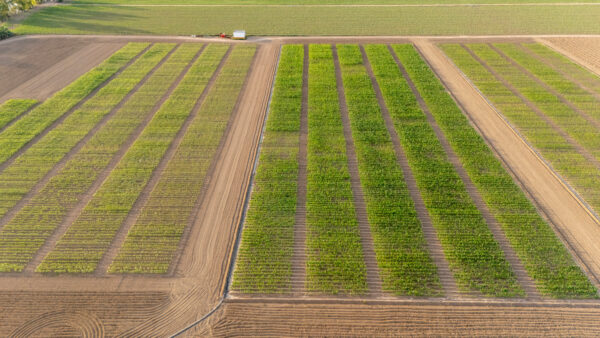
Once selection and registration are complete, the varieties released to the market are incorporated into the National Network of Alfalfa Cultivars, which evaluates their performance across Argentina’s diverse production environments. This framework enables comparisons of forage yield, persistence, and adaptation under real-world conditions of use.
The network currently runs trials at 11 sites, spanning from Chaco to Chubut, and includes both irrigated and rainfed locations, tailored to the environmental characteristics of each region.
“The Cultivar Evaluation Network aims to evaluate the cultivars that are being marketed. Each company voluntarily sends the materials it wants to test,” Arolfo explained. According to the researcher, the trials seek to measure “production, persistence and behavior against pests and diseases in different locations,” which generates comparable information for producers and technicians.
In that context, he said that “at this time the Amaya variety is being evaluated in an essay,” and added that the network also plays a role in the previous stages. “As INTA coordinates this network, we often use it to test the populations that we are developing,” he said.