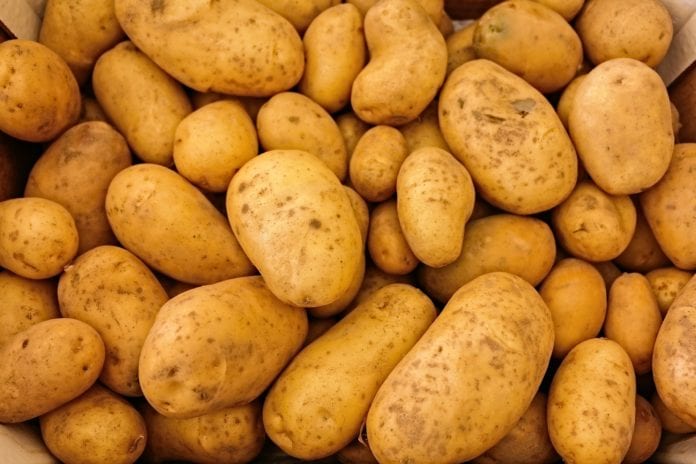
Potato browning after cutting, peeling, or during storage is a familiar challenge for both consumers and the food industry. While it does not affect food safety, it undermines appearance, lowers market value, and generates substantial losses across the production chain. In a country where potatoes are a staple and strategic crop, addressing this issue offers a clear opportunity to improve efficiency, sustainability, and overall food quality.
A recent study published in the journal Agronomy reports a meaningful advance. Researchers from Chile’s Institute of Agricultural Research (INIA), led by scientist Humberto Prieto, developed potato lines with delayed post-cut oxidation using precision gene editing—without introducing external genes. The work forms part of INIA’s institutional initiative, “Strategic genetic improvement in INIA: development of gene editing platforms based on CRISPR/Cas,” which aims to modernize plant-breeding tools in Chile.
Why potatoes darken — and the target for improvement
Browning occurs when the enzyme polyphenol oxidase (PPO) is exposed to oxygen following mechanical damage. PPO oxidizes phenolic compounds, producing dark pigments that discolor the tuber. Within this enzyme family, the PPO2 gene plays a major role in the visible darkening of potato tissue, according to a press release.
To address this, the INIA team used CRISPR-Cas9 delivered through a transient geminivirus-derived system to precisely edit the PPO2 gene in Yagana-INIA, a Chilean variety adapted to local agroclimatic conditions. The goal was to reduce the enzyme activity responsible for browning while preserving the variety’s other productive traits.
Promising results — and a key regulatory milestone
Following the editing process, several candidate lines were assessed using biochemical and visual evaluations. Tubers were cut and exposed to air for 24 hours, then compared with unedited potatoes.
Two lines showed notably improved performance—line 286 and line 108—both demonstrating a significant reduction in browning relative to the control. Importantly, line 286 also met a critical criterion from a regulatory standpoint: tests detected no Cas9 sequences and no vector DNA, confirming it as a gene-edited, non-transgenic potato line.
This result is especially significant because it demonstrates that precise trait improvements can be achieved in vegetatively propagated crops like potato without leaving external genetic material in the final product.
Reduce losses and waste beyond the field
Food losses are often associated with what happens on the farm. Yet a substantial share of waste occurs after harvest — during processing, transport, storage, retail, and ultimately at the consumer level.
For that reason, reducing potato browning is more than a cosmetic improvement. It can deliver benefits across the entire value chain. For processors, lower oxidation means less waste during peeling and cutting, higher yields in minimally processed, frozen, or dehydrated products, and reduced reliance on antioxidant additives.
During transport and storage, potatoes that are less prone to browning after mechanical damage retain their visual quality for longer, tolerate handling better, and extend commercial shelf life. At retail, a lighter, more stable appearance improves consumer acceptance, reduces product rejection on shelves, and lowers economic losses. In households, products that maintain their appearance after cutting are more likely to be used rather than discarded.
A 2024 study estimates that Chile wastes more than 5.2 million tons of food per year — around 295 kilograms per person. The same analysis, comparing waste to food availability, estimated discard rates of 68% for fruits, 48% for vegetables, and 29% for roots and tubers, including potatoes.
These figures underscore the scale of the challenge and highlight why innovations that reduce post-harvest deterioration can have an outsized impact — improving food system efficiency and cutting waste from processing lines to household kitchens.
Gene editing: a proven and strategic tool
Reducing potato browning is not a new objective in agricultural biotechnology. More than a decade ago, the U.S. company Simplot developed a potato with delayed oxidation using RNA-based gene silencing. Marketed as the Innate® potato, it has been sold in the United States since 2014. Under most regulatory frameworks, however, that approach is treated as a genetically modified organism (GMO), because it falls within transgenic biotechnology regulations.
In Latin America, Argentina’s INTA-Balcarce developed the region’s first gene-edited potato a few years ago, also aimed at delaying oxidation. The same research group later applied gene editing to reduce sugar accumulation during cold storage — a key issue in transport and storage — and to improve drought tolerance.
What differentiates today’s precision gene editing is its ability to introduce targeted changes without adding external genes, and to do so directly in commercial varieties already adapted to local conditions. This is especially important in potato, a clonally propagated crop that does not self-pollinate and has a complex tetraploid genome—factors that make conventional breeding through crosses significantly more difficult and time-consuming.
In Chile, INIA’s achievement was developed in a variety adapted to national soils and production systems, providing a practical foundation to incorporate this trait into the institute’s potato improvement programs and accelerate the delivery of improved varieties to the productive sector.
A regulatory pathway enabled in Chile
Producing an edited line without transgenes has important regulatory implications. In Chile, this type of product can be evaluated through the Agricultural and Livestock Service (SAG) regulatory consultation process, which determines case by case whether a new variety contains GMOs in the final product. If it is determined to be free of GMOs, it falls outside the scope of Chile’s GMO regulations.
By the end of 2025, more than 90 gene-edited products had been submitted to this process in Chile and were considered outside GMO regulations, enabling their progression to field trials and potential commercialization as equivalent to products developed through conventional breeding. Globally, only the United States exceeds this figure, having cleared more than 200 gene-edited products to date.
Against this backdrop, INIA’s development aligns closely with Chile’s regulatory trajectory and reinforces gene editing as a practical pathway for locally driven agricultural innovation — supporting productivity, sustainability, and the reduction of food waste.