It was supposed to be a malt barley — until it started outyielding the feed competition by up to 30%. Now TR22669 is gunning for a top spot in high-input systems across the Prairies.
Barley breeding is never linear — but progress is cumulative. After nearly 30 years of trial, error, and adaptation to western Canadian conditions, the team at Western Crop Innovations (WCI) is bringing forward a new feed variety that has the industry paying attention: TR22669.
Originally developed as a malt prospect in 2014 by breeder Oriana Grace, TR22669 didn’t quite hit the mark for malting specs — but showed too much agronomic promise to abandon. After three years of official testing, it’s now registered as a feed barley, with strong yield potential under high-input management systems.
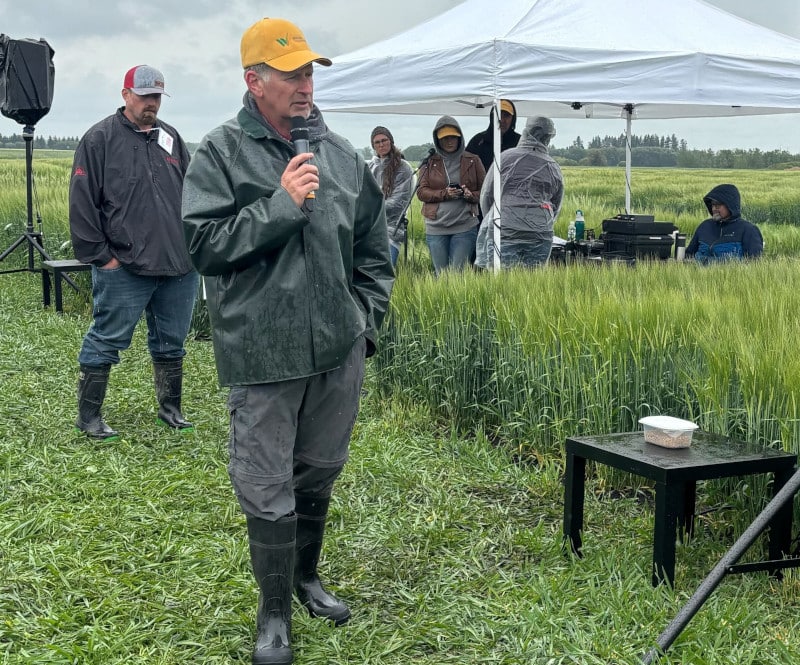
“We saw excellent standability, yield, and overall agronomics,” says John Bowness, senior research associate at WCI. “So instead of walking away, we pivoted and registered it as a feed line. It’s already proving to be competitive with some of the top-performing varieties in that class.”
Built for High-Input Systems
TR22669 is a semi-dwarf, two-row, hulled barley that thrives under intensive management — ideal for operations using manure-based fertility, irrigation, or other high-input strategies. That puts it squarely in the same category as Esma and Suresh, varieties that have carved out a niche in the feed space.
“Under those conditions, semi-dwarfs can really separate themselves,” Bowness explains. “In one irrigated, high-input strip trial in southern Alberta, TR22669 yielded 30% more than Esma and Suresh. It was just one rep, but it’s an early signal that we’ve got something worth watching.”
Proven Performance in Trials
The numbers back it up. In the malt co-op trials — where TR22669 was originally tested — the line held its own against major benchmarks:
- 4% higher yield than CDC Copeland
- 1% higher than AC Synergy
- Only 2% behind Austenson
When analyzed by soil zone, TR22669 stood out in the black soil zone:
- 8% over Copeland
- 2% over Austenson and Synergy
WCI’s own pre-registration trials confirmed the trend. Across irrigated and dryland sites like Westlock, Olds, and Lacombe, TR22669:
- Outyielded Suresh by 6%
- Beat Esma and Austenson by 2%
Disease Package: Strengths and Watchouts
TR22669’s resistance package checks several important boxes:
- Resistant to: stem rust, loose smut, surface-borne smuts
- Intermediate resistance: fusarium head blight (FHB), spot form of net blotch
- Susceptible to: scald
Scald susceptibility will be a consideration in regions with higher disease pressure, but for many western Canadian growers, Bowness says the tradeoff may be worth it.
“Compared to Suresh and Esma, we’re already ahead on disease,” he notes. “It’s not quite at the level of something like FB23618, but it’s a step in the right direction.”
As more side-by-side trials roll out this season, WCI is looking to confirm what the early data suggests: TR22669 could become a go-to choice for feed barley under high-management scenarios.
“If you’re running a high-input system and looking to replace Esma or Suresh, this line deserves a look,” Bowness says. “It’s early days, but everything we’ve seen points to real potential.”