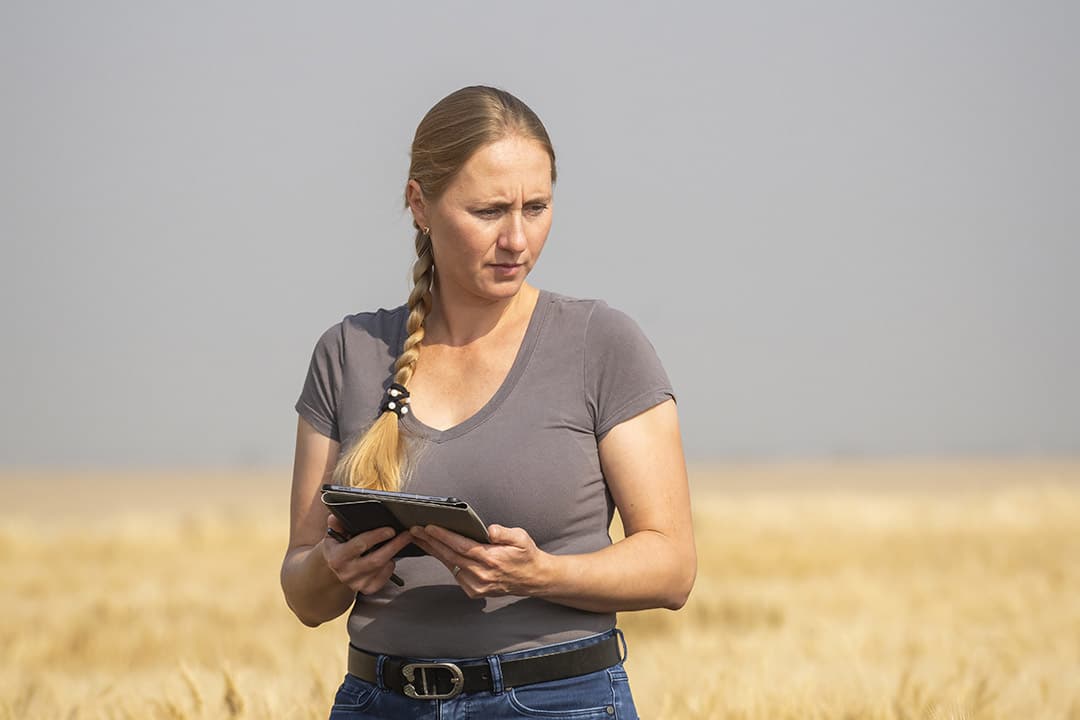
With two PhDs and a global research pedigree, Valentyna Klymiuk is poised to supercharge Sask Wheat’s breeding game from lab to field.
Valentyna Klymiuk isn’t just bringing a new approach to wheat — she’s bringing two PhDs, a global research track record, and a laser focus on pushing genetic frontiers. As the newly appointed Saskatchewan Wheat Development Commission Applied Genomics and Pre-breeding Chair at the University of Saskatchewan, she’s stepping into a role designed to fast-track the development of climate-smart, high-performing crop varieties.
Funded by Sask Wheat and anchored in the university’s Crop Development Centre (CDC), the chair position is more than academic—it’s about turning cutting-edge genomics into tools producers can actually use.
“As the research chair, Dr. Klymiuk will design and deploy leading-edge strategies and technologies to assess genetic diversity for delivery into new crop varieties that will benefit Saskatchewan producers and the agricultural industry,” said Dr. Angela Bedard-Haughn, dean of the College of Agriculture and Bioresources at USask.
It’s a job tailor-made for someone like Klymiuk, who has spent over a decade working at the intersection of wheat genetics and genomics, with a particular focus on wild relatives of the crop. Her research will link discovery science, gene bank exploration, and pre-breeding to accelerate variety development for Saskatchewan’s growing conditions.
“Better adapted wheat varieties give Saskatchewan producers more effective tools in their rotational toolbox,” said Jake Leguee, Chair of Sask Wheat’s Board of Directors. “We strongly believe in public wheat breeding programs and as a producer I have seen first-hand the superior wheat varieties that come from program investments like this research chair.”
Klymiuk starts her new role August 1, 2025, with an assistant professorship in the Department of Plant Sciences and the CDC. She’ll also help shape the next generation of scientists by supporting undergrad and graduate training.
“The CDC has a proud history of wheat breeding, and we are grateful to Sask Wheat for their support of this new research chair. We are thrilled to welcome Dr. Klymiuk to the CDC team,” said Dr. Curtis Pozniak, director of the CDC. “Dr. Klymiuk is a talented early-career researcher, and her passion for innovation will address new challenges as we strive to advance agriculture in western Canada.”
Klymiuk’s journey started in Ukraine, where she earned her bachelor’s, master’s, and first PhD in biology and hydrobiology. Her second PhD, from the University of Haifa in Israel, focused on plant genetics and the use of wheat’s wild cousins to fight disease.
“I am thrilled to join the CDC and the College of Agriculture and Bioresources as I work to discover and deploy new traits to support our variety development programs,” she said. “My vision is to bridge advances in science and technology with applied crop breeding, contributing to the CDC’s mission of delivering superior wheat varieties that strengthen the resilience of the agricultural sector.”
Before her appointment, she was already making waves inside the CDC as a research officer in Dr. Pozniak’s lab, leading work on Fusarium Head Blight resistance. Her resume includes heavy-hitting genomic tools, applied breeding strategies, and a growing list of accolades—including the 2019 Jeanie Borlaug Laube Women in Triticum Early Career Award and the 2022 Carlotta Award for contributions to wheat science.
For Saskatchewan wheat—and the global future of food—Klymiuk’s arrival signals a new era. The wild side of wheat just found its champion.
Read the news release here.