Dr. Gwendolyn Kirschner, a researcher at The James Hutton Institute, has received a prestigious postdoctoral award from the Scottish Universities Life Sciences Alliance (SULSA) for her research on root angle control in barley.
Her work focuses on gravity signaling in plants, which influences root growth and could help crops better access essential resources like water.
SULSA recognized four exceptional postdoctoral researchers whose work shows strong potential to impact the life sciences and to raise their profile in Scotland. The prize supports the next generation of life science leaders and includes a fully funded tour of three Scottish universities, where recipients deliver seminars and engage with staff, as well as flexible funding to advance their career development, according to a press release.
“The SULSA postdoctoral prize will allow me to visit the universities of the Highlands and Islands, Edinburgh and Glasgow to present my research — an ideal opportunity to meet the plant research community, explore collaborations and learn more about the local resources in Scotland, for example local barley varieties,” Kirschner said.
Kirschner’s research explores a fundamental question in plant biology: why do stems and branches grow upwards, while roots grow downwards?
Plants are able to sense gravity and orient their growth accordingly. While scientists understand how roots respond to a gravitational stimulus, such as a rotation, it remains unclear how roots maintain specific growth angles over time and how they sustain angles that differ from vertical.
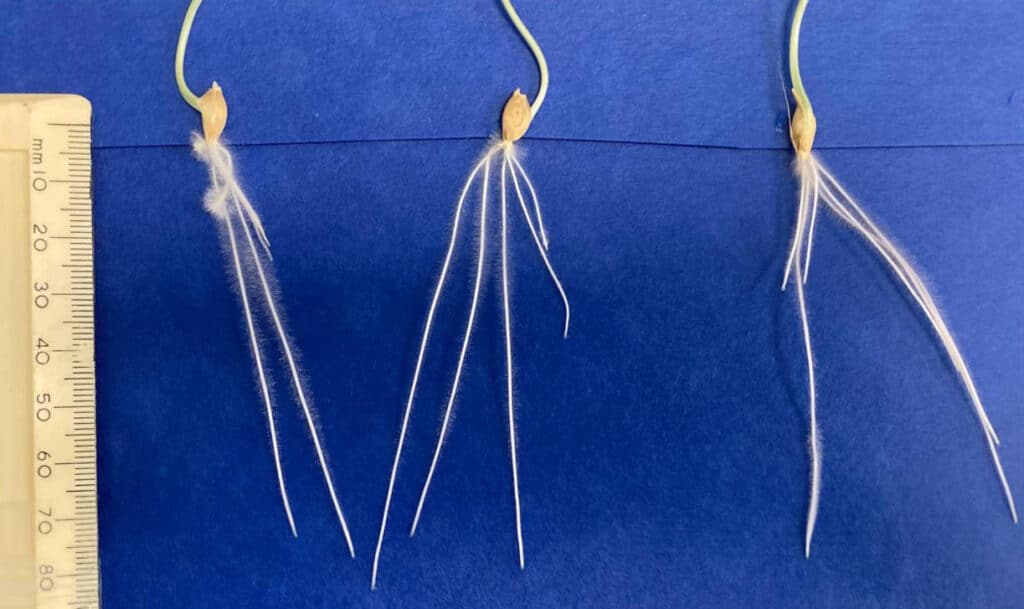
Barley’s seminal roots—the first roots to emerge after germination—provide an ideal model for studying root angle. These roots are of similar age and developmental stage, yet grow at different angles.
Kirschner’s research compares the signaling pathways in roots with different angles to determine whether the root angle “set-point” is controlled at the level of gene expression or proteins, and to identify the key regulators of this process.
Root angle is critical because it shapes the plant’s root architecture, which directly affects access to water and nutrients. Steep roots penetrate deep into the soil, reaching deep-water reserves and mobile nutrients such as nitrate, while shallow roots spread across the soil surface, absorbing immobile nutrients like phosphate.
To investigate how root angle affects crop performance, Kirschner uses barley mutants with varying root angles to study water and nutrient uptake under different soil conditions. This research will ultimately inform the development of climate-resilient crop varieties capable of thriving in low-input systems.
A deeper understanding of root angle regulation could enable scientists to optimize root system architecture, improving yields by enhancing access to water and nutrients, particularly under challenging conditions such as drought.
Kirschner’s work is part of the International Barley Hub at the James Hutton Institute, a centre of excellence that connects industry-focused research with innovation to deliver immediate impact and support the long-term sustainability of UK and global agriculture, brewing and distilling, and food and non-food sectors.