A fresh regulatory framework gives new genomic techniques a place of their own — opening the door to faster, smarter and more resilient crop innovation across Europe.
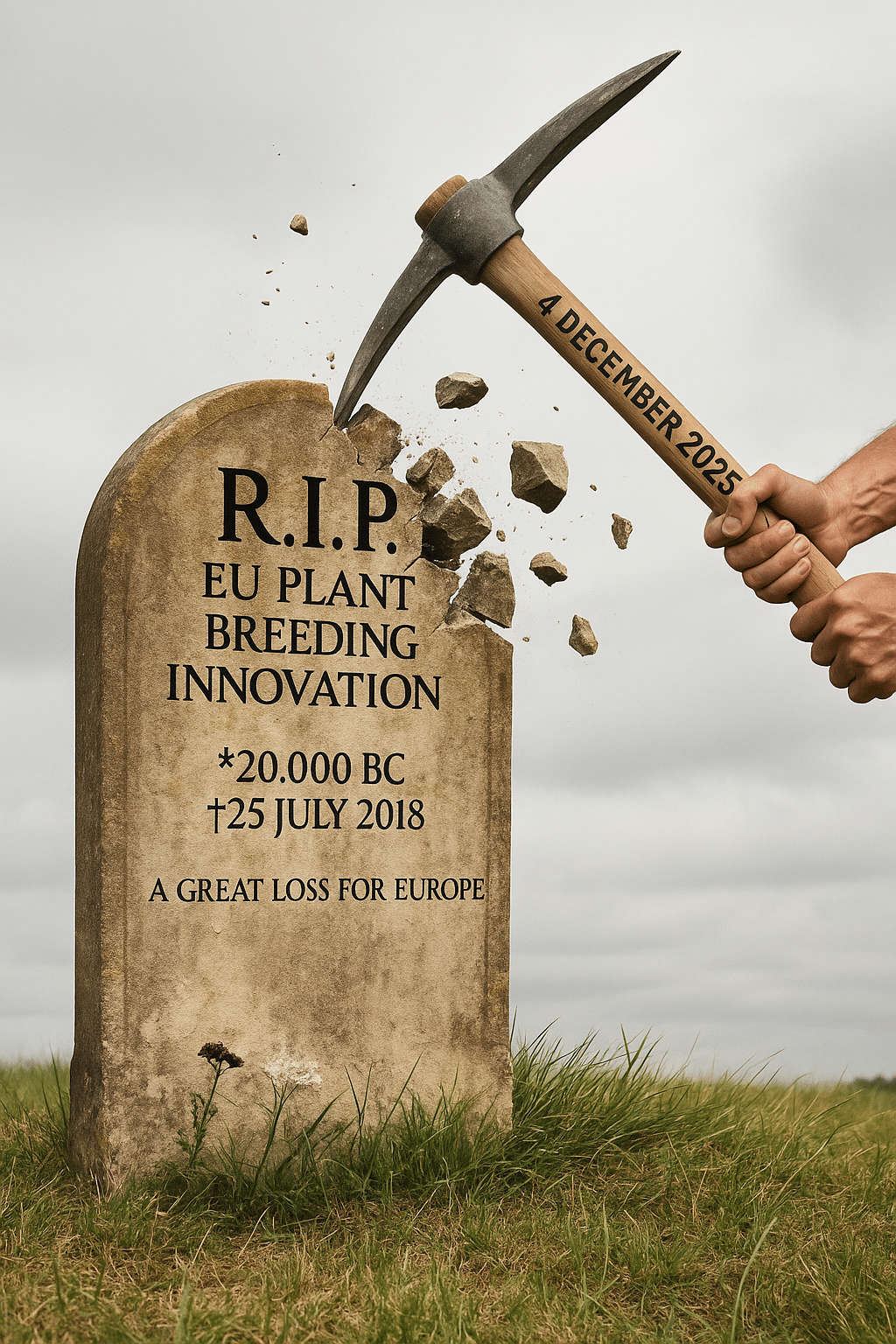
A few years ago, when we put a tombstone on the cover of European Seed with the inscription “R.I.P. EU Plant Breeding Innovation – born: 20,000 BC / died: 25 July 2018 – A Great Loss for Europe” some people thought we were being dramatic. But you try watching a legislative process stall and not reach for a chisel. At the time, it felt like Europe had buried the future of plant breeding with full honours: a solemn ceremony, a few speeches, and the lingering hope that maybe, just maybe, someone would misplace the death certificate.
Well, it turns out resurrection is not just for mythologies and movie franchises. Because here we are, in 2025, witnessing something I honestly wasn’t sure I’d ever see again: Europe cracking open the vault, brushing off the cobwebs, and saying, “You know what? Let’s give innovation another go.”
If you listen closely, you can almost hear the tombstone sigh.
A New Chapter (Finally) Begins
After what felt like an eternity in regulatory limbo, Europe is finally opening the door to a fresh set of breeding tools: the kind we didn’t even dream of when our old rulebook was written.
When the 2018 Court decision placed NGT plants under the existing GMO framework, it landed with a heavy thud in the plant breeding and seed sector. While the ruling provided legal clarity, it also swept a whole new generation of breeding tools into a system never designed with them in mind. For many of us, it felt like innovation had been put in the wrong queue. Not out of malice, but simply because the legal machinery had no other shelf to put it on at the time.
It was clear, though, that this was not a long-term solution. These new tools would eventually need a chapter of their own. And with the new NGT regulation, that chapter has finally, and thankfully, been written.
The new two-category system is more than administrative tidying. It recognises that some NGT plants are biologically indistinguishable from what nature or traditional breeding could achieve, while others may warrant closer oversight. It’s a balanced, proportionate approach, a long-awaited acknowledgement that innovation comes in different shapes and sizes.
Why It Matters — Europe Steps Back Into the Game
For years, European breeders watched colleagues elsewhere move ahead with tools we were not allowed to use. Meanwhile, climate change didn’t politely wait for Brussels. Pests did not stop at the Schengen border. Farmers certainly didn’t stop needing resilient varieties.
NGTs allow breeders to speed up what they already do best: improve plants. More precisely. More efficiently. More sustainably. Traits that help crops withstand drought, heat, new pathogens, or reduced inputs are no longer optional extras: they are essential to the survival and competitiveness of European agriculture.
This regulation doesn’t solve everything, but it does something incredibly important: it allows Europe’s seed sector to rejoin the global innovation race without tying its shoelaces together first.
But Let’s Not Break Out the Champagne Just Yet
Every miracle comes with footnotes.
While the political agreement marks a major shift, several areas still deserve close attention:
- Implementation must be consistent across Member States. If every country colour-codes the categories differently, we’re back to regulatory spaghetti.
- Transparency and patents need clarity. The sector will watch closely how new mechanisms affect access to materials and breeders’ freedom to operate, especially for SMEs.
- Beware administrative creep. If additional layers of procedure siphon time and resources away from actual breeding, we’ll have missed the point.
The path ahead is promising, but it’s not without a few bumps.
Communication Will Make or Break This Transition
NGTs may be technologically precise, but public perception operates on an entirely different wavelength. This regulation will only succeed if we explain, clearly and consistently, what NGTs are, and just as importantly, what they are not.
Farmers need to understand why these tools matter. Consumers need honest information before rumours fill the gap. Policymakers must remain vigilant without becoming paralysed by hypotheticals.
This is not just a regulatory shift. It is a cultural one. And the seed sector has a responsibility to guide the conversation with the same care we apply to breeding a new variety.
A Second Chance Worth Taking
Back in 2018, when the tombstone graced our cover, it symbolised frustration, and more than a little mourning, for a Europe that seemed unwilling to acknowledge scientific progress. Today, that same Europe is showing signs of revival. The stone hasn’t fully rolled away, but it’s cracked open, and a warm beam of light is finally getting through.
This is not the end of the story, but it could be the beginning of a far more hopeful one. With thoughtful implementation, transparent communication, and continued investment in innovation, NGTs can help build a sustainable, resilient, and competitive agricultural future for Europe.
And who knows, maybe one day we’ll print a new cover. Not a tombstone this time, but a birth announcement.