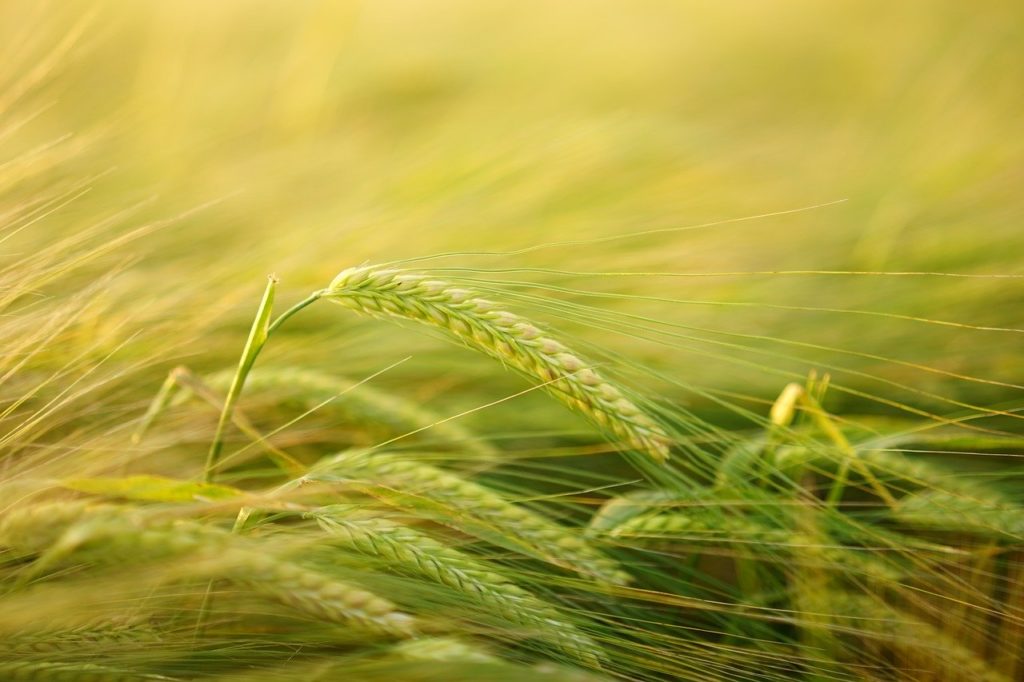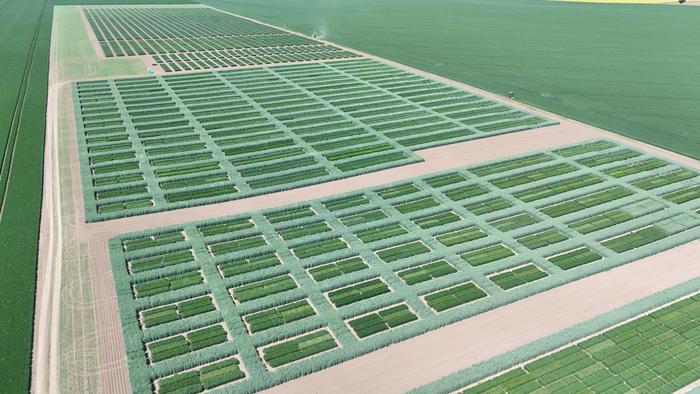
When two homozygous plant lines with different traits are crossed, their offspring are often more vigorous and higher-yielding than either parent. This effect — known as heterosis — can arise when beneficial gene variants mask harmful ones, or through complex networks of interacting genes that influence each other’s activity. To better capture these interactions, the research team has developed a new statistical method that analyses them faster and with greater precision.
Instead of testing billions of gene combinations one by one, the new approach — hQTL-ODS (Heterotic Quantitative Trait Locus – One-Dimensional Scan) — estimates each gene’s overall contribution by measuring how it performs through interactions across the genome. In a large wheat study of more than 5,000 hybrids, the method pinpointed key loci that contribute most to heterosis. The team also integrated multiple mathematical techniques into hQTL-ODS to make it practical for whole-genome sequencing data.
The advantages of the new method are clear. “Using conventional methods, it would have taken us years to complete the same analysis,” explains Dr. Guoliang Li, first author of the study. “With our new approach, however, we were able to complete the evaluation in just a few days. It’s as if we were suddenly looking at the genome through a telescope instead of a magnifying glass.”
“We have seen that heterosis is caused by genes that talk to each other,” Guoliang Li continued. “It’s like an orchestra, where the conductor leads by communicating with the musicians. With heterosis, however, there isn’t just one conductor that increases the final yield.” Thus, the researchers show that it is the combined effect of many gene interactions that determines heterosis, rather than the effect of a few very dominant genes, according to a press release.
The method reveals previously hidden genetic patterns. “Our method can also detect weak signals that were previously overlooked,” Guoliang Li explains. “It’s like suddenly seeing the entire network of cables that controls the plant beneath the surface.” “This study demonstrates the importance of developing advanced mathematical/ statistical tools for understanding complex biological mechanisms”, says Dr. Yong Jiang, researcher in the research group “Quantitative Genetics” and also one of the leading authors of the study.
The new model provides a fresh way to uncover the genetic drivers of heterosis in the era of whole-genome sequencing, and it can be extended to other crops such as maize and rice. hQTL-ODS could help breeders pinpoint parent lines most likely to produce strong hybrid vigour, speeding up yield gains—an important step toward safeguarding food supplies as climate change intensifies and the global population continues to grow.