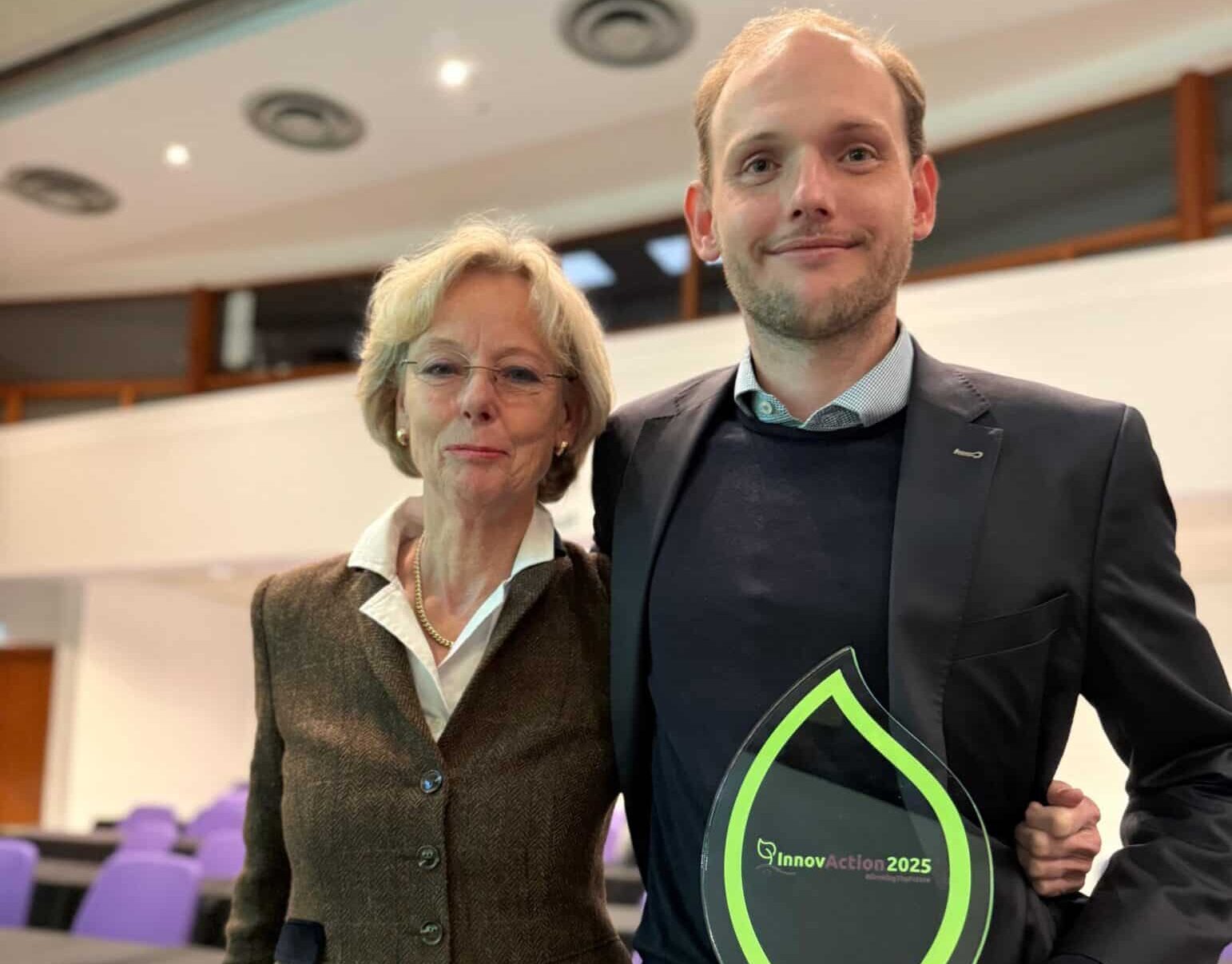
Euroseeds 2025 InnovAction Stage winner brings 3D and 4D clarity to seed quality, breeding and processing.
This week, Seed World Europe is featuring the third, second and first place winner of Euroseeds InnovAction Stage 2025. Today we are featuring first place winner phenoLytics.
When phenoLytics stepped onto the Euroseeds InnovAction Stage in 2025, it wasn’t just another promising technology pitch, it was a clear signal that advanced seed phenotyping is ready to move from potential to practice. Awarded first prize for its high-throughput 3D and 4D X-ray CT phenotyping solutions, the company impressed the jury with a technology ecosystem that delivers ground-truth seed and seedling data across the entire seed sector value chain. In this interview, Johannes Wolff, founder and CEO of phenoLytics, explains how phenoLytics’ approach is changing the way seed quality is measured, decisions are made, and value is unlocked from breeding to production and beyond.
Seed World Europe: Johannes, could you explain in your own words what phenoLytics does, what is the core idea behind your 3D/4D-phenotyping technology, and what motivated you to develop this solution?
Johannes Wolff (JW): Our entire technology portfolio was developed to address a key challenge in the seed industry: the lack of ground-truth high-throughput phenotypic data of seeds and plants which is needed for all processes across the value chain, from breeding to production to processing to seed treatment, quality control and sales — because you can only optimize what you can measure. While it may not always be called “phenotyping”, all processes rely on it: quality and purity testing relies on classifying seeds and plants, for processing you need to distinguish between good and bad seeds and for assessing the effects of seed treatments you need to measure their effects on germination and vigour.
As there were no suitable technologies available to provide this ground-truth high-throughput phenotypic data, our founder, Dr. Antje Wolff, developed our technology portfolio at a breeding company with the help of the Fraunhofer Institute to solve these daily, real-life challenges. Over the last 30 years, our technology portfolio was created and refined, growing into an interconnected technology ecosystem of 3D Xray CT technologies (phenoCheck & phenoTest) linked to advanced, patented 3D sorting technologies (phenoScort).
We, as phenoLytics, are now further developing this portfolio for all crops and broad applications. With our partners PhenoKey and the Fraunhofer IIS, under our newly established, joint brand SeedTelligence, we now sell and implement these technologies as turn-key solutions in a modular “lego” system where you can build these technology blocks increasingly into the end-to-end approach which unlocks value for all functions across the value chain.
SWE: Why do you believe there is a real need today for high-throughput 3D/4D phenotyping and seed/plant data — what are the main challenges in traditional seed quality testing, breeding or seed processing that you are solving?
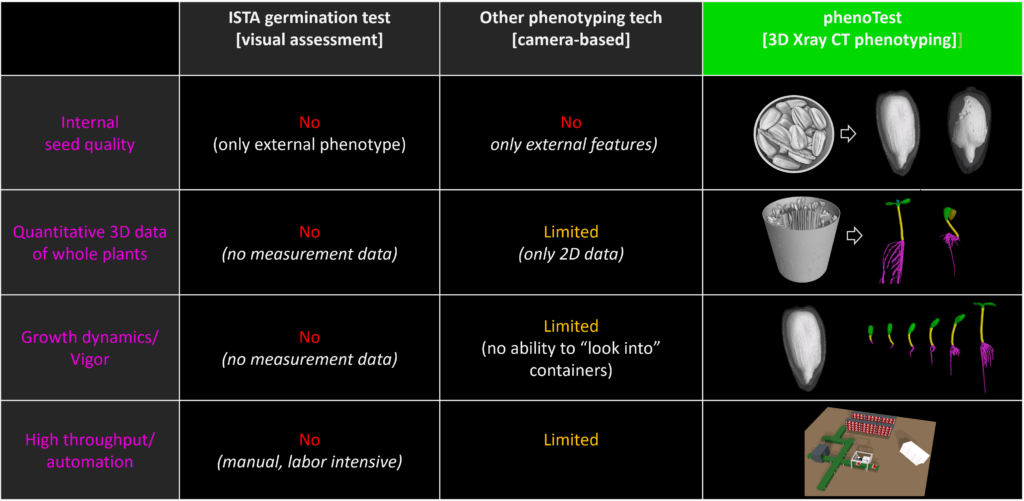
JW: All processes in the seed industry rely on seed quality data, because only a high seed quality can unlock the real genetic potential of plants. However, seed testing for now over 100 years still relies on visual, manual and, unavoidably, objective germination and purity testing. A germination test provides only a percentage, but no phenotypic data and no “diagnostic” insights because they do not measure seed quality directly on the seed. You know that there is a problem, but not what the problem is and what to do against it. And with widespread labour shortages, relying on labour-intensive and seasonal manual tests for business critical processes become a real operational challenge and risk.
Due to these limitations, we see significant challenges in the way the seed industry currently operates, and our end-to-end technology portfolio is designed to provide solutions and unlock value across the entire seed value chain:
Lack of globally harmonized quality data across labs and decentralized production that predict performance in the field. Ground-truth phenotypic data of seed and seedling quality, germination speed and vigour, allowing data-driven, objective and standardized quality data across labs globally which ensures stable quality results in the field
Lack of automated solutions to create high-throughput data to leverage AI and big data for R&D and breeding. Fully-automatable, high-throughput data generation of seeds and seedlings as part of routine testing, allowing to build predictive seed-seedling models at ten-thousands of datapairs per day, and accelerating R&D and breeding with actionable big data from the lab
Long lead times because every germination test adds weeks to each step, e.g., in production & processing, preventing fast decision-making. Quick, few minute seed bulk scans to predict usable seeds directly after harvest, detect quality problems early and steer seed processing with quick bulk scans in-line, to integrate seed quality data across the supply chain and enable earlier decision making
High waste in seed processing due to an inability to “diagnose” problems and inability to sort for seed quality and germination outcomes on a single seed level. Quickly characterize each seed lot and seed, set the right sorting parameters and tailor the border between usable and non-usable seeds to prevent valuable seeds and lots from going to waste. Sort directly for seed quality, and with predictive models for seedling quality, on a single seed level at a high throughput with the phenoScort.
We thus enable the creation of ground-truth data which can be shared across functions and across organizations to steer and optimize all operational processes and provide breeding and R&D with the actionable big data needed to accelerate discovery and innovation.
SWE: What makes phenoLytics’s approach particularly innovative compared with existing methods (e.g. manual seed testing, traditional 2D imaging, visual inspection, or conventional breeding/quality control)?
JW: 3D Xray Computed Tomography (CT) is the only energy source known in physics that can tick all of the following boxes:
- Measure internal & hidden structures (e.g., seed organs or roots in medium)
- in 3D as volumes and real biomass data
- over the germination process from seed to plant
- at a high-throughput and with the possibility of full automation
With this, we can create real biomass ground-truth data rather than indirect proxies. This ground-truth biomass data is crucial to close the genotype-phenotype gap, and you always need the ground-truth to make the most of proxies
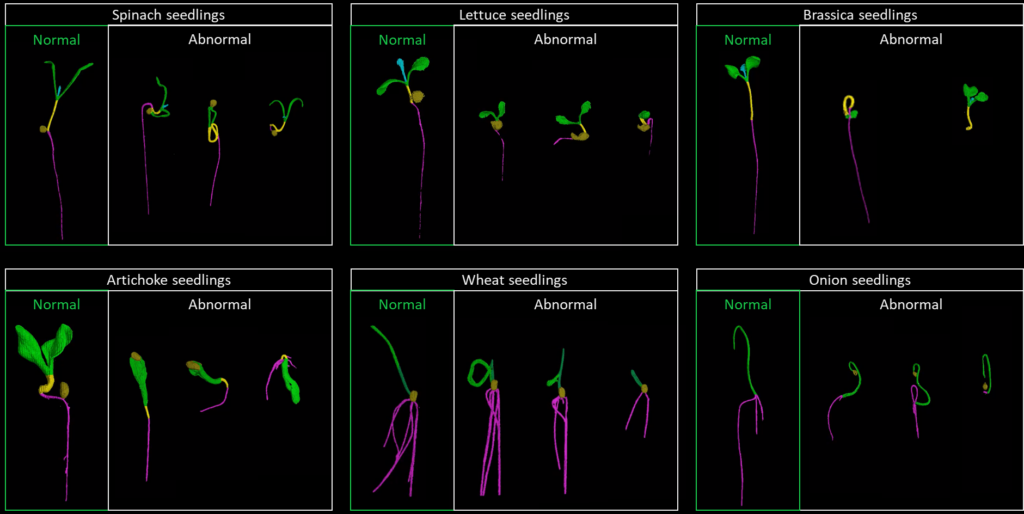
This makes this technology so robust and universally applicable: provided that differences show up in density, volume, shape or structure and that we can resolve them (which we usually can with a resolution in the low µm range), we can also measure them. With this, we can phenotype seeds and seedlings at a high throughput in automated workstreams, extract measurement data and classify with AI and directly link this data output to clear decisions for each seed lot. With the new phenoMatch solution, we can also 1-1 phenotype seeds and seedlings at a high throughput, linking and predicting germination and seedling quality/vigour to seed quality with every routine quality test.
With the phenoScort, we also have the possibility to translate this “diagnostic” seed-seedling data directly into AI-based sorting decisions based on predictive models, to sort not just for 3D seed quality, but also seedling quality.
SWE: Winning first prize at the 2025 Euroseeds InnovAction Stage must have been a major milestone. What does this recognition mean for phenoLytics, and how might it shape your next steps (e.g. R&D, commercial expansion, collaborations)?
JW: This is indeed a big validation for us that comes just at the right time. While winning the SeedInnovaction stage in 2023 was an important validation for us personally that we are indeed on the right track, this year’s Euroseeds win should act as a validation to the industry that these technologies are market-ready and worth investing in.
What we have seen over the last few years is that across the industry, there is a great interest and recognition of the potential of our technologies. However, the transition from interest to widespread adoption has been a challenge (as with most disruptive technologies), and while many want to be the pioneers, few want to take the risk to be the first.
So, we have spent the last years further developing, validating and thus derisking the technologies for ever broader applications, so that we now finally can confidently say: we are not just market-ready, but already in the market with a good pipeline of system implementations ahead.
As the adoption is now picking up and the general interest translating into real urgency to adopt the technologies to unlock value with them, the Euroseeds win is a strong catalyst to accelerate this process. In parallel to the validation that comes with new proven use cases and real-life implementation, the win acts as a further signal to the industry to be part of this transformation.
Additionally, many applications of our technologies have a general value to the industry. Think, for instance: automated ISTA classification and in-house seed quality certification, automated seed purity analysis, vigour testing and lab screens for abiotic and biotic stress, prediction of usable plants in soil etc. Here, we seek to set up pre-competitive consortia with firms and research institutes to optimize such applications for routine use in the entire industry. Here, Euroseeds may help to coordinate these efforts and promote collaboration in the industry.
SWE: Looking forward: what are your short- and long-term goals for phenoLytics? For example — which types of crops or markets do you aim to target next, how do you see 3D/4D-phenotyping transforming seed production, breeding and agriculture globally, and what wider impact do you hope to have?
JW: On the product side, we have now reached a market-ready product portfolio. The flagship product is the new ST Scan Multi which combines all functions in one machine: Seed bulk scans and seed-to-seedling phenotyping. We have, so far, validated 3D Xray CT phenotyping for over 150 species, from vegetables to row crops to forestry species, and now can offer algorithm pipelines to extract reliable data for most key crops.
On the development side, we are currently implementing truly universal AI approaches for seed/seedling isolation, organ segmentation and classification that build on and work together with conventional algorithms. This allows us now to expand the technological scope quickly into any plant species and application much faster than was previously possible.
With additional laboratory capacities and capabilities, we can now also validate and demonstrate new applications fast and efficiently in trials- because usually customers want to first test the systems on their own varieties and applications before committing to a purchase.
On the business side, with our partners PhenoKey and Fraunhofer, we recently launched the brand SeedTelligence. This formalizes our long-term partnership under a joint umbrella to draw on our complimentary skills and experiences to deliver customized systems anywhere in the world, integrated into existing processes, with the service/support to make the most of the data. Here, we will offer a modular model, where customers can first test & validate the technology for their needs and then have the choice of first implement one solution vertically to optimize one function, or implement them end-to-end to better link functions horizontally and maximize value across the entire organization.
We, as phenoLytics, will focus on the R&D core, optimizing existing applications for industrial needs and developing new applications. In this function, we will also further expand our activities in participating in international research projects and acting as a research service provider. We are also planning to soon offer sorting services, that leverages our knowledge from our phenotyping capabilities to offer a solution for seed lots where current methods fail.
Click here to read about Polyfly, second place winner of the Euroseeds InnovAction Stage 2025.
Click here to read about Cgrain, third place winner of the Euroseeds InnovAction Stage 2025.