A Timely Setting For a Global Discussion
As the global seed sector gathers in Lisbon for the ISF World Seed Congress, the location is more than a backdrop. For Southern Europe, and especially Portugal, it is a fitting place to discuss resilience, trade, and innovation at a time when agriculture is under pressure from climate stress, market volatility, and uneven access to new technologies.
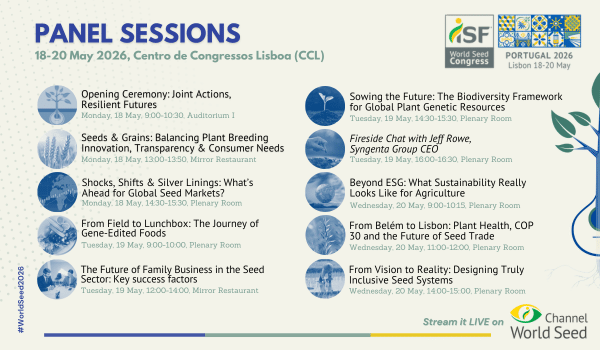
Portugal also offers an example worth noting. Its recent international recognition for economic performance and food systems resilience reflects an important point: resilience is not abstract. It is built through openness, adaptability, and long-term thinking. This is highly relevant for a sector now navigating disruption on multiple fronts. Below are some topics that will feature highly on the Congress agenda and on conversations in the corridors, trading tables, and meeting rooms.
Why Seed and Cooperation Matter More Than Ever
Seeds rarely make daily headlines, yet they sit at the foundation of every harvest and every food system. Food security, climate adaptation, productivity, biodiversity, and sustainability all begin with seed. More than ever, the global seed sector must take a central role in public and policy discussions on feeding a growing population sustainably. Seed is not a niche topic; it is a strategic one. The sector’s importance lies not only in breeding and innovation but also in its ability to translate science into practical value for farmers and society.
Geopolitical tensions, conflicts, protectionist policies, and other non-scientific barriers are making international trade more volatile. But seed systems cannot function in isolation. No country can supply all the seed its farmers need on its own. The movement of seed, plant material, innovation, and knowledge is essential to global agriculture.
That reality makes multilateral cooperation more important, not less. ISF’s role is to help keep the sector grounded in science-based, rules-driven dialogue and to create space for companies, policymakers, researchers and other stakeholders to work around shared interests. The politics may shift, but the objective remains clear: farmers need access to quality seed, innovation and choice.
A Collective Voice With Growing Impact
ISF’s influence comes from bringing the global seed sector together and engaging constructively with governments, international institutions, nongovernment partners, and other stakeholders. That collective voice matters most when borders tighten, and trade becomes less predictable.
Over the past decade, the seed sector has gained more recognition in international discussions on trade, access to genetic resources, innovation, and resilient food systems. That progress reflects persistent engagement, media outreach, and evidence-based advocacy. It also reflects a growing understanding that resilient futures will depend on resilient seed systems.
One of the clearest developments in recent years is the growing role of public-private cooperation in improving seed systems.
ISF’s partnership with CGIAR focuses on strengthening seed systems and improving farmers’ access to quality seed and innovation from both the public and private sectors. A G7-OECD initiative launched in 2024, with ISF as a strategic partner, is helping strengthen Africa’s participation in the OECD Seed Schemes, supporting certification, trust, and trade. In Asia-Pacific, a WTO Standards and Trade Development Facility project led by APAARI, with ISF and APSA among the partners, is helping improve phytosanitary compliance and structured dialogue between regulators and the seed sector.
These are practical examples of how partnership can improve market access, strengthen trust and expand the reach of quality seed.
Delivering a Resilient Future
The future of seed will be shaped by AI, data-driven systems, and new breeding techniques, yes, but these tools can only be deployed when they are trusted and collectively pushed by the sector. Innovation can accelerate productivity and resilience, but it cannot be measured by technical capacity alone.
This is especially important when considering the gap between advanced technology and local farming realities: innovation only matters if it reaches the people who need it most and can use it. Strong seed systems are those that support farmers of all sizes, enable seed choice, and ensure that progress does not remain concentrated in only part of the value chain.
The opportunity in Lisbon is not simply to restate the challenges facing agriculture. It is to build momentum around practical solutions: more resilient seed systems, more open and predictable trade, stronger partnerships, and innovation that delivers measurable value for all.