With imaging platforms, aerial analysis and growing datasets, breeders are beginning to shorten selection timelines and improve accuracy.
It’s safe to say crop breeding has never been more exciting. Decades ago, breeders first transformed the field by scaling up plot numbers and enabling wide-scale phenotype selection. Years later, genome mapping and new genetic technologies drove another shift. Now, AI is pushing crop breeding into its next phase, and the industry is paying attention.
First, the big picture. In 2025 alone, researchers published numerous scientific reviews examining how AI is changing crop breeding. In one review, a team in India explains that “advances in genomics, phenomics and environmental sensing have enabled the development of high-dimensional datasets, fostering more precise and efficient breeding strategies.”
They note that AI-driven approaches, including machine learning models such as random forests and convolutional neural networks, improve phenotypic predictions and yield forecasting. Deep learning also accelerates genotype-to-phenotype mapping by extracting key traits from large-scale datasets.
The same team adds that “AI-powered genomic selection and gene editing tools, such as CRISPR-Cas9, are revolutionizing targeted breeding.”
In June 2025, U.S. Department of Agriculture (USDA) scientists Worasit Sangjan, Daniel Kick and Jacob Washburn published another review. They highlight similar trends and add that AI supports crop breeding through data mining, multi-omics, environmental tracking, crop management practices, cross-species inference, sustainability and economics. “Improvements in these areas could increase predictive accuracy for plant traits,” they explain, “thereby expediting breeding cycles and optimizing resource management.”
Earlier in 2025, a team in China reported that combining crop big data with AI allows researchers to model genomic, phenotypic and environmental data with greater precision. These models help breeders predict the genetic potential of future phenotypes and refine hybridization strategies. As a result, breeders can shorten breeding cycles and improve selection accuracy.
Another review, published in July 2025 in Nature by an international team spanning the U.S., U.K., Germany, Saudi Arabia, Australia and China, outlines how breeders can integrate elite alleles generated through these technologies into both existing and newly domesticated crops.
A separate team in China introduced the Breeding 5.0 framework. At its core, the framework positions AI as a tool that can “understand germplasm,” not just by identifying markers but by interpreting structure, plasticity, regulatory logic and environmental interactions. This level of “germplasm intelligence” supports predictive trait modeling, optimized parental design and more targeted selection.
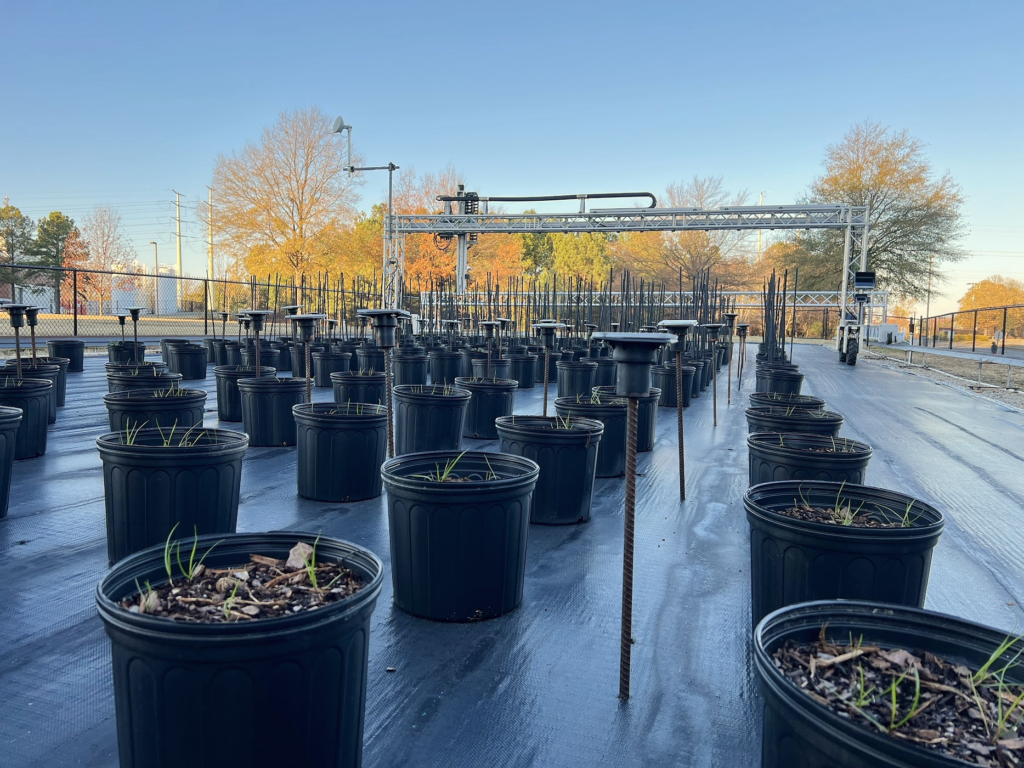
One of its key pillars is peopleless data capture. Automated phenotyping in trial plots, often referred to as high-throughput phenotyping platforms, speeds data collection, reduces labor and improves consistency.
Imaging Every Plot, Every Trait
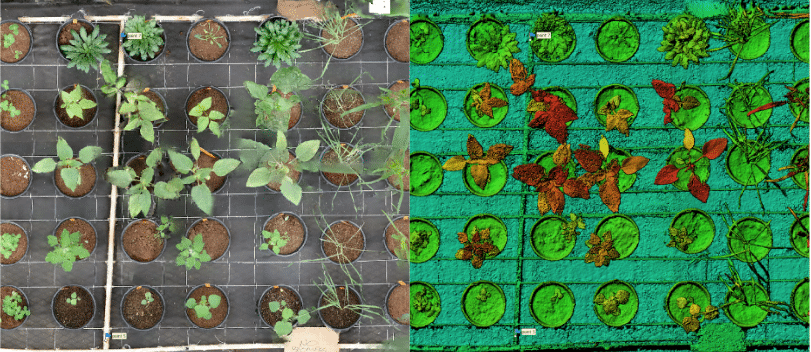
To push phenotype selection further, AI systems rely on detailed image data from field plots. Breeders train these systems to detect specific traits and identify phenotypes of interest.
University of Guelph researcher Riley McConachie uses AI for wheat head detection and identifying fusarium head blight. He explains that traditional field scoring of traits such as disease levels, leaf angle and head size takes significant time and often introduces subjective error. In contrast, “AI analysis tools provide opportunities to significantly decrease the time required to evaluate these characteristics, either by solving the problem directly or by supporting the evaluation process.”
Drones, Robots and Field-Scale Data
Researchers at Iowa State University developed a thin “phenorobot” that moves between rows and captures images autonomously. The system collects high-quality data while navigating around plants. Other teams use similar robotic systems, while drones and satellite imagery continue to expand coverage at scale.
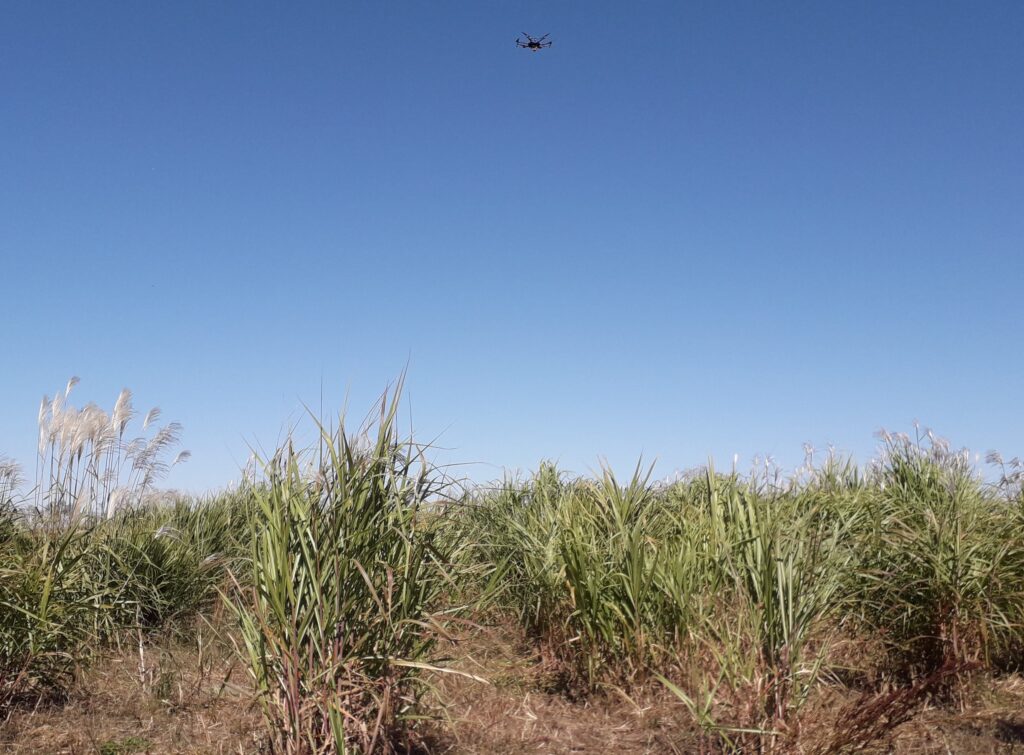
In April 2025, a team at the University of Illinois Urbana-Champaign published a study describing an AI vision system that identifies flowering traits using drone imagery. The system analyzed “heading” across thousands of plots containing genetically diverse populations of two miscanthus species. It identified heading nearly nine times faster than in-field human observation.
The team developed a custom learning approach called ESGAN. This method reduced the need for human-annotated training data by one to two orders of magnitude compared to traditional supervised learning. Researchers are now exploring whether ESGAN and similar tools can double breeding progress in perennial crops such as miscanthus by compressing phenotyping, selection and crossing into a single season.
“That would be a substantial gain,” says Andrew Leakey, Center for Digital Agriculture at the University of Illinois Urbana-Champaign.
Leakey says the team has filed a patent and may commercialize the technology if the right opportunity emerges. For now, the group focuses on academic applications across multi-location crop trials and continues expanding AI-based computer vision tools for plant science. He adds that seed companies already use aerial remote sensing widely, which could accelerate ESGAN’s adoption.
Reducing Human Bias in Phenotyping
Echoing these points, Chris Reberg-Horton at North Carolina State University emphasizes that data preparation remains the biggest bottleneck. His team, working with the USDA Agricultural Research Service, is completing a large-scale AI crop imagery project called the Ag Image Repository (AgIR). The dataset includes 1.5 million plant images and trains AI systems to recognize species and growth stages. The team plans a nationwide release this fall.
“Obtaining quality images, processing and annotating them is where the bulk of the work occurs,” he says. “When we get a new grant or contract, 95% of the effort goes into these steps.”
He credits team members including Alexander Allen and computational agronomist Matthew Kutugata with automating more of that workflow.
Kutugata notes that agriculture has lacked the large, well-labeled image datasets common in other industries. “AgIR closes that gap so we can train models that hold up across farms, seasons and applications,” he says. Because the dataset will remain open, researchers, students, small labs and growers can build and test tools without starting from scratch.
The Power and Limits of Big Datasets
Reberg-Horton says the AI crop community has long needed datasets like AgIR.
“Many other sectors have massive free datasets, but agriculture has moved more slowly,” he explains. “The variation in biological systems makes the problem more complex. A stop sign looks similar across locations, but plants vary widely even within the same species. That means we need far more images.”
He adds that progress will depend on how quickly researchers share data. “We hope this effort snowballs until teams can train AI systems without always starting with image collection.”
Cost Barriers Remain
Washburn, a USDA scientist involved in one of the 2025 reviews, says cost will continue to limit adoption.
“Both data generation and model development require significant investment,” he says. “Breeding programs, especially those focused on minor crops or operating in the public sector, often face tight resource constraints. Many proven breeding methods remain underused because of cost.”
Beyond cost, Washburn points to data availability as the primary barrier. While datasets such as AgIR will help, many programs still lack the scale of data needed to deploy AI effectively.
Smarter Models With Less Data
At the same time, he sees opportunity on the technical side.
“Some of the most important advances will come from methods that perform well with less data,” he says.
Techniques such as data augmentation and transfer learning already support many of today’s leading AI systems. Future improvements in this area could expand access and improve performance across breeding programs.