How root rot went from an overlooked issue to the biggest challenge in peas and lentils.
When yellow fields left Prairie growers stumped, Dr. Syama Chatterton dug deeper and uncovered a hidden enemy that would redefine pea and lentil production.
In the early 2010s, Prairie pulse growers began spotting mysterious yellow patches in their fields. Many chalked it up to weather stress or nutrient deficiencies. Few suspected a soil-borne pathogen was about to become one of the greatest production challenges in pulses: root rot.
That mystery became the life’s work of Dr. Syama Chatterton, plant pathologist at Agriculture and Agri-Food Canada in Lethbridge. In March 2025, she received the Alberta Pulse Growers’ Innovator Award — recognition for a scientist who has spent more than a decade investigating organisms too small to see, yet powerful enough to reshape entire crop rotations.
From Puzzling Fields to a Clear Diagnosis
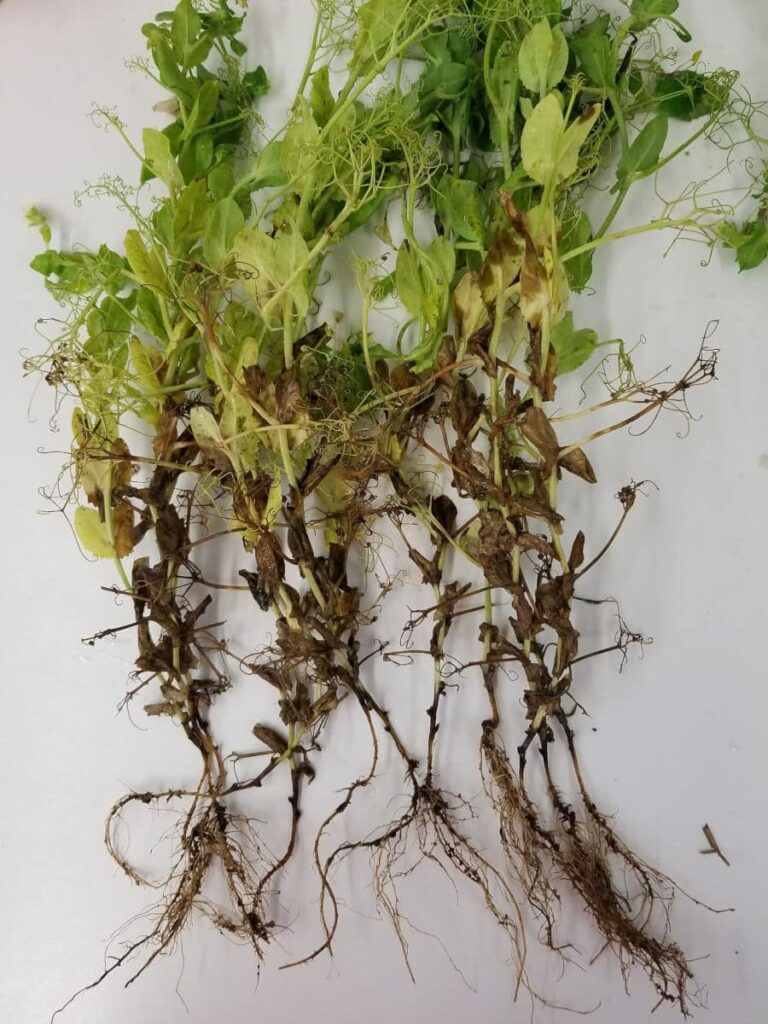
Chatterton’s background in root diseases put her in the right place at the right time. When she arrived in Alberta in 2012, farmers and commissions were already asking: why were peas and lentils yellowing?
Within a few years, she and her team identified Aphanomyces euteiches, then little known in Canada, as a primary culprit alongside a suite of Fusarium species. “The first step was simply awareness,” she says. “Once you know what you’re up against, you can start changing practices.”
Her outreach work crisscrossed Alberta and Saskatchewan, warning growers that rotation practices — like the once-popular lentil-durum cycle — were fueling the problem.
She also worked with seed labs to validate DNA soil tests for Aphanomyces and Fusarium, tools now widely used to help farmers assess risk before planting pulses. “Seed analysts became like the soldiers on the front lines,” she notes. “They see problems first, and their involvement was crucial.”
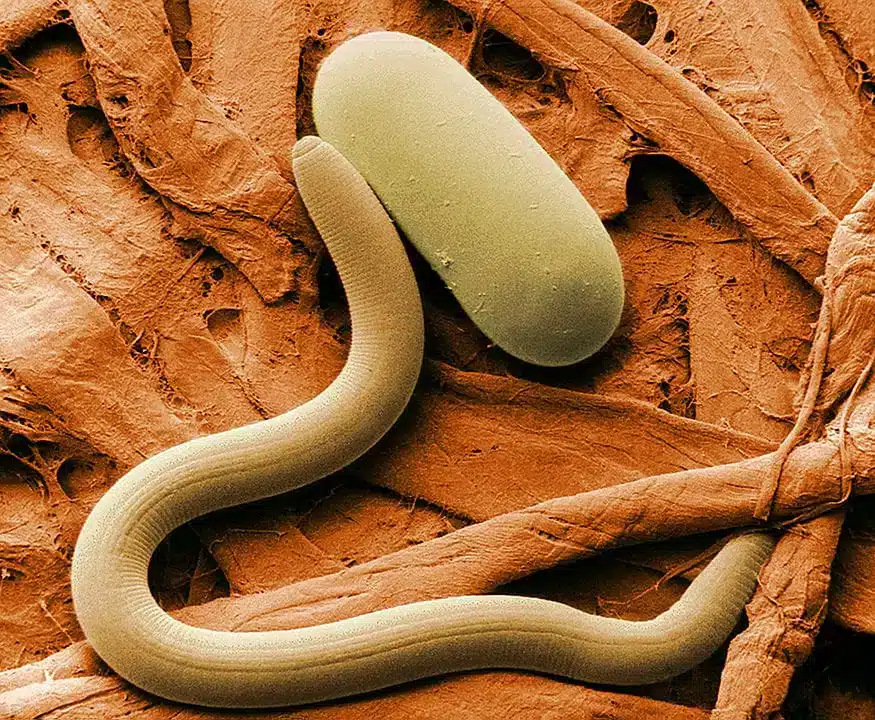
Managing root rot is no simple task. Aphanomyces can persist in the soil for a decade, yet paradoxically resists long-term culture in the lab. “We can’t keep it alive more than a few months,” Chatterton says.
And it rarely acts alone. Multiple pathogens often strike together, thriving under different soil and moisture conditions. Add in the Prairie’s massive field sizes and diverse soil zones, and the diagnostic and management challenges multiply.
Breeding Hope: Resistance and Beyond
The big question for farmers remains: will resistance solve root rot? Chatterton’s answer is cautious. Some pea lines show resistance in greenhouse trials, but under field conditions where multiple pathogens co-exist, resistance often breaks down.
“That’s why the future is in pyramiding resistance,” she explains—stacking multiple genes to counter multiple pathogens. Genome Canada projects are already screening thousands of pea lines worldwide, combining genomic sequencing with field testing to identify durable resistance.
None of this is happening in isolation. Millions of dollars from Prairie grower groups are funding more than 20 researchers, from plant geneticists to biocontrol specialists, all contributing to a multi-pronged attack. “Pulse grower groups have been fantastic,” Chatterton says. “They’ve given researchers latitude to try bold ideas, and that’s how real breakthroughs happen.”
A Scientist for Farmers
Even with global collaborations and genome-scale projects, Chatterton’s compass remains farmer-focused. Whether it’s advising on rotations, interpreting soil test results, or setting expectations for resistance, her work always comes back to practical tools for the farm gate.
“Root rots are a tough problem,” she says. “But by pulling together — from farmers to seed labs to geneticists — we’re starting to put the puzzle together.”
For Prairie growers, her research has already reshaped pulse production — proving that naming the enemy is the first step toward beating it.