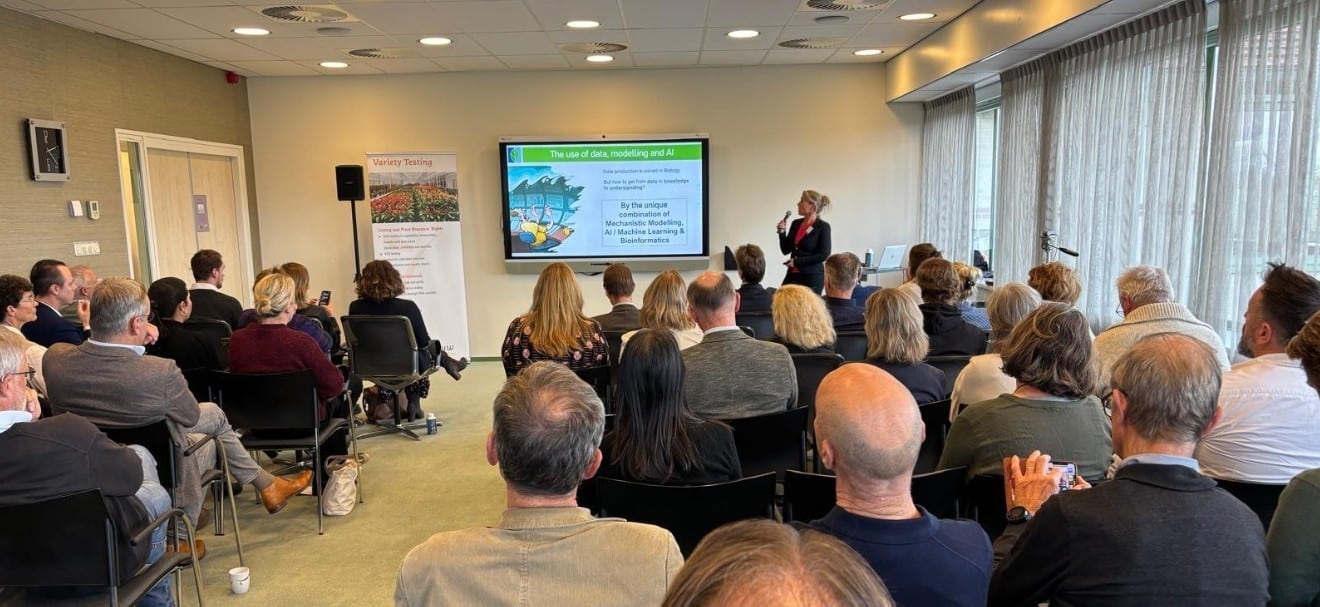
On Thursday, Oct. 30, Naktuinbouw hosted a symposium titled “To Divide Is to Multiply: How Can DNA Accelerate or Improve DUS Testing and Breeding Processes?” The event brought together key experts and stakeholders from across the plant breeding sector to discuss the application of DNA information in breeding and Distinctness, Uniformity, and Stability (DUS) testing.
The central theme revolved around one pressing question: how can the sector enhance collaboration and knowledge sharing in the use of DNA technologies—and what is needed to make that possible?
Contributions and Insights
Participants were treated to four in-depth presentations offering diverse perspectives on the integration of DNA data into plant breeding and variety testing:
- Hedwich Teunissen (Managing Director, CropXR) outlined CropXR’s mission as a public–private partnership to develop resilient crops by 2033 through data-driven design using artificial intelligence, modeling, and machine learning. Collaboration and open data sharing were identified as key success factors, with several commercial partners already joining the initiative.
- Tosca Ferber (Chief Technology Officer, Dümmen Orange) provided insight into Dümmen Orange’s breeding strategy and its growing reliance on DNA information across an expanding range of crops. She highlighted the company’s efforts to establish systems that foster knowledge sharing and collaboration.
- Cécile Collonnier (Technical Expert, Research & Innovation, CPVO) examined the legal framework for DNA use in DUS research under European regulations, emphasizing the need for clarity and harmonization at the EU level.
- Raoul Haegens (Head of Identification and Variety Testing, Naktuinbouw) presented Naktuinbouw’s vision for integrating DNA techniques into DUS testing, stressing that data sharing and collaboration are essential for sector-wide progress.
Open Discussion: Shaping Collaboration and Trust
The symposium concluded with an interactive group discussion focused on how organizations can collaborate and share DNA knowledge effectively, according to a press release. Participants explored motivations, preconditions, and practical steps for cooperation.
Key motivations for collaboration included:
- Reducing costs and improving efficiency for data providers.
- Accelerating the registration process through shared resources.
- Aligning DUS testing with technological developments and breeding practices.
- Promoting international data exchange to reduce duplication of effort.
- Enabling data-driven breeding and future integration with Plant Breeders’ Rights (PBR) research.
Essential preconditions for collaboration included:
- Establishing clear, shared objectives and transparent frameworks for data security.
- Creating legal agreements that differentiate between public and private dataset use.
- Prioritizing crops where support is most critical.
- Educating breeders about how DNA is applied in DUS testing and how they can benefit.
- Achieving international validation of the system through CPVO as part of plant variety protection.
- Building mutual trust among companies and institutions to ensure genuine collaboration.
Practical steps to foster cooperation:
- Setting up a dedicated working group with representatives from across the sector.
- Ensuring time, communication, and transparency are central to progress.
- Promoting an open-source approach so both large and small breeders have equal access to tools and data.
Innovation, Infringement, and the Future of DNA in Variety Research
The discussion also touched upon infringement issues, noting that the increasing use of CRISPR-Cas technologies is likely to result in more essentially derived varieties (EDVs). Incorporating DNA-based methods into the plant variety rights system can enhance accuracy in assessing these cases and provide stronger support in infringement disputes.
Overall, the symposium demonstrated broad recognition of the opportunities offered by DNA collaboration and data sharing, though commercial and legal concerns still present challenges. Naktuinbouw reaffirmed its commitment to working with stakeholders to explore practical pathways forward.