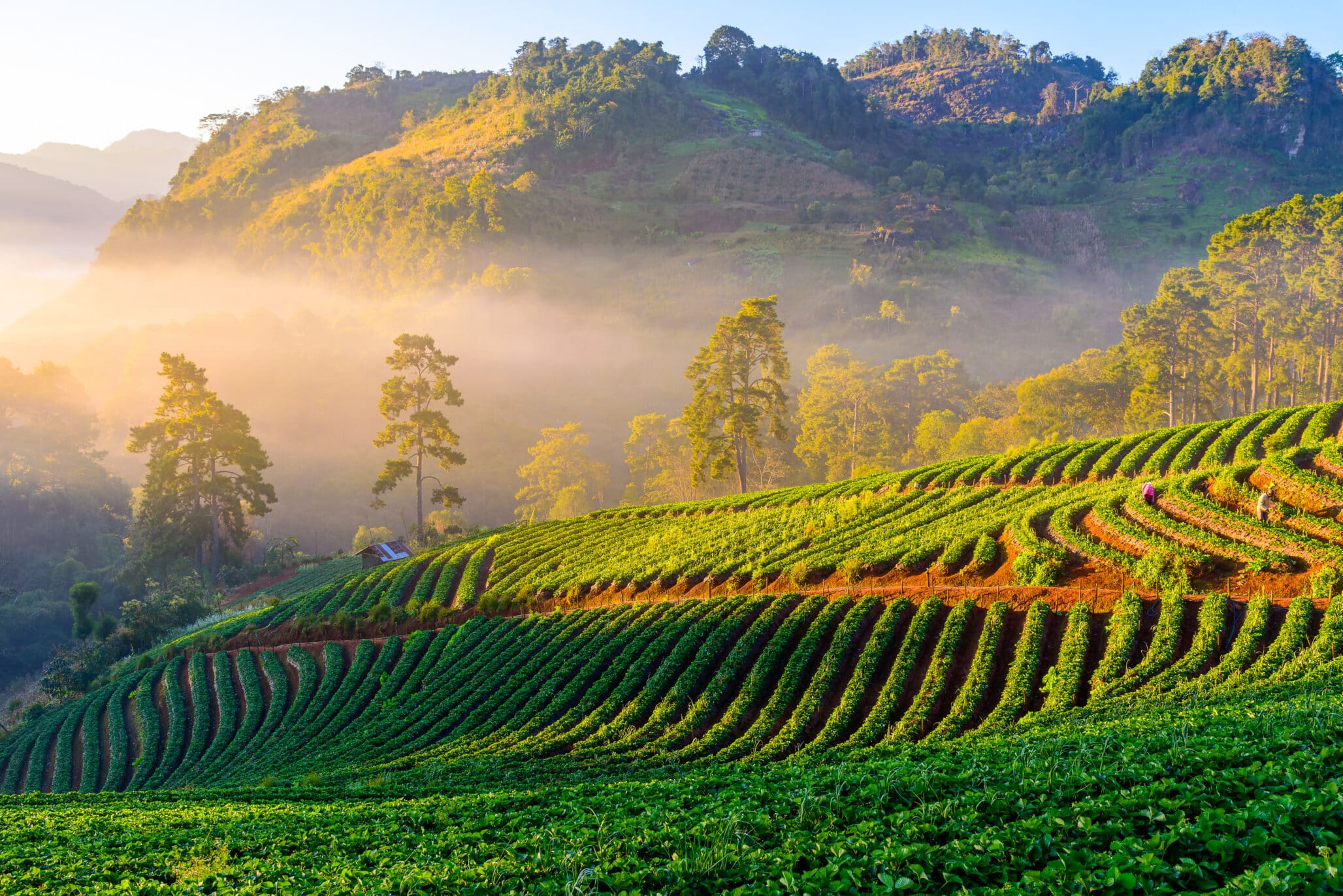
Practical innovations reshaping global agriculture.
“Agriculture stands at a crossroads,” observes Emily Rees, President and CEO of CropLife International. On one hand, global farming systems face mounting pressures from climate change, land degradation, and resource scarcity. On the other, agriculture holds untapped potential to raise productivity, restore ecosystems, and drive meaningful climate action. The challenge, Rees notes, is not whether transformation can happen, but how to scale what already works.
This dual reality underpins a new report, A Practical Guide to Sustainable Agricultural Growth: Success Stories from Around the World (November 2025), co-authored by CropLife International and NTT DATA. The guide offers policymakers and the seed sector a blueprint for aligning productivity, sustainability, and inclusion in agricultural systems worldwide.
“When productivity, resilience, and inclusion move in tandem,” says Rees, “agriculture can evolve into a driver of sustainable growth.”
For negotiators at COP 30 in Belém, Brazil, the message is clear: seeds don’t just deliver yield, they unlock transformation.
From Concepts to Practice
Somang Yang, Senior Manager for Sustainability at CropLife International, explains that the guide illustrates how productivity and environmental considerations, captured in SDG Indicator 2.4.11, are being addressed in diverse farming systems across the world.

“The report brings the framework to life,” says Yang. “We wanted to show what solutions were delivering impact in the field.”
Each of the chapters focuses on a key challenge facing agriculture, such as profitability, soil health, water use, input efficiency or biodiversity. After outlining the challenge, the report details a success story where the challenge was successfully addressed in a way that has benefitted the farmer and the environment.
Making Land More Productive Without Expansion
With global farmland increasingly degraded, Rees stresses that the only sustainable growth path is “doing more with what we already have.” In Brazil’s Goiás region, the Santa Brígida farm’s transition from exhausted soybean pastures to an integrated crop-livestock-forestry (ILPF) system more than doubled maize yields and tripled pasture productivity, without clearing new land.
Restoring the Soil Beneath Our Feet
“Soils are the lifeblood of food production,” Rees emphasizes, “yet a third of the world’s soils are degraded.”
In Cambodia’s Kampong Thom region, farmers combined locally produced biochar and compost to rebuild soil structure and moisture retention, stabilizing yields. Seed innovation complements such systems: genetics adapted to regenerative practices can multiply returns.
Governments, meanwhile, can scale impact through soil-health incentives and farmer demonstration networks that link seed performance to ecosystem restoration.
Profitability Drives Sustainability
Yang reminds that productivity alone doesn’t sustain change: “Unless farmers see real income gains, they won’t adopt solutions that are better for the environment.”
In South Africa, the GMO Act enabled the rapid adoption of biotech maize and soy, improving yields and lowering costs. Farmers invested in better seeds that allowed a more reliable and predictable harvest, knowing that there was a long-term policy commitment to biotechnology, giving them the confidence to learn about and invest in, biotech seeds.

Resilience Starts with Farmers
Agriculture’s inherent volatility, from climate to markets, demands resilience at the farmer level. IFAD’s index-insurance program, INSURED, is one model: when rainfall falls short, farmers receive quick payouts that keep them planting rather than abandoning production.
People and Prosperity: The Human Dimension
Yang highlights the importance of the agricultural sector providing good jobs with upward mobility, especially in regions where farming remains the main source of income. Ghana’s crop service-provider networks have created new rural jobs while delivering precise pesticide application to farmers while the WFP-Mastercard Foundation youth partnership has trained over 600,000 young Africans to become agri-entrepreneurs.
From Field Success to Global Policy
As COP 30 is underway, Rees believes the timing of the report is pivotal: “Agriculture can, and must, be recognized as part of the climate solution.”
For the seed sector, the report’s message is one of opportunity: invest in innovation that supports climate-resilient systems, partner across value chains, and show how improved seeds contribute to national climate and food-security goals.
For policymakers, the guide offers actionable lessons: align incentives, scale proven practices, and treat agriculture as central to achieving the Paris Agreement and the Sustainable Development Goals.
Scale with Intent
“The challenge now,” says Yang, “is to learn from what works and scale it with intent.” Rees adds: “If we align productivity, resilience, and inclusion, agriculture can deliver both prosperity and planetary health.”
The Practical Guide proves that sustainable agricultural growth isn’t theoretical, it’s already happening, from Brazil to Cambodia to Kenya. What’s needed next is policy coherence and investment to take these successes global.
To explore all eleven dimensions of sustainable agricultural growth and discover the full set of global case studies, read the complete report “A Practical Guide to Sustainable Agricultural Growth: Success Stories From Around the World” at https://croplife.org/wp-content/uploads/2025/11/A-Practical-Guide-to-Sustainable-Agricultural-Growth-Report-2025.pdf?v=1762188471
Footnote 1: For more information on SDG Indicator 2.4.1, see here: https://openknowledge.fao.org/server/api/core/bitstreams/3e3a18b0-ff0d-4dbc-bdbf-ebb854419fd3/content