Our seed and plant-breeding systems are stuck in a risk-averse, underfunded loop, experts say. As other nations invest, adapt and accelerate, we face a critical choice about the future of our food system.
Canada says it wants to be an innovation superpower. But in agriculture, its R&D system is slowly drifting from “global leader” toward a cautious, risk-averse middle tier.
That’s the message Seeds Canada and the Canadian Agri-Food Policy Institute (CAPI) are delivering to policymakers, warning that Canada’s seed and innovation systems are slipping just as global competitors pick up speed.
“Innovation is what got us to where we are today, and it’s what will get us to where we need to be tomorrow,” says CAPI’s Tyler McCann. “But we now have to ask if Canadian ag innovation is in a crisis. Increasingly, the evidence says yes.”
Seeds Canada policy director Lauren Comin puts it more bluntly: regulation is stalling innovation, and Canada’s rules for seed and plant breeding are no longer suited to today’s competitive pace. “Our regulatory system, particularly for seed, is extremely risk-averse,” she says. “In some cases, it discourages innovation outright.”
A System That Used to Lead — and Now Just “Averages Out”
Globally, agricultural R&D spending has been rising, but unevenly. High-income countries’ public investment has stalled, while developing countries are gradually catching up. Canada is part of that stagnation. Public agricultural R&D spending declined from roughly $0.86 billion in 2013 to $0.68 billion in 2022 — the lowest among the top seven OECD agricultural producers.
Research intensity has also slipped: while much of Europe and high-income Asia invest about 4.5% of agricultural GDP in public ag R&D, Canada invests closer to 2%.
“We used to be a leader. Now, depending on the metric, we’re just average — and trending the wrong way,” McCann says, citing CAPI’s new report identifying fragmented coordination, aging infrastructure, declining investment, and weak links between labs and farms.
Meanwhile, competitors are holding or expanding their investments. Australia maintains roughly $3 billion annually in total ag R&D, with private spending outpacing public. China, Brazil and others are combining strategic private and public investment to drive sustainability, productivity and technological adoption.
Canada isn’t collapsing. But it is slowly losing ground.
Regulation for Growth, Not Paralysis
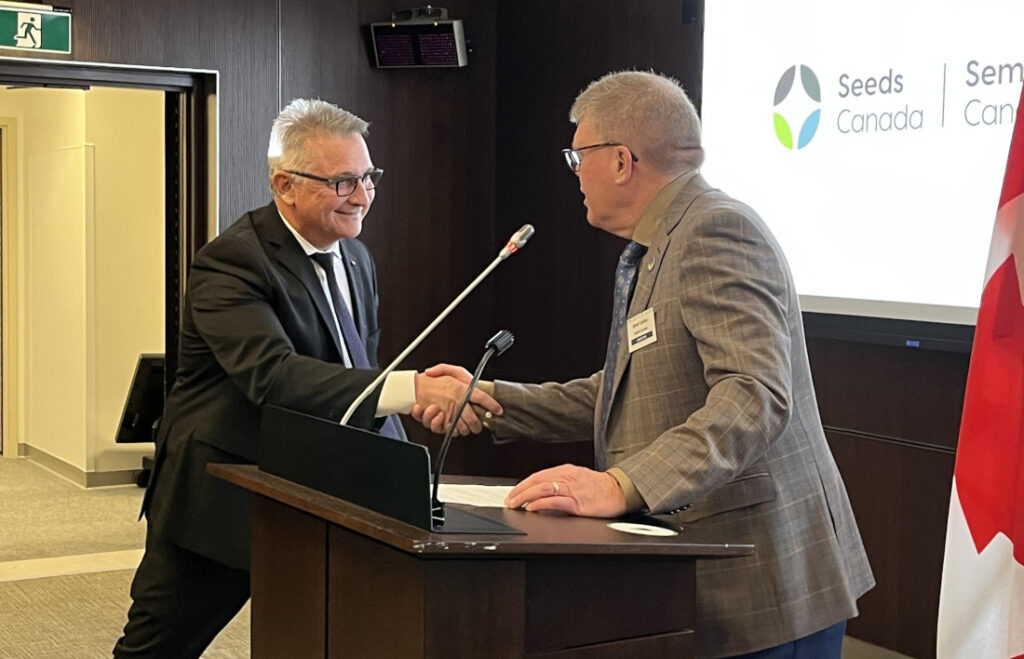
Seeds Canada carried out its annual meetings on Parliament Hill in Ottawa last fall with two main priorities: regulation for growth and incentivizing investment and innovation in plant breeding and intellectual property (IP).
Comin says MPs were receptive. Seeds Canada’s argument is that Canada needs a modern regulatory framework supporting economic growth rather than slowing it down. “We need to ask hard questions like: does this need to be regulated at all, or can it move to voluntary industry standards?”
One of their boldest proposals: move the Canadian Food Inspection Agency (CFIA) — at least the parts focused on productivity and competitiveness — from the health portfolio back into Agriculture and Agri-Food Canada (AAFC). “For many agriculture regulations, the primary focus isn’t health and safety,” Comin says. “It’s productivity and growth.”
Surprisingly, the concept resonated with most MPs.
Seeds Canada, along with the Canadian Seed Growers’ Association, is also pushing to formalize an inclusive seed regulatory advisory body as part of the long-running Seed Regulatory Modernization process. CFIA’s own proposals now reference such a body.
Intellectual Property and the Risk of Losing Top Varieties
On intellectual property, the warning was straightforward: without reform, Canada will struggle to attract or retain top-tier plant varieties, particularly cereals. “We need more investment in plant breeding from both public and private sectors,” Comin says. “The current environment isn’t delivering that.”
A major issue is the fact AAFC has so far not included most public cereal varieties in the Variety Use Agreement (VUA) system. Seeds Canada estimates AAFC could have generated about $22 million in reinvestment since 2020 had it opted into the VUA for eligible varieties.
“That’s real money that could be flowing back into Canadian innovation,” Comin says.
Seeds Canada is also urging the federal government to finalize Plant Breeders’ Rights regulatory amendments and explore tools used in other jurisdictions — such as reporting farm-saved seed use or allowing royalties on farm-saved seed. Both are politically sensitive, but increasingly central to global competitiveness.
Everyone Agrees the System is Broken — But Not on How to Fix It
If Comin’s message is about specific fixes, McCann’s is about structural dysfunction. CAPI surveyed participants across the innovation continuum, and most consider Canada’s ag-innovation system weaker than other sectors. About a quarter say it is “much weaker.”
Three-quarters agree the current system structure actively hinders outcomes. “That’s an extraordinary level of consensus that something is fundamentally wrong,” McCann says.
“It’s not just a money issue,” McCann says. “We have structural, coordination and adoption problems. People inside the system know it doesn’t work as well as it needs to.”
Budget 2025: Big Rhetoric on Innovation, Cuts in Ag
This comes as the recent federal budget frames itself as a pivot from “spending” to “investment,” emphasizing research, advanced technology, IP, and productivity. Billions are earmarked for areas like AI, tax credits and global talent recruitment.
“The front end of the budget reads like it was written by people who fully understand the innovation challenge,” McCann says.
But agriculture is treated differently. AAFC is facing up to $150 million in annual savings, likely landing heavily on science and innovation functions, even as contribution programs remain mostly intact. “If the government were really serious about its stated priorities, it would be doubling down on agricultural science, not cutting it,” McCann argues.
AAFC plans to “streamline” science, concentrate on four priority areas, and shift more work to other actors. It continues to reference new models such as its “wheat science” framework, but the implications for plant breeding remain unclear.
“Change is coming to the science footprint,” McCann says. “We just don’t know what it looks like yet.”
Globally, public ag R&D growth is now driven mostly by emerging economies, while many high-income countries — including Canada — are flat or declining. International bodies like the UN and IFPRI emphasize that the world needs more, not less, agricultural innovation to feed 10 billion people and withstand climate shocks.
Canada isn’t declining in a vacuum — it’s falling behind as others accelerate.
“Fragmentation matters more when funding is tight,” McCann notes, pointing to Australia, where clearer delineation between funders and performers has helped stretch resources. “If you’re not going to spend significantly more, you at least have to spend smarter. Right now, we’re not doing either very well.”

Seeds Canada’s Strategy: Show Up, Simplify, and Stay
Seeds Canada’s approach is to be consistently present in Ottawa and relentlessly clear in its messaging. The organization held 24 meetings over three days during its 2025 lobby event, plus follow-ups, submissions, and a joint evening reception with CropLife Canada and Fertilizer Canada. About 150 people attended.
Seeds Canada is also working to simplify its message. “We assume people understand the difference between seed regulatory modernization and intellectual property, but they often don’t,” Comin says. “We have to start from a shared understanding. That’s how you get good policy.”
Both Comin and McCann end in the same place: collaboration is essential.
“Any meaningful solution will come from working together — Seeds Canada, growers, public institutions, private breeders, the whole chain,” McCann says. “We don’t need a new alphabet-soup organization. We need people to show up and collaborate.”
Comin sees real opportunity. Policymakers are actively asking for input. Committees are studying regulation, innovation and trade. Seeds Canada has already been invited to speak to the Standing Committee on International Trade on free trade and seed.
“Lobby Day isn’t a photo op,” she says. “It’s part of a long, ongoing conversation about how Canada can stay competitive.”