The seed sector is sowing the foundations of a more sustainable, resilient food system — and ISF’s papers show how it can help balance trade, productivity and planetary health.
When we talk about sustainability in agriculture, the conversation often gravitates toward what happens in the field: fertilizers, water use, soil management, and emissions. Yet, as Ben Rivoire and Khaoula Belhaj-Fragnière of the International Seed Federation (ISF) remind us, the journey toward a greener, more resilient food system begins long before a single plant emerges from the soil. It starts all with seed.
“The seed is where sustainability truly begins,” says Rivoire. That starting point is also where measurable gains are built in over time. “Every improved variety carries within it the potential to use resources more efficiently, to withstand climate pressures, and to help farmers produce more with less environmental impact.” notes Belhaj-Fragnière
That conviction is at the heart of recent ISF papers: Contributions of the Seed Sector to Improve the Environmental Sustainability of Agriculture and Food Systems (July 2025), Navigating the Evolution of Plant Breeding Innovation(March 2024) and A Call for Policy Action to Foster Plant Breeding Innovation (November 2024).
The documents underscore how the global seed industry leverages innovation to help agriculture reduce its environmental footprint while maintaining productivity. They also provide a roadmap for the next phase of sustainable transformation of our food systems.
Innovation at the Root of Progress
Seed innovation is not new, but its role in environmental sustainability is being recognized as never before. Every new variety released to the market represents years of research, testing, and refinement, combining conventional breeding and cutting-edge technologies.

International Seed Federation.
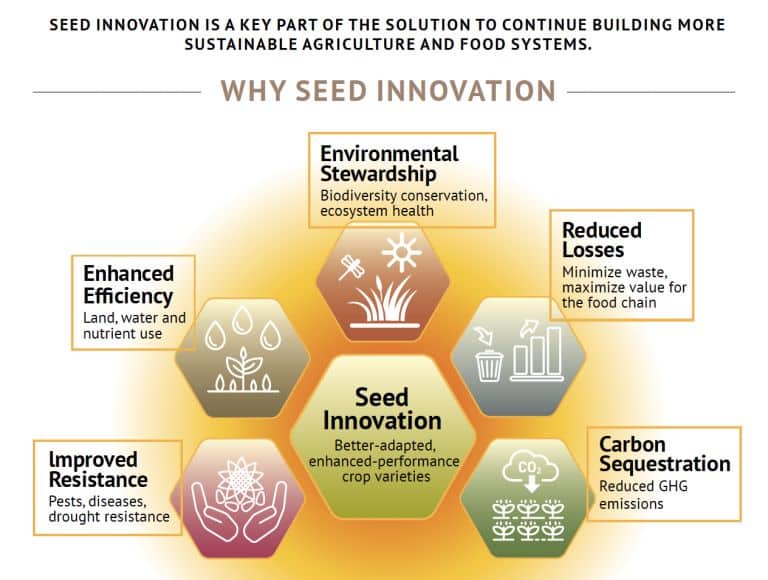
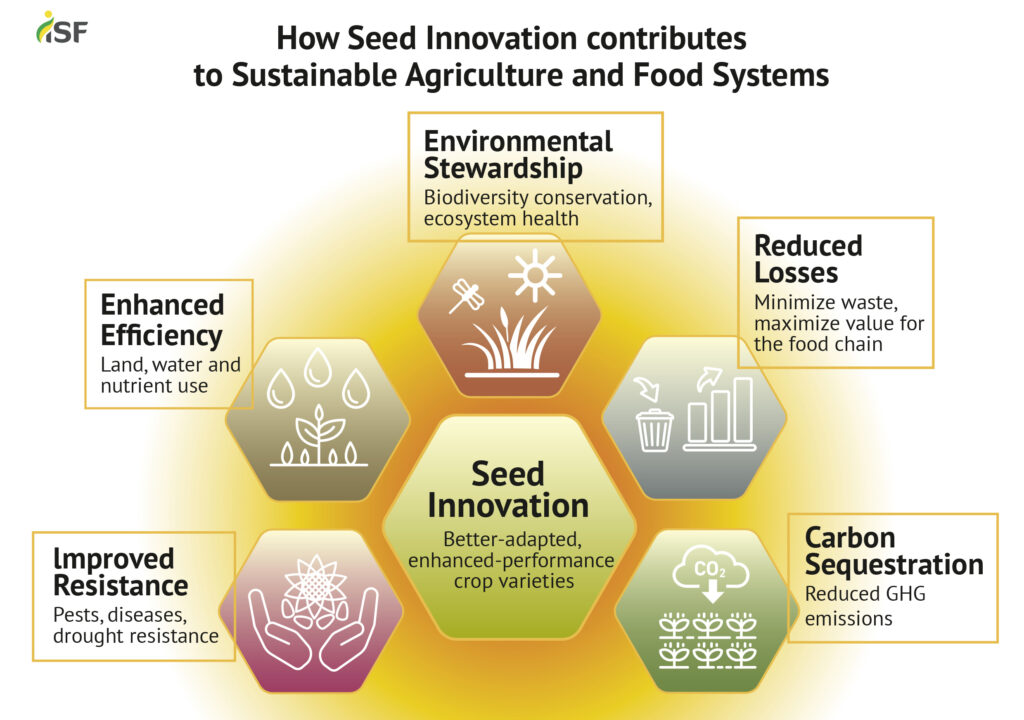
From drought-tolerant cereals to pest-resistant vegetables and forage crops that reduce methane emissions from livestock, these innovations are helping farmers adapt to a rapidly changing climate. “Through high-performing germplasm, seed-applied technologies, and microbial treatments, we can enhance resilience at the most fundamental level of production,” explains Rivoire.
For example, maize treated with beneficial Bacillus bacteria has shown remarkable productivity gains on infertile soils, while soybean and rice varieties inoculated with similar microbes have shown improved nutrient efficiency.
Similarly, plant breeders have enhanced sorghum forage quality by introducing chemically induced mutations that reduce lignin production since the late 1970s. “These ‘brown midrib’ (BMR) hybrids make sorghum more digestible for ruminants, boosting feed value compared to non-BMR varieties” says Belhaj-Fragnière.
Such innovations enable farmers to achieve higher yields with fewer inputs, reducing both environmental pressure and production costs. And the benefits go beyond the farm gate. Improved vegetable varieties with extended shelf life can significantly reduce postharvest losses, one of the most overlooked sources of greenhouse gas emissions in the food chain. Meanwhile, perennial crops contribute to carbon sequestration thanks to their deep root systems and longer growing cycles.
“Every new generation of seed technology offers a multiplier effect,” says Rivoire. “Better-adapted crops mean more stable harvests, lower input needs, and ultimately, more sustainable farming systems.”
Yield, Efficiency, and Environmental Gains
Productivity and sustainability are often portrayed as opposing goals, but the seed sector is demonstrating that the two can go hand in hand. According to ISF, yield increase and yield stability are among the most powerful levers for environmental progress.
When farmers can produce more on the same land, the need to convert forests and natural habitats into farmland diminishes. Higher yields per hectare mean reduced land use, which translates directly into biodiversity preservation and lower carbon emissions.
“Without the advancements made by modern plant breeding, agriculture would need to occupy a far larger footprint to meet global food demand,” Rivoire points out. “Thanks to improved varieties and quality seeds, we’ve been able to avoid additional deforestation and protect natural ecosystems.”

The data support this. In Europe, improved seed varieties have boosted yields in key arable crops by 20% over the past 15 years. In the U.S., maize yields have multiplied ninefold since the 1930s, much of that progress driven by plant breeding (e.g. hybridization). “The results are striking: farmers now produce five times more corn than in the 1930s on 20% less land, with yields jumping from 1.6 to 10.4 tons per hectare,” notes Belhaj-Fragnière
But yield stability is equally important. As climate change brings more frequent droughts, floods, and heatwaves, farmers increasingly depend on resilient varieties that can withstand extreme weather. “We’re no longer just breeding for productivity,” says Rivoire. “We’re breeding for reliability, ensuring that even under stress, farmers can maintain their livelihoods and feed their communities.”
In regions prone to climatic extremes, such resilience can make the difference between a successful harvest and a total loss. Stable yields also help maintain consistent food supplies and prices, a crucial factor for food security in a volatile world.
Beyond the Field: An integrated global Approach to Sustainability
The ISF concept paper “Contributions of the Seed Sector to Improve the Environmental Sustainability of Agriculture and Food Systems” underscores an essential principle: sustainability cannot be achieved through seeds alone. Instead, it requires a holistic approach that integrates improved varieties with better agronomic practices, modern technology, and supportive policy frameworks.
To achieve meaningful change, innovation in seeds must go hand in hand with innovations in how those seeds are cultivated. Conservation tillage, precision agriculture, and cover cropping can all amplify the environmental benefits of new varieties.
Rivoire emphasizes that this systems perspective is vital. “A sustainable agricultural system isn’t defined by any single technology, it’s about how all the pieces fit together. Seeds are the foundation, but they must be supported by the right tools, knowledge, and policies.”
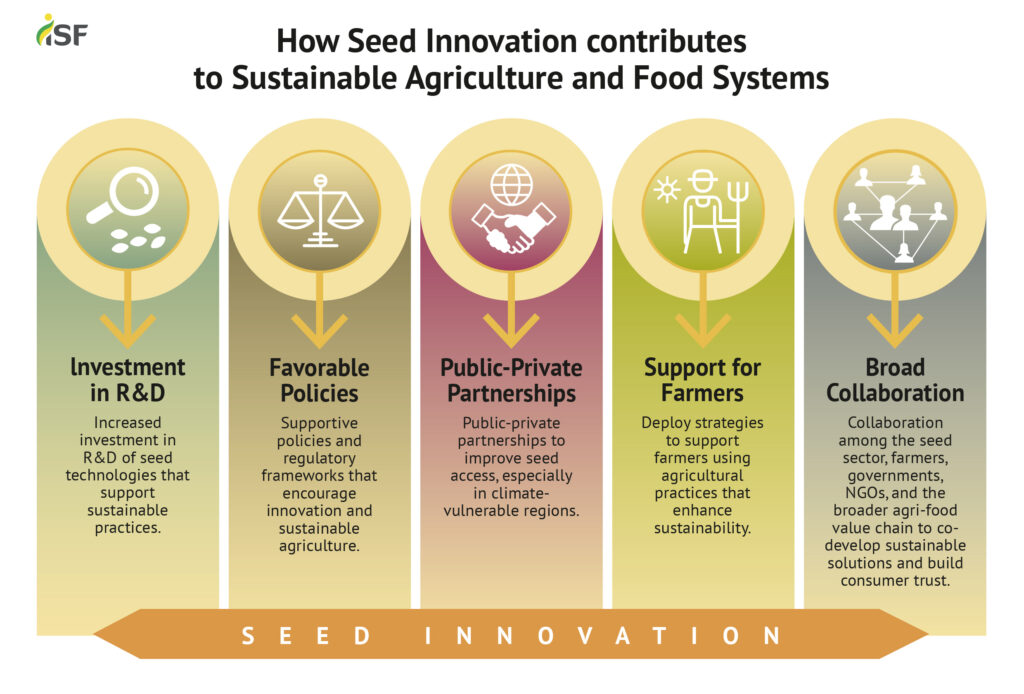
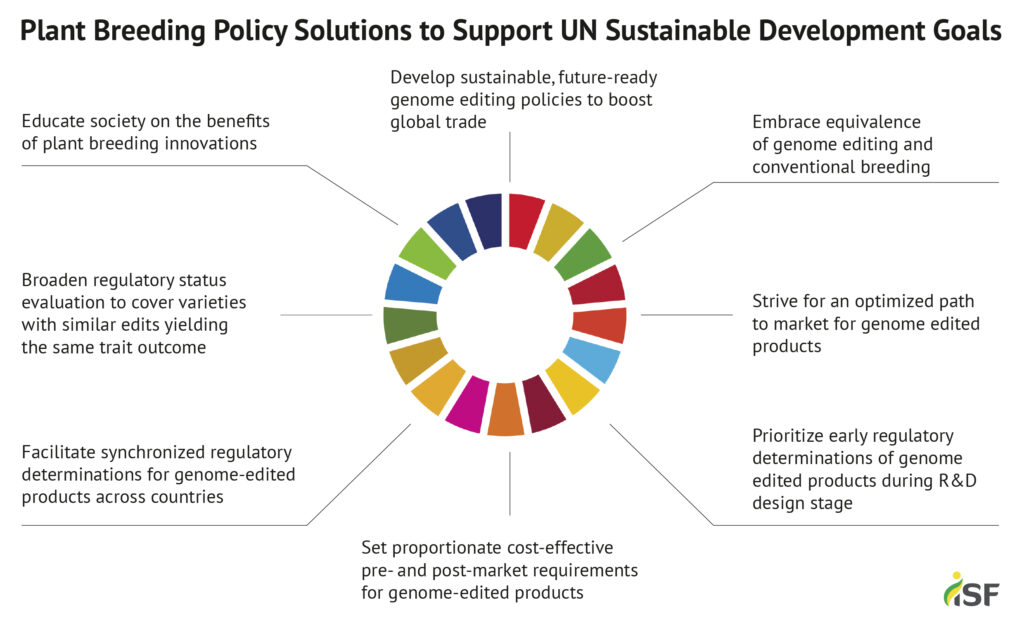
Governments and financial institutions have a crucial role to play, providing incentives and investment to accelerate the adoption of sustainable practices. ISF calls for proportionate, science-based regulatory frameworks that enable innovation to reach the marketplace while maintaining safety and public trust
“Science-based policy is the enabler of progress,” says Rivoire. “When regulatory systems are predictable and proportionate, they give companies and researchers the confidence to invest, and that investment drives solutions for farmers and the environment alike.” That same link between regulatory certainty and on-the-ground outcomes is echoed by Belhaj-Fragnière. “Clear, fair regulations give innovators the green light to invest, transforming those investments into tangible, real-world solutions for farmers, consumers and the planet “says Belhaj-Fragnière emphasizing the urgent need for policy actions outlined in the ISF statement A Call for Policy Actions to Foster Plant Breeding Innovation.
At the same time, public-private collaboration remains key. ISF advocates for mechanisms that bring together governments, research institutions, and private seed companies to enhance seed systems, particularly in climate-vulnerable regions where access to high-quality seed remains limited. This public private collaboration is exemplified in the World Seed Partnership, a collaborative platform bringing together five international organizations: ISF, OECD, UPOV, ISTA and the World Farmers Organization.
Seeds for All Farmers
One of the strongest messages is inclusivity. The benefits of seed innovation must reach farmers everywhere, from large commercial operations in Europe to smallholder communities across Africa and Asia.
Climate-resilient seeds are described as a “core solution” to building more sustainable agri-food systems. Ensuring their availability and accessibility to all farmers will be critical for global adaptation efforts. “Every farmer, no matter their scale or geography, deserves access to the best seeds science can provide,” says Rivoire. “That’s how we build resilience, not just for individual farms, but for food systems as a whole.”
Access to quality seeds depends on strong international cooperation and open trade across borders. ISF’s vision calls for harmonized policies and trade facilitation to ensure high-quality seeds reach the places they’re needed most.
This commitment is reflected in various ISF initiatives, including the G7-OECD initiative on Strengthening Seed Certification in Africa, where ISF is key partner, notes Belhaj-Fragnière. “This partnership aims to improve seed quality, boost yields, expand smallholder farmers’ access to quality seeds, and facilitate trade, ultimately enhancing food security, and building more resilient food systems,” she adds.
Partnerships, Policy, and the Path Ahead
The various papers conclude with calls to action, not just for the seed industry, but for everyone invested in the future of food. Achieving environmental sustainability will require collective effort, combining innovation, collaboration, and supportive governance.
The seed sector’s contributions are tangible and growing. Improved varieties that reduce resource use, enhance carbon sequestration, and safeguard biodiversity. Yet unlocking their full potential requires an enabling environment, one that rewards innovation and fosters cooperation across the value chain.
“Plant breeding innovation plays a critical role in advancing the UN Sustainable Development Goals, particularly in areas like zero hunger, good health and well-being, and climate action,” says Belhaj-Fragnière. She says by developing crop varieties that are more resilient to climate change, more nutritious, and more productive, plant breeding innovation like genome editing can help ensure food security, promote sustainable agriculture, and improve livelihoods, all while reducing the environmental footprint of farming.
Rivoire is optimistic about what lies ahead. “The seed sector has always been about progress,” he says. “We’ve seen how innovation can transform agriculture before. The challenge now is to ensure that transformation is sustainable, equitable, and grounded in science.”
As policymakers, farmers, and industry leaders convene around sustainability targets, ISF’s framework offers both inspiration and direction. It connects the dots between climate resilience, productivity, and food security, and reminds us that the smallest input in the agricultural cycle can have the biggest impact.
A Shared Responsibility
Ultimately, the path to sustainable agriculture is one of shared responsibility. Governments must craft proportionate, science-driven policies. Financial institutions must support green investment. Farmers must continue to adopt practices that protect soil, water, and biodiversity. And the seed industry must keep pushing the boundaries of innovation.
The three papers serve as both a statement of intent and an invitation, a reminder that sustainability is not a distant goal but a journey already underway, and that all actors have shared responsibility to find solutions to UN SDGs.
“Our vision is of a world where every seed sown contributes to a more sustainable planet,” says Rivoire. “
Belhaj-Fragnière says through “innovation and collaboration, we can feed future generations while preserving the resources that sustain us.”
As agriculture faces mounting pressure to do more with less, the seed sector’s role has never been clearer. Seeds are not only the beginning of every crop, but they are also the beginning of every sustainable solution.
And for those who want to explore the full breadth of ISF’s thinking, the ISF papers offers detailed pathways and recommendations on how the industry, policymakers, and partners can work together to achieve the UN Sustainable Development Goals with lasting environmental impact
Because the future of sustainable agriculture may well be written, one seed at a time.
Related Articles:
G7 Launches New Plan to Boost Africa’s Participation in the OECD Seed Certification Scheme
Strengthening Africa’s Seed Certification: An OECD and G7 Initiative
Strengthening Africa’s Seed Certification: A Collaboration for Food Security
References
Navigating the Evolution of Plant Breeding Innovation (March 2024)
A Call for Policy Action to Foster Plant Breeding Innovation (November 2024)