
One of the things I’m most passionate about at Nexeed is training, because confidence on the plant floor directly impacts quality, efficiency, and profitability.
That’s why we continue to invest in what we call our “Nexeed Seed School” — training we offer both in person and virtually as seed processing technology becomes more advanced.
Anyone who has tried to train operators during a normal production day knows how challenging it can be. Alarms are going off, trucks are lining up, and attention is constantly divided. People may be listening, but their focus is elsewhere. When we bring customers into our lab (or connect them virtually), we remove those distractions entirely. The only focus is colour sorting.
That’s where learning really clicks.
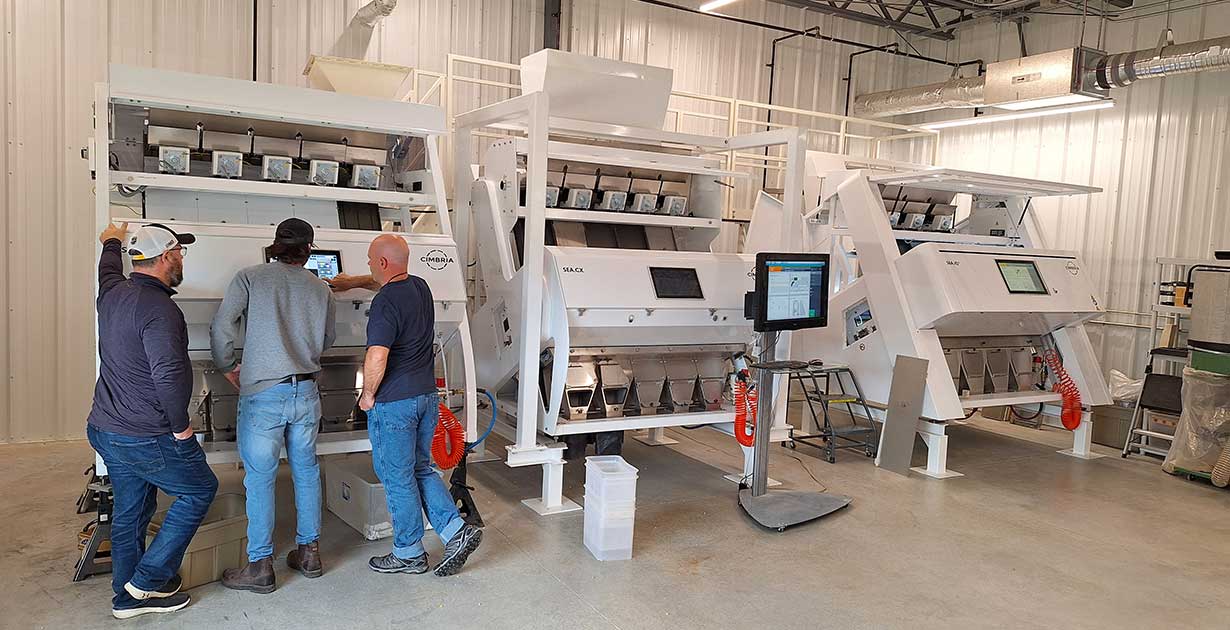
In our lab, customers can test-drive a colour sorter just like they would a new vehicle. They run their own samples, touch the screen, adjust recipes, and instantly see the results. We can simulate live runs, capture accepts and rejects in bins, and measure outcomes immediately. When someone changes a setting and sees how it affects quality or how much good product is saved, the results don’t lie — and the “aha” moment happens fast.
What’s most rewarding is what we hear after training. Quality managers often tell us they can see the difference right away. Operators come back more confident, make adjustments on their own, and consistently improve finished product quality. That confidence often saves good seed that would otherwise be rejected, which directly impacts the bottom line.
Virtual training has also become a powerful tool. Using colour sorter simulators on our laptops, we can show customers how the machine “thinks.” We use real images of good and bad product, explain how the sorter differentiates between them, and demonstrate how recipe changes affect decisions. It’s the same interface as the machine itself, just portable — and highly effective for both training and introductions.
As AI becomes more common in new colour sorters, training requirements will change. Machines with built-in AI handle much of the complexity automatically. However, many systems in operation today still require a solid understanding of how and why adjustments are made. For those machines, retraining remains essential.
We believe the best approach combines classroom learning with hands-on experience. Teach the fundamentals first, then apply them at the machine. When operators understand what adjustments do and when to use them, everything else becomes fine-tuning. My grandfather always told me: “Go try it out first, then come back and read the manual. When you go to use it again, you’ll then master it.” Those were wise words. He was saying there’s no substitute for getting your hands dirty right off the bat. The technical stuff and fine tuning can be learned after you have a feel for things.
At the end of the day, even the most advanced technology only performs at its best when people truly understand how to use it. And there’s no substitute for a classroom and an experienced teacher.