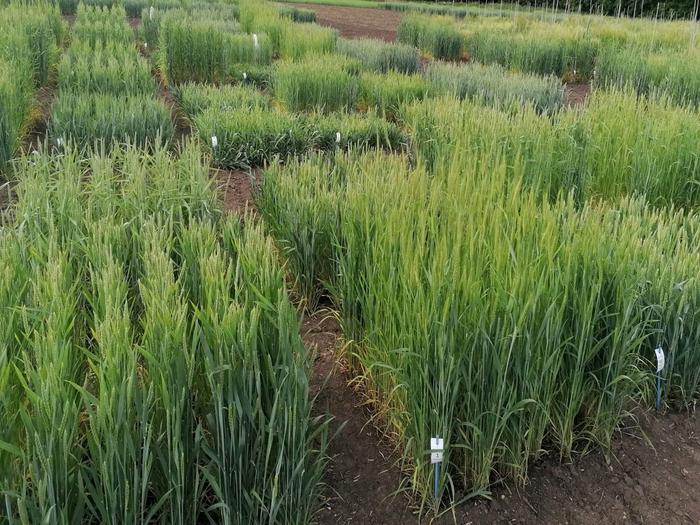
Wheat is a cornerstone of the global diet, particularly in the form of bread. A new study by the Leibniz Institute for Food Systems Biology (LSB) at the Technical University of Munich and the Leibniz Institute of Plant Genetics and Crop Plant Research (IPK) finds that extremely dwarf wheat has a less favorable gluten composition than semi-dwarf, dwarf, or tall wild-type varieties, resulting in flour with poorer baking properties.
The introduction of dwarfing genes (Reduced height — Rht genes) during the “Green Revolution” of the 1960s was a major agricultural milestone. These genes make wheat plants shorter, reducing their susceptibility to wind damage (lodging), while allowing them to allocate more energy to grain filling — a key factor in the dramatic yield increases achieved during that period.
“Today, more than 70% of all wheat varieties grown worldwide carry at least one of these genes,” says co-author Andreas Börner, scientist of the Genebank Department at the IPK and co-author of the study.
Unclear Influence on Gluten
Until now, it was unclear whether Rht genes affect not only wheat’s straw length but also the gluten composition of the grain. Wheat gluten is made up of two main protein groups: gliadins and glutenins. Gliadins give dough its stretchiness and viscosity, acting as a softener, while glutenins provide elasticity and strength. A balanced gliadin-to-glutenin ratio is essential for good baking quality — too many gliadins make dough too soft, reduce bread volume, and produce poor baking results, according to a press release.
To investigate the influence of Rht genes on gluten, researchers compared tall wild-type wheat with five nearly identical variants across four wheat lines differing only in their Rht genes. All lines were cultivated over three growing seasons (2021–2023) at the IPK in Gatersleben, providing comparable sample material under variable climatic conditions.
The study found that dwarfism genes in modern wheat varieties (Rht1, Rht2, and their combination) had minimal effect on gluten composition. In contrast, genes causing extreme dwarfism (Rht3 and Rht2+3) reduced gluten content and altered the gliadin-glutenin balance, potentially harming baking quality. Notably, environmental factors had an even greater impact: the warm, humid conditions in 2021 during grain filling produced a particularly high and unfavorable gliadin-to-glutenin ratio.
“Our results show that the introduction of semi-dwarf and dwarf genes during the Green Revolution did not negatively affect the gluten composition of modern wheat varieties,” explains first author and principal investigator Sabrina Geisslitz from the LSB. She adds: “However, in the future, consideration should be given to whether genes that cause extreme dwarfism should be introduced into new breeds. Such genes could impair baking quality and also increase the immunoreactive potential, as both are associated with a high gliadin content.”
“The study highlights how complex wheat breeding is,” adds Katharina Scherf, head of the Food Biopolymer Chemistry research group at the LSB. “As we were able to demonstrate, it is not only genes but also environmental conditions that determine the gluten composition in wheat. In view of climate change, this poses further challenges in optimizing breeds in terms of their gluten composition.”
Publication: Geisslitz, S., Schierenbeck, M., Börner, A., and Scherf, K.A. (2025). Semi-Dwarfing Reduced Height Genes Hardly Influenced Gluten Protein Composition While Extreme Dwarfing Genes Decreased Glutenins in Wheat. Food Sci Nutr 13, e70649. 10.1002/fsn3.70649. https://doi.org/10.1002/fsn3.70649
Funding: This study was supported by the Alexander von Humboldt Foundation (Dr. Matías Schierenbeck) and by core funding from the Leibniz Institute of Plant Genetics and Crop Plant Research. Open access funding was enabled and organized by Project DEAL.
Did You Know…
The “Green Revolution,” beginning in the 1960s, introduced modern agricultural technologies—short-stature wheat, fertilizers, pesticides, irrigation, and mechanization—dramatically boosting yields while creating lasting ecological and social impacts.
Grain filling is the final growth phase in cereals, when pollinated ovaries develop into mature grains through the transfer of starch and nutrients. This stage determines grain size, weight, quality, and overall yield.
Wheat gluten consists of two main protein groups: glutenins and gliadins. Glutenins are large polymers providing elasticity and strength, while gliadins are smaller monomers that give dough stretchiness and viscosity. LSB research has clarified their roles in baking and revealed the structure of immunoreactive gliadin sequences that can trigger celiac disease in genetically predisposed individuals.
Celiac disease is a chronic intestinal condition caused primarily by gluten intolerance, with additional co-factors still under study.