A multidisciplinary team from CONICET is working on the genetic improvement of one of Argentina’s most widely cultivated barley varieties, Andreia. The goal is to increase its content of degradable starch, which would enhance fermentation and improve malting efficiency. This is being pursued by introducing a gene from the seaweed Ostreococcus tauri. While the primary focus is on boosting brewing barley production, the project also holds promise for developing higher-quality fodder for animal nutrition.
The research builds on earlier work at the Center for Photosynthetic and Biochemical Studies (CEFOBI, CONICET-UNR). There, scientists successfully transferred the OsttaSBE gene from O. tauri into Arabidopsis thaliana, a model plant commonly used in genetic studies. The resulting genetically modified Arabidopsis showed higher starch content, more fermentable glucose units, and smaller starch granules. Inspired by these results, CONICET doctoral fellow Amanda Rosario Gómez Ibarra began investigating how to introduce the same algae gene into barley, a crop of significant agronomic value.
To advance this effort, an inter-institutional team was assembled, led by CONICET researchers María Victoria Busi (CEFOBI) and Hugo Permingeat (Institute of Research in Agricultural Sciences of Rosario, IICAR, CONICET-UNR). The group also includes scientists from the Agrobiotec Platform of the Faculty of Agricultural Sciences and the Faculty of Biochemical and Pharmaceutical Sciences at the National University of Rosario (UNR). What sets this project apart is that, while transgenic barley already exists, this is the first time algae enzymes have been used to modify the crop, according to a press release.
According to Busi, barley was chosen because of its strong growth in Argentina, both for brewing and other agricultural uses. Moving from trials in Arabidopsis to barley required specialized genetic transformation tools, which the team found at the Agrobiotec-FCA platform, directed by Permingeat.
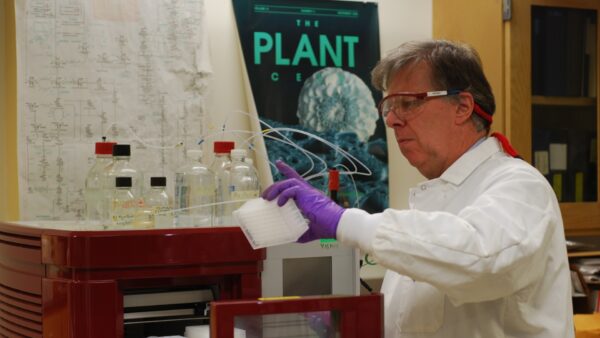
“The platform is a structure, where we have a laboratory of cellular and molecular biology, and we have chambers to grow plants all year round in very controlled conditions,” comments Permingeat, and highlights that this is an advantage, since barley is a winter growing cereal, with which in a space like the platform you can work during any season. He also maintains that by generating transgenic plants, it forces the entire system to be very controlled so that that seed does not disperse.
To generate the new barley variants, Gómez Ibarra first had to develop an in vitro cultivation system. The algae gene was introduced into the barley genome using a gene gun, but only after being modified to ensure expression occurred exclusively in the grain’s endosperm, rather than throughout the entire plant. Once the seedlings reached the appropriate stage, they were transplanted into pots and grown to maturity, allowing researchers to harvest their seeds and analyze the next generation.
Permingeat points out that not every variety within a species responds well to in vitro culture and genetic transformation. Most international studies rely on the widely used barley variety Golden Promise. In this case, however, the team worked with Andreia, a variety grown in Argentina. “To our surprise, Andreia responded better than Golden Promise,” notes Permingeat.
Gómez Ibarra adds that the research was recognized in 2024 at the International Barley Congress, where it received an award for its novelty. Few projects target the industrial improvement of barley, she explains, as most research focuses on yield and disease resistance.