Researchers discover triticale and hairy vetch can boost soil health, cut erosion and double as renewable fuel sources.
Cover crops could soon do more than just protect the soil — they could help power the future.
New research from Washington State University (WSU) and the Pacific Northwest National Laboratory found that certain cover crops grown during Washington’s off season can be turned into biofuel without harming soil health.
After harvest, fields typically sit bare, leaving soil vulnerable to erosion and weeds — and farmers without income. Cover crops can prevent that, but many growers worry about nutrient loss, shorter planting windows and limited markets for the crops themselves.
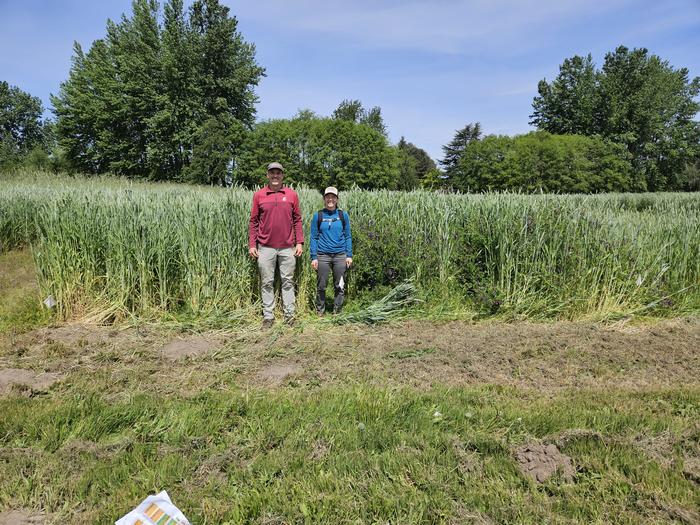
A team led by WSU scientists tested four cover crops over multiple years in western and central Washington. Two stood out: triticale, a wheat–rye hybrid and hairy vetch, a nitrogen-fixing legume.
“Triticale produced the highest yields, and hairy vetch offered consistent performance at low cost while enriching the soil,” says Miki Santosa, a WSU graduate student and corresponding author on the study, published in Biomass and Bioenergy.
Santosa’s team also examined each crop’s potential as a renewable energy source using hydrothermal liquefaction — a process that turns plant biomass into fuel.
“The ultimate goal is to give refineries and processors more renewable feedstocks,” Santosa says. “Working with farmers to identify viable crops is key to scaling biofuel production.”
Unlike traditional biofuel processing — which varies by crop — hydrothermal liquefaction can blend different types of biomass into one fuel source. That flexibility could make it easier to develop regional biofuel markets.
“If processors can homogenize materials to make fuel, we can start thinking about what grows best where,” says Chad Kruger, director of WSU’s Center for Sustaining Agriculture and Natural Resources.
Kruger notes that even after removing biomass for fuel, soil health remained intact. “We found that harvesting cover crops like triticale didn’t damage the soil,” he says. “That’s a win for farmers and the environment.”
While more research is needed, researchers say the findings point to a promising new value stream — one where growers improve their land and earn additional income from the same acres.
“Cover crops have always been grown to help the soil,” Kruger says. “Now farmers might be able to get paid for them, too.”