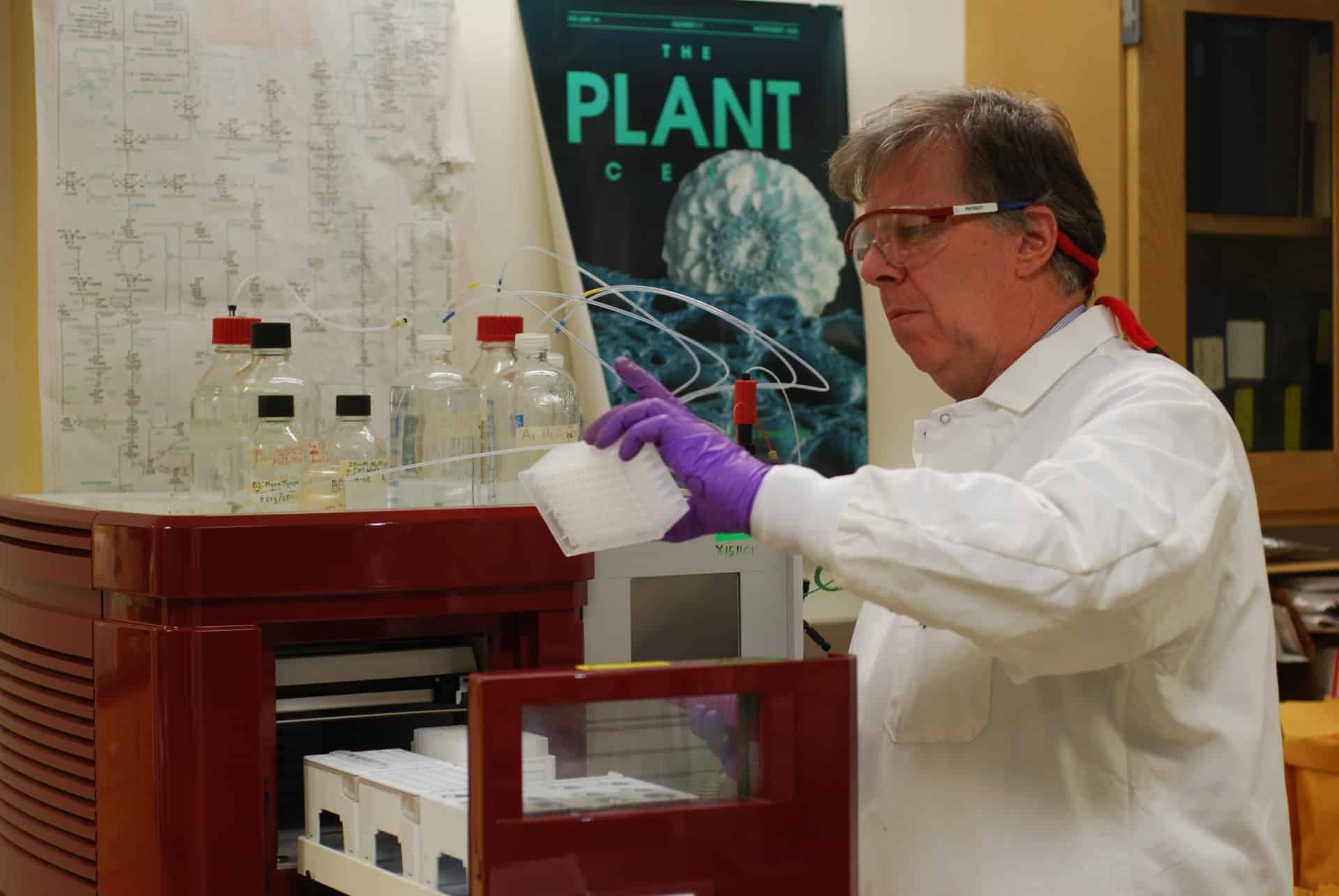
As seed companies manage tighter margins and higher expectations, new research points to a biological factor that could extend usable inventory.
Seeds are built to survive the impossible.
They dry down to a fraction of their original moisture, sit in storage for months or years, and all the while, damage accumulates. Proteins degrade. Cellular systems weaken. Time does what time always does.
And yet, when water returns, the expectation is immediate. Germinate. Emerge. Perform.
For University of Kentucky seed biologist Bruce Downie, that contradiction never quite sat right.
“Seeds that we talk about most of the time are orthodox seeds,” Downie says. “As the mother plant finishes developing the seed, she cuts off the vascular tissue, and the seed dries… and in that state they’re extremely resilient.”
Resilient, but not preserved.
“It’s got to both protect itself and then enter into this state of quiescence,” he says. “And then when it rehydrates, all of these accrued problems have to be repaired if you’re going to complete germination.”
That repair step, packed into the first hours after water uptake, often determines whether the seed succeeds or fails.
The Moment Seeds Start Failing, And Fixing Themselves
The instant a dry seed takes up water, the clock starts running. Everything that went wrong during storage suddenly is exposed. Proteins that have quietly degraded must either function, be replaced, or be repaired quickly enough to keep the system moving forward.
At the center of that response is what Downie calls the protein repair enzyme, known in corn as ZmPIMT1. It does not rebuild the seed. It stabilizes it.
Instead of forcing the plant to degrade damaged proteins and synthesize new ones, a process that requires transcription, translation, folding and transport, the enzyme repairs them in place. It restores function at a fraction of the energy cost.
That distinction matters most when energy is limited and timing is unforgiving.
“The amount of ATP that takes relative to repair… is a no brainer,” Downie says.
But he explain that not all seeds operate with the same level of repair capacity.
Downie and his team found genetic differences in the promoter region of this enzyme lead to significant variation in how strongly it is expressed. Some corn lines produce high levels. Others produce far less.
The consequence is not theoretical. Seeds with stronger repair capacity maintain higher germination and vigor after storage stress. Seeds with weaker expression lose performance more quickly, not because they lack protection, but because they cannot recover as effectively once damage accumulates.
“If you can repair that rapidly… we have a hard time trying to figure out, why would you not want to do that?” Downie says.
A Trait Hiding in Plain Sight, and in Your Germplasm
The variation isn’t something scientists created. It already exists in corn. In some lines, the team found a large stretch of DNA in front of the repair gene that acts like a dimmer switch, turning the system down and limiting how much of the enzyme the seed can produce during germination. It is a built-in constraint on recovery.
From a breeding standpoint, it looks like an easy decision.
“If you have the choice between a line that has this attenuated ability… and a line that has the enhanced ability, choose it every time,” Downie says.
Downie points out that this lower-expression version hasn’t been eliminated over time. It still shows up across germplasm, suggesting it may be neutral or tied to a tradeoff scientists don’t yet understand.
The answer is not yet clear. But he believes the opportunity is there. This trait is already in the germplasm. Breeders can select it, stack it and push it into advanced lines.
The Genetic Tradeoff No One Can Explain Yet
The presence of reduced repair capacity raises a deeper question about how traits evolve and persist. If higher repair activity improves seed performance under stress, why has the opposite not been selected out?
The difference may not matter in some environments. And reduced expression may still give plants an advantage scientists haven’t yet measured, tied to timing, metabolism or development. For now, Downie says those remain hypotheses.
“It’s just confusing us more,” he adds.
What the research does make clear is that seed biology is not operating on a simple maximize-everything model. It is a system of tradeoffs, constraints, and priorities that are still being uncovered.
For breeders, that uncertainty does not negate the value of the trait. It simply means the biological story is not finished.
Where Seed Biology Meets Inventory Risk
The implications sharpen quickly when the conversation moves out of the lab and into operations. Seed companies do not just manage genetics. They manage inventory, timing and risk.
“You’re always producing a little bit more than you think you’re going to be able to sell,” Downie says. “Can you store it and then guarantee your farmers 98% germination?”
That threshold defines whether a seed lot holds its value. If it falls short, the consequences are immediate. Companies discount it, move it down the value chain or pull it off the primary market. In a tight-margin environment, those decisions carry weight.
Most current strategies focus on protection. Treatments, packaging and controlled environments are designed to slow degradation and preserve vigor. But they do not eliminate damage; they only delay it.
What this research introduces is a second lever — recovery.
If a seed can repair damage more effectively during germination, it extends the window in which it can meet performance standards.
“Then you can sell it next year,” Downie says.
Not as leftover inventory, but as product that still meets expectation.
That shift changes how longevity is valued. It is no longer just about how long a seed can sit in storage. It is about how well it can come back from it.
“As you stack traits… this is a great one to stack on top of it,” he says.
The Proteins that Decide Whether a Seed Lives or Stalls
As Downie’s research moved deeper into the mechanism, he says one pattern became clear. The repair system is not evenly distributed across all proteins. It is selective, and that selectivity reveals what the seed prioritizes.
At the top of that list are proteins responsible for translation — the process that converts stored RNA into functional proteins during germination.
Seeds begin life using what they already have. It must quickly and efficiently translate transcripts stored during development to initiate growth.
Poly A binding proteins play a central role in that process. They stabilize RNA and enable its translation into protein. If they fail, the system does not gradually degrade. It stalls.
“The repair enzyme kind of hovers over it,” Downie says, “and anytime there’s a problem, it just keeps repairing it.”
That continuous maintenance keeps the translation machinery functional during the narrow window where the seed transitions from stored reserves to active metabolism.
Without it, the seed cannot produce the proteins it needs to establish itself, even if other systems stay intact.This aligns with what seed biologists describe as Job’s rule — the principle that the machinery of protein synthesis must be protected above all else.
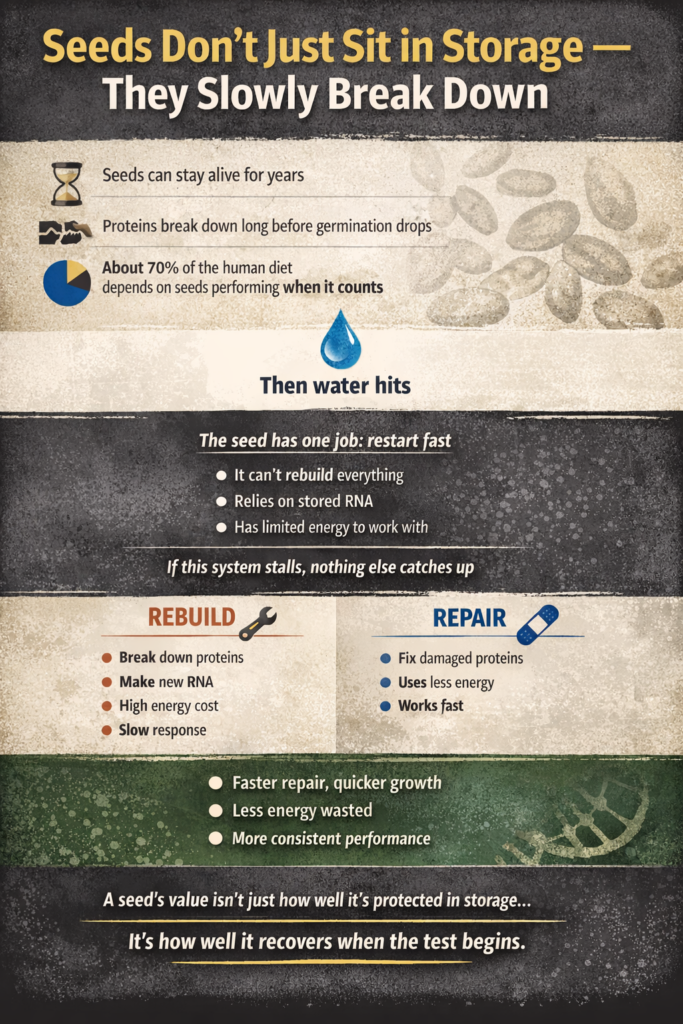
“These protection and repair mechanisms are not ambiguous,” Downie says. “There are certain proteins that are more important to repair or protect than others.”
That hierarchy reframes seed longevity. It is not about equally preserving everything; it is about ensuring that the systems required for recovery remain intact.
A Ready-To-Use Trait; No Platform Required
What makes this discovery different is how little stands between understanding and application. Downie says the variation in repair capacity is already present. It does not require transgenic development, gene editing, or new regulatory pathways.
“It’s a naturally occurring alteration in the promoter,” he says. “We’re not making any transgenic lines.”
That removes one of the largest barriers to adoption. It also compresses the timeline.
For breeders, that shifts the question. It is no longer whether they can develop the trait, but whether they prioritize developing the trait can be developed.
Every addition to a breeding program competes for space. Yield, disease resistance and agronomic performance remain central.
Downie’s research suggests that repair capacity does not compete with those traits. It reinforces them.
A hybrid that maintains higher germination after storage does not just perform better in a controlled test. It preserves stand establishment, reduces variability, and expands flexibility in how seed is produced and sold.
Downie does not hedge the conclusion.
“If you have the choice… choose it every time,” Downie says.
Longevity Isn’t Storage. It’s Recovery Speed
There is a tendency to define seed longevity by how long a seed can sit on a shelf. But, that definition misses what actually determines performance.
Downie says storage is not static. It is a period where damage slowly accumulates, often invisibly. The outcome comes down to germination, when the seed must respond at once.
His work clarifies that protection alone does not define success. Even under ideal conditions, degradation occurs.The difference is whether the seed can correct it in time and that entirely shifts the framing.
Longevity is not just about preservation. It is about recovery speed. Seeds are not inert products waiting to be used. They are living systems carrying both the effects of storage and the capacity to overcome them. The moment water is introduced, the capacity test begins.
And increasingly, the outcome may depend on something most people never see. Not just how well a seed is protected.But how well it repairs itself when everything starts again.