A new Gates Foundation grant will help expand seed testing, speed variety approval and unlock soybean market growth across sub-Saharan Africa.
Building a soybean market in Africa is not just about introducing a new crop. It is about creating a functioning ecosystem of seed companies, processors and trade partners that can connect to the global soybean economy. For more than a decade, the Soybean Innovation Lab has been working toward that goal.
Now, a new $1.5 million grant from the Bill & Melinda Gates Foundation to the University of Illinois Urbana-Champaign will strengthen and expand testing of new soybean seed products across sub-Saharan Africa.
“With 12 years of federal funding from USAID, we conducted the research, built the infrastructure with our partners and de-risked market-led growth in Africa’s soybean sector,” says Peter Goldsmith, Soybean Innovation Lab director and emeritus professor in the Department of Agricultural and Consumer Economics in the College of Agricultural, Consumer and Environmental Sciences.
From research to registered seed
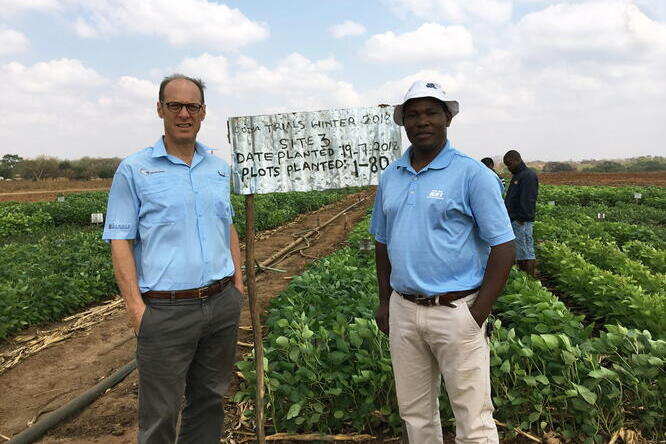
Following the closure of USAID funding streams, the lab scaled back its footprint from 31 countries to four. One of those is Malawi, where the team is leveraging irrigation infrastructure from the Shire Valley Transformation Program to build soybean production in the region. That work was made possible by an anonymous $1 million donation. The new Gates Foundation investment allows the lab to expand its reach once again.
The two-year grant will fund expansion of the Soybean Innovation Lab’s Pan-African Trials (PAT™) platform, a market-based system that allows new soybean varieties to be tested, registered and commercialized across multiple countries at the same time.
Breaking the bottleneck in Africa’s seed systems
For decades, fragmented national registration systems slowed the movement of improved varieties from research plots to farmers’ fields. In some countries, access to new soybean genetics lagged by a decade or more.
“Historically, the seed approval process in many countries takes at least two years, which can slow down the availability of new soybean varieties in the market,” Goldsmith says. “Through PAT™, we’ve found a way to work within Africa’s regional trade structures so that once a soybean variety is registered in two countries, it becomes available in up to 28 others. That’s a massive breakthrough for farmers and seed companies.”
By 2027, the lab and its partners aim to register at least 10 new soybean varieties in the Southern African Development Community and Common Market for Eastern and Southern Africa regional catalogs. That includes varieties with soybean rust resistance. Since launching PAT™ in 2019, the platform has already supported the release of eight soybean varieties in Malawi alone.
Why Africa’s soybean growth matters globally
While the work is focused on African farmers and seed systems, Goldsmith says the impact extends well beyond the continent. Stronger soybean markets help stabilize global supply chains, create new trade opportunities and open doors for collaboration across regions.
Demand for soybean is rising rapidly across sub-Saharan Africa, driven by growth in poultry, aquaculture and plant-based protein sectors. As soy becomes an industrial standard, Goldsmith sees opportunities for U.S. exports of grain, seed and value-added products.
“Every time a country builds a functional, transparent seed and grain market, the global system becomes more efficient and resilient,” he says. “It creates a foundation for trade, from grain and seed to inputs, machinery and management know-how, and those are areas where the U.S. continues to lead.”
Built on years of public investment
Goldsmith is clear that this milestone rests on years of public-sector support.
“This project wouldn’t exist without USAID’s early and sustained support,” he says. “Those funds enabled us to do the research, build partnerships and understand the system well enough to make it work commercially. The market is taking over, which is good. However, what about the next innovation, breakthrough or improvement? The Soybean Innovation Lab’s impact demonstrates the critical role public funding plays in high-risk, early-stage research and development.”