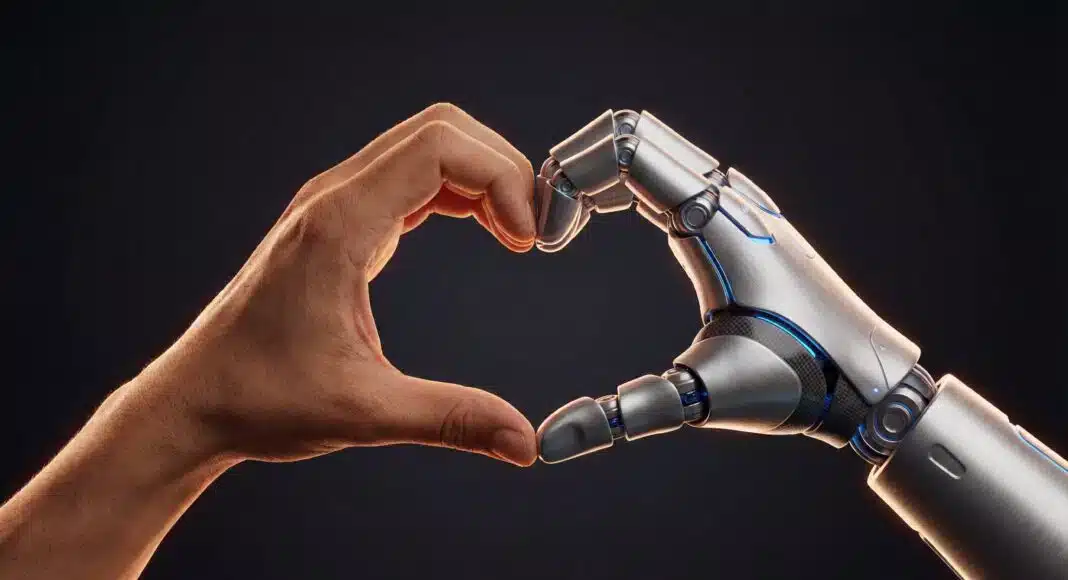
For growers, artificial intelligence isn’t about replacing people — it’s about questioning assumptions and making better use of time.
There’s a phrase that makes Robert Newcombe nervous: “We’ve always done it this way.”
In agriculture, tradition runs deep. But Newcombe, founder of AI-First Consulting, argues that artificial intelligence offers farmers a rare opportunity to pause and challenge the habits that quietly shape how work gets done.
“There are a lot of assumptions, a lot of constraints, a lot of ways we do things just because they’ve been done that way for decades,” he says. “With new technology, it’s a great opportunity to reflect on your activities and ask: is this really the best way to do it?”

For Newcombe, AI isn’t just another digital tool. It’s a catalyst, an excuse, even, to rethink how farms operate.
He frames adoption through what’s known as first principles thinking: breaking a problem down to its core truths and questioning every assumption along the way.
“Think like a two-year-old,” he says. “Why do we do it this way? Why? Why? Why? When you break it down to the fundamentals, you can build a better solution from the ground up.”
The approach is common in tech circles, but its relevance to agriculture is straightforward: don’t confuse tradition with necessity.
Newcombe’s own introduction to that mindset began on his family’s dairy farm.
“I grew up milking at 3 p.m. and 3 a.m.,” he says. “Every Thursday morning in high school and early university, I’d be up in the barn at 3 a.m.”
When his family considered installing robotic milkers, Newcombe ran the numbers as part of an MBA consulting project. The investment, he concluded, was essentially a wash — about a 15-year payback.
“I told my dad it was basically break-even and the money might be better spent elsewhere.”
His father installed the robots anyway.
“It’s more than just the money,” his dad told him. “It’s about our staff. They don’t want to be in the barn at 3 a.m. There are better value-added activities they could be doing.”
The lesson stuck.
When Newcombe talks about artificial intelligence today, he returns to the same principle: technology should elevate work, not eliminate it.
“It’s not about displacing people,” he says. “It’s about getting them to focus on higher-value activities — making the work easier, better, smoother.”
In many ways, he sees AI as simply the next step in a long line of agricultural innovation. The act of milking cows has changed dramatically over the past half-century — from buckets to tie stalls to parlours to robotic arms. The goal hasn’t changed, and neither have the people behind the work. What changed is how that work gets done.
Artificial intelligence, he says, fits the same pattern.
Where it shines most is in the tasks farmers tend to avoid: paperwork, administrative work, and the endless flow of documents that modern agriculture demands.
“If there’s work on the farm that’s drudgery — the tasks you avoid, the ones that drain your energy — that’s where AI is strongest.”
Generative tools such as ChatGPT, Microsoft Copilot, and Google Gemini can draft policy templates, summarize meeting transcripts, convert spray records into compliance documents, or even digest lengthy government reports into farm-specific summaries.
“It’s not 100% done,” Newcombe says. “You still need to review and tweak it. But it’s a lot easier than staring at a blank page.”
That doesn’t mean the technology is flawless.
AI systems can still produce errors — sometimes confidently inventing facts or sources, a phenomenon known as hallucination. The best safeguard, Newcombe says, is to treat the technology as an assistant rather than an authority: ask for citations, provide context, and keep human judgment firmly in the loop.
“These systems are trained on the internet,” he says. “By default, they’ll give you something very average and generic. The more context you provide — your location, your operation, your scale — the better the result.”
Concerns about data privacy also require common sense. “Don’t put anything into ChatGPT that you wouldn’t want leaked,” he says, noting that sensitive financial records, employee information, or confidential data should stay out of open systems.
Ultimately, however, the biggest barrier to adopting AI isn’t the technology itself. It’s mindset.
“This is the worst AI you will ever use,” he says. “It’s only getting better.”