Growing tomatoes and generating energy on the same land. It sounds like a compromise, but the data suggests it may be a strategic advantage in water-constrained systems.
For the seed sector, the relevance sits in how crops perform under altered microclimates. Agrovoltaic systems combined with deficit irrigation cut water use by around 50%, with only a ~20% yield penalty, pointing to new breeding targets around shade tolerance, water-use efficiency, and stress resilience.
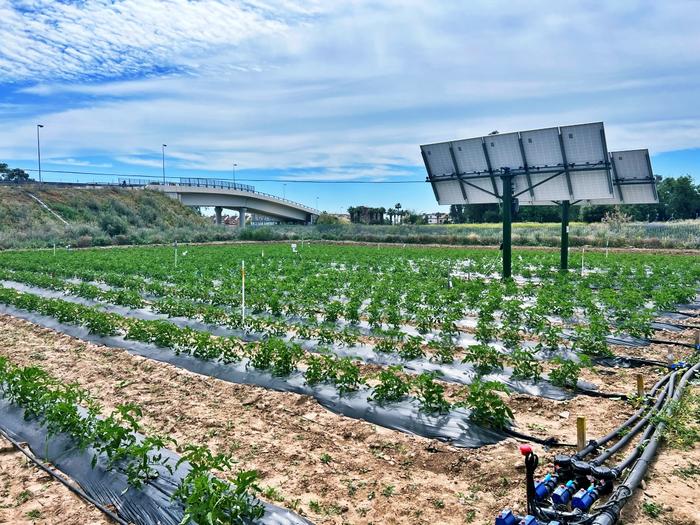
Researchers from the University of Seville and the Polytechnic University of Madrid have shown that tomatoes can be grown while solar energy is generated on the same land, an approach that could help address global water scarcity.
The study, conducted in Madrid and Seville during spring 2024, evaluated agrovoltaic systems alongside regulated deficit irrigation as a way to improve water efficiency in tomato production. The results showed that while reduced irrigation lowered total harvest volumes, the overall system became more efficient and sustainable, according to a press release.
By combining crop production with photovoltaic panels, the system uses shade to reduce plants’ evaporative demand and make better use of both land and water. Researchers compared three irrigation strategies: full irrigation as a control, regulated deficit irrigation based on plant water status, and an agrovoltaic treatment that applied the same water restriction under solar panels. They tracked plant stress through indicators such as leaf water potential and gas exchange across different growth stages. Although the panels reduced available radiation, the system still supported adequate crop development through most of the cycle.
One of the study’s clearest findings was that deficit irrigation reduced water use by about 50% compared with conventional irrigation. That saving came with a trade-off, with yields falling by around 20% in the regulated deficit irrigation treatment, largely due to severe water stress during ripening. Even so, irrigation water productivity increased significantly in the Seville trials, showing that more fruit could be produced per unit of water applied.
The broader value of the agrovoltaic approach was confirmed through the Land Equivalent Ratio, which measures the combined efficiency of agricultural and electricity production. Values of 1.54 in Madrid and 1.67 in Seville showed that producing tomatoes and solar energy on the same land was substantially more efficient than separating the two activities onto different plots. Although tomato yields were lower under the panels, the addition of clean energy improved the system’s overall sustainability and profitability.
The researchers concluded that agrovoltaics is a promising tool for the future of agriculture, although more precise irrigation management will be needed to avoid excessive crop stress. They suggest that combining plant-based measurements with soil moisture sensors could further refine these systems. The findings highlight the potential of dual land use as a practical response to climate pressure, water scarcity and the energy transition.
The study formed part of the Ministry of Science and Innovation and State Research Agency project PID2021-122772OB-I00, titled Sustainable vegetable production based on agrovoltaic systems. It was led by experts from ETSIAAB at the Polytechnic University of Madrid, CEIGRAM and ETSIA at the University of Seville, with the results published in Agricultural Water Management.