A new study provides one of the most comprehensive global assessments yet of how biochar can support climate-smart agriculture.
The findings offer important insights for farmers, researchers and policymakers looking for sustainable ways to improve food production while addressing climate change.
Biochar is a carbon-rich material made from biomass. It has long been valued for its potential to improve soil health, increase crop yields and reduce greenhouse gas emissions. However, its impact can vary widely depending on climate, soil conditions and farm management practices.
To better understand these differences, researchers developed a new process-based model that can predict how biochar performs across a wide range of agricultural systems around the world.
“Our goal was to provide a robust, science-based tool that helps optimize biochar use under real-world conditions,” said lead author Wei Ren. “This model allows us to evaluate not only crop productivity but also soil carbon storage and greenhouse gas emissions in an integrated way.”
The research team calibrated and tested the model using data from 48 field experiment sites around the world. These sites covered different climates, soil types and cropping systems, including maize, wheat and soybean, according to a press release.
The results closely matched real-world observations, showing that the model can effectively simulate key outcomes such as crop yield, soil organic carbon and carbon dioxide emissions.
The findings show that biochar can make an important contribution to more sustainable agriculture, but its benefits depend heavily on local conditions. The model performed best in tropical and temperate regions and in medium-textured soils. It was less accurate in arid environments and coarse soils, highlighting the need to tailor biochar use to specific regions and soil types.
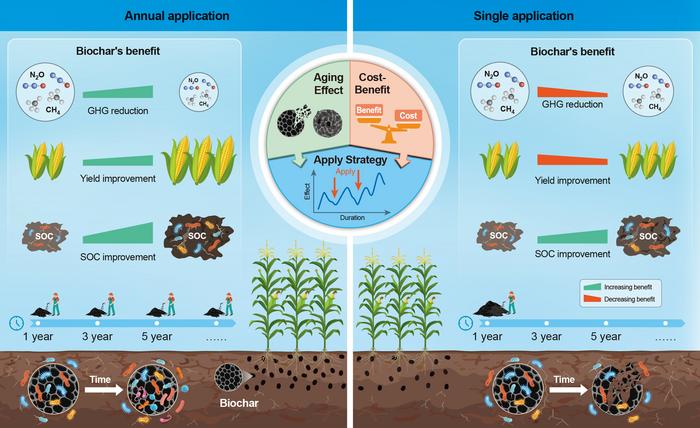
The study also found that application rates are important. Moderate biochar rates tended to produce the best crop yield results, while higher rates were more effective at increasing soil carbon storage and influencing greenhouse gas emissions.
Beyond yield benefits, the model also helps explain how biochar interacts with soil systems. Biochar can affect nutrient cycling, water retention and microbial activity, all of which support long-term soil health and resilience. By bringing these processes together, the model gives a clearer picture of how biochar works within agricultural systems.
“This work bridges a critical gap between field experiments and large-scale applications,” Ren explained. “It enables us to explore how biochar can contribute to global goals such as sustainable intensification and net-zero agriculture.”
The researchers stress that while biochar has strong potential, wider adoption will depend on better predictive tools and a clearer understanding of how it performs in specific locations.
Models like this can help farmers, researchers and policymakers identify where biochar is likely to be most effective and how it should be applied, reducing uncertainty in decision-making.
As agriculture faces growing pressure from climate change, tools that connect productivity, sustainability and climate mitigation are becoming increasingly important. This new model is a major step toward using biochar more effectively to improve agricultural systems worldwide.