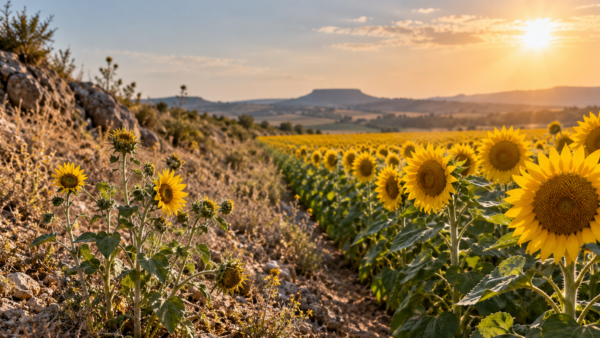
The HelEx project is crossing drought tolerant wild sunflower material from arid regions into European breeding lines as researchers race to build hybrids for a hotter, drier climate.
New sunflower varieties being developed through the EU-funded HelEx project could help European farmers manage drought and heat while opening markets for pollinator-friendly crops and plant protein.
Around 75% of the world’s sunflowers are grown in continental Europe, where rising temperatures and water scarcity are putting pressure on yields. HelEx brings together 17 partner organisations, including researchers, plant breeders, biotechnology companies and farmers, to address those challenges.
“There is also increasing societal demand for plant proteins,” said project coordinator Nicolas Langlade of France’s National Research Institute for Agriculture, Food and Environment (INRAE). “Sunflower seeds contain about 43 % oil and 17 % protein. They are mainly used in animal feed, but there is also potential in human food applications.”
Drawing on Wild Sunflower Genetics
The project combines conventional breeding with gene editing to strengthen drought and heat tolerance. Building on earlier research identifying genomic regions associated with drought tolerance, scientists screened wild sunflower populations from arid areas of the United States and crossed the most drought-tolerant material with commercial European varieties.
Final field trials across France, Germany, Hungary, Romania and Serbia will assess whether these approaches produce more resilient crops, according to a press release.
“If we don’t do anything, then sunflower yields will decrease and might no longer be viable in places like Greece and Bulgaria,” said Langlade.
The work could also create opportunities to expand sunflower production in northern Europe. Industrial partners hope to eventually deploy the resulting hybrids across the continent.
Breeding for Pollinator Appeal
Researchers also identified genes controlling sunflower UV colour and nectar sugar content, traits that influence pollinator attraction.
“We also discovered that bees recognise differences in the microbiome in nectar,” said Langlade. “They are more attracted to certain types of microbes.”
The work has produced a sunflower variety intended to provide more resources for pollinators, with potential benefits for nearby crops and honey production.
“This sunflower produces six times more nectar and pollen than conventional varieties,” said Langlade. “It also flowers in summer, which is when many hives starve, as resources for pollinators are more abundant in spring. This could be great for honey producers as well.”
Exploring New Protein Markets
HelEx is also identifying genes associated with protein content. Higher-protein sunflower seeds could expand food applications and help meet demand for European-grown plant protein, potentially reducing reliance on imported soybeans.
A new sunflower variety from the project is undergoing registration, with Langlade expecting it to become available in 2028.