The longtime Crop Development Centre breeder developed more than 100 barley and oat varieties, including CDC Austenson, while helping shape Canada’s global leadership in cereal crop innovation.
For decades, Brian Rossnagel’s work quietly reshaped Western Canadian agriculture.
Now it’s earning one of the industry’s highest honours.
The Canadian Agricultural Hall of Fame announced today that Dr. Brian Rossnagel, the longtime Crop Development Centre (CDC) barley and oat breeder at the University of Saskatchewan, will be inducted as part of its 2026 class, recognizing a career that produced more than 100 crop varieties and helped transform Canada’s competitiveness in cereal grains.
Rossnagel joins four other agricultural leaders in the 2026 cohort and will be formally inducted Nov. 7 in Laval, Que. According to the Hall of Fame, his 35-year career delivered “lasting economic benefits to farmers, processors and consumers” while strengthening Canada’s international position in barley and oat production.
It’s a fitting recognition for a scientist whose work has likely touched more Prairie acres than most farmers realize.
While Rossnagel developed more than 100 barley and oat varieties during his career, one variety in particular became synonymous with his legacy: CDC Austenson.
The feed barley variety, released in 2009, went on to become the most widely grown barley variety in Western Canada and remained a dominant force in farmers’ fields for more than a decade. In 2025, Seed World Canada named CDC Austenson its Seed of the Year, citing its combination of yield, straw strength, grain quality and adaptability.
Looking back on the variety’s success, Rossnagel told Seed World that CDC Austenson represented far more than a single breeding breakthrough.
“CDC Austenson was really the result of 30 years of work,” Rossnagel said. “We produced about 20 feed barley varieties over my career, but CDC Austenson, without question, is number one. It’s a variety I’m most pleased with.”
That success wasn’t obvious from the beginning.
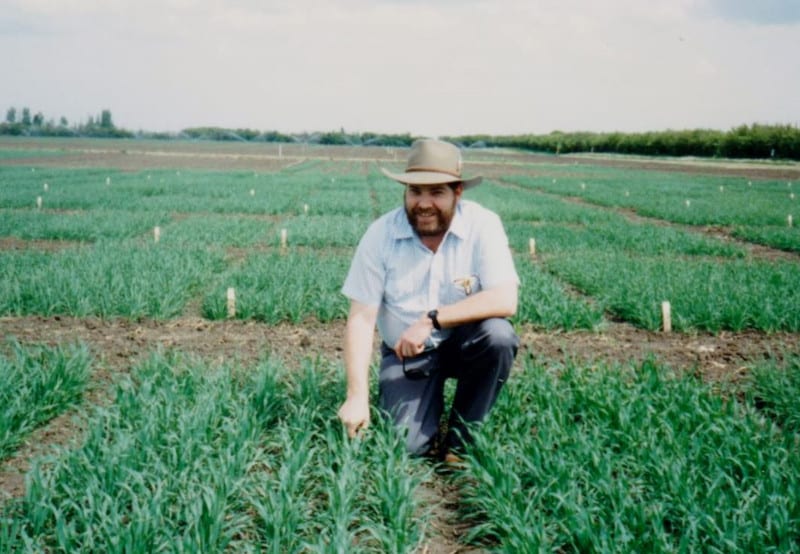
The variety emerged from breeding work that began with parental lines developed in the 1980s and a final cross made in 2000. Years of field testing followed before the line separated itself from thousands of competitors.
“When we reached the yield trial stage,” Rossnagel told Seed World, “there was a set of sister lines from that cross which stood out … but the selection that became CDC Austenson consistently stood out.”
The result was a variety that delivered what producers wanted most: yield without sacrificing agronomics.
“It combined exceptional agronomic performance with excellent physical grain quality — plumpness, kernel size and uniformity,” Rossnagel said.
But colleagues say Rossnagel’s influence extends well beyond a single variety.
The Hall of Fame specifically highlighted his collaborative approach to plant breeding and his commitment to mentorship, extension and training future crop-development leaders. Those contributions helped build the foundation for one of Canada’s most respected public breeding programs and established a pipeline of talent that continues to shape cereal crop innovation today.
That combination of scientific excellence and practical impact is increasingly rare.
Agricultural innovation often happens far from public view, unfolding over decades rather than product cycles. Plant breeders can spend years evaluating thousands of experimental lines before a single variety reaches farmers’ fields. The payoff comes not in headlines but in higher yields, stronger farm profitability and more resilient food systems.
Rossnagel understood that reality better than most.
“Plant breeding is as much about eliminating the poorer selections as it is about selecting the better ones,” he told Seed World.
Even after retirement, he continued to take pride in seeing CDC Austenson’s influence endure.
“After 15 years, it’s still occupying the majority of western Canadian feed barley acreage,” Rossnagel said in 2024. “And it’s contributed significantly to the parentage of newer varieties that build on its strengths.”