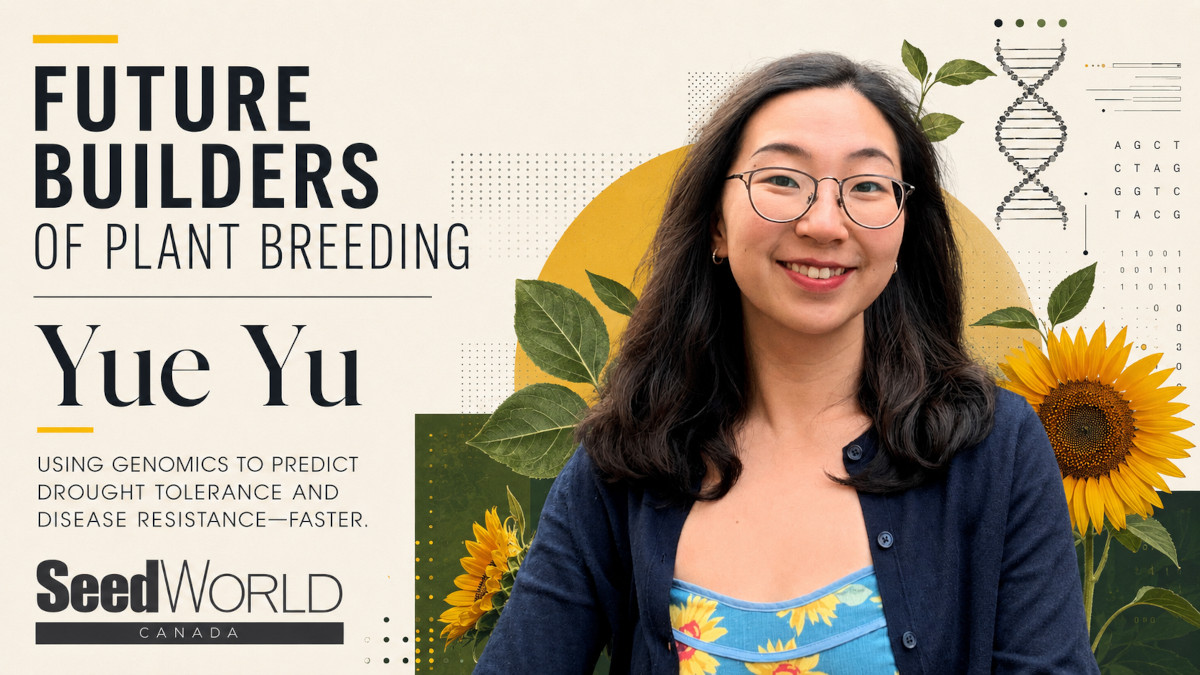
Yue Yu sees enormous potential for genomic prediction to accelerate plant breeding — and an equally important challenge in everything that happens before those genetics reach the farm.
Plant breeding is getting faster.
Genomic prediction can help identify promising plants before breeders spend years evaluating them. Better computing, environmental data and genomic tools are giving researchers information that previous generations of breeders simply didn’t have. But there’s a catch: breeding a variety faster doesn’t necessarily mean farmers get it faster.
That distinction is becoming increasingly important as researchers explore just how much time technology can remove from the breeding process.
Yue Yu, a researcher at the University of British Columbia, works at the intersection of genomics, plant breeding and environmental adaptation. Her research has included lodgepole pine and sunflower, using genomic information to understand how plants respond to their environments and how breeders might make better decisions earlier.
The possibilities are significant. But Yue says biology remains stubbornly complicated.
“The question is always about how accurate are these predictions?” she says.
Some traits are much easier to predict than others. A trait controlled largely by a single gene presents a different challenge than one influenced by many genes and their interaction with the environment.
That means even sophisticated genomic predictions still need something decidedly old-fashioned: plants growing in the real world.
“A lot of my work still includes the validation that requires phenotypic data, which includes some of these long field trials to back up the results that we got from these innovative genomic tools,” Yue says.
Field testing, she adds, remains a “gold standard” for determining whether those predictions actually work.
Knowing Earlier What to Put in the Field
That doesn’t diminish the potential value of genomic prediction. Yue has already seen what it can do in lodgepole pine, where researchers have decades of field data against which genomic predictions can be tested.
“I would say our prediction accuracy is about 60 to 70%,” she says.
Those genetic results are already being incorporated into breeding decisions and conservation planning in British Columbia.
The implication for crop breeding is intriguing.
If breeders can identify poor candidates earlier, they can potentially concentrate their field testing, money and time on material with a greater probability of success. The objective isn’t necessarily to eliminate field trials. It is to become much better at deciding what deserves to enter those trials in the first place.
Could prediction eventually become so good that some field trials disappear? Yue can imagine it — eventually.
“If we do get to know everything in the end, yes, I could see how field trials could be in the history book,” she says.
But she quickly adds a significant qualifier. “I don’t think we will see that in our lifetime, at least.”
The Genetic Potential We Left Behind
One place breeders may find useful information is in wild relatives of modern crops.
Agriculture has spent generations selecting plants for characteristics such as yield, quality and uniformity. That process produced extraordinarily productive crops, but selection can also narrow the genetic diversity available to breeders.
Wild relatives have faced a different kind of selection pressure. Drought. Heat. Disease. Pests. Unpredictable environments. Yue describes those plants as holding “untapped potential” for breeding.
“They actually have so much,” she says, pointing particularly to genetic diversity associated with biotic and abiotic resistance.
That diversity could become increasingly valuable as breeders try to develop crops for environments that themselves are becoming harder to predict. And therein lies one of modern breeding’s great paradoxes: our ability to predict plant performance is improving at precisely the moment the environment we are predicting may be becoming less predictable.
“If you don’t know where the goal is, you don’t know where to run to,” Yue says.
Breeding for an anticipated future climate takes years and considerable resources. If that future unfolds differently than expected, breeders risk investing enormous effort in solving the wrong problem.
Is Faster Always Better?
New technology promises to shorten at least some of those timelines. But Yue cautions against treating speed itself as the objective. There are situations where speed is essential. If an important crop variety becomes vulnerable to a new disease or other threat affecting farmers across a large region, breeders may need every available tool to respond quickly.
“But I also think faster can be a dangerous thing,” Yue says.
Moving too quickly without understanding the underlying biology — or without adequately determining whether a variety performs consistently — can come at the expense of quality.
“It’s really a balance between the speed of breeding as well as the quality,” she says.
That balance points toward a larger issue in the race to accelerate crop development. Even if technology dramatically shortens the breeding cycle, breeding is only one part of the journey to market.
The Bottleneck Can Move
Once breeders have developed promising material, it still has to navigate the processes that allow it to reach farmers.
“The whole breeding process itself can be lengthy, but a lot of time it’s also the downstream part,” Yue says.
That includes steps such as registering a variety, releasing it and making it legally available for sale domestically or internationally.
“That downstream process also takes a lot of time,” she says.
It changes the way the industry needs to think about breeding speed. If genomic prediction, computational tools and other technologies remove years from one part of variety development while the downstream system remains unchanged, the bottleneck may simply move.
From a farmer’s perspective, what ultimately matters isn’t how quickly a breeder can identify promising genetics. It is how quickly those genetics become a proven variety that can actually be planted.
“The technology is great. It’s providing so much more, and it could accelerate things compared to traditional breeding,” Yu says.
Podcast: Play in new window | Download