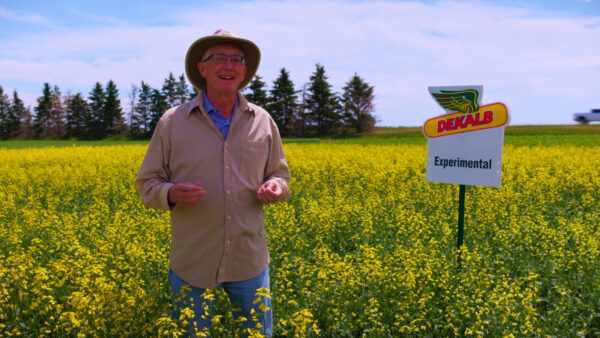
After another cold, wet and generally odd season across much of the Prairies, Jake Ayre, who farms near Minto, Manitoba, keeps returning to the same logic: a crop that spreads his risk across the calendar is a crop worth growing. But the thing that makes that bet pay — the winter hardiness, the disease resistance, the yields that keep climbing — did not appear on its own. It was built, over decades, through public investment in plant breeding.
That is the part Ayre wants people to sit with. Because the system that produced those varieties is now under pressure, and he has watched it long enough, from close enough, to be worried.
Ayre is co-owner of Southern Seed Ltd., a family-run pedigreed seed operation that grows and processes seed for other farmers alongside its own acres. He sees new varieties from both sides of the fence — as a grower deciding what to plant, and as a seed seller deciding what is worth multiplying. From that seat, the value of Canadian plant breeding investment is not theoretical. It is the difference between a crop he can count on and one he cannot.
What Canadian Plant Breeding Investment Looks Like in a Field
To understand what is at stake, look at what winter wheat used to be.
Ten to fifteen years ago, Ayre says, producers were devastated by Fusarium head blight, a fungal disease that downgrades quality, cuts yield, and can leave a crop nearly unmarketable. For a stretch, it made winter wheat a gamble a lot of growers were not willing to take.
That is not the crop he grows today. Genetics and disease ratings have improved sharply, and newer publicly developed varieties carry resistance that did not exist a generation ago. AAC Coldfront — bred at Agriculture and Agri-Food Canada’s Lethbridge research centre, — yields in the range of 111 per cent of the check varieties while holding intermediate resistance to Fusarium head blight. It has become one of the most widely grown winter wheats in Western Canada.
That progress is not luck. It is breeding. And breeding is the thing Ayre is trying to protect.
“Canadian bred varieties give me the confidence to try something new,” he says. “It has the winter hardiness. It’s been bred for these conditions. I can try and test and put it to work.”
The 34-to-1 Case for Canadian Plant Breeding Investment
Then there is the math, which Ayre returns to almost as a reflex. He puts the return on public plant breeding at 34 to 1 — thirty-four dollars of value for every public dollar invested.
“There’s nowhere else in any sector, not just agriculture, where you can see that sort of return on investment,” he says.
It is not an outlier claim. Wheat breeding alone has been pegged at a benefit-cost ratio in the same range, and varieties from Agriculture and Agri-Food Canada are grown on roughly 80 per cent of Canadian wheat acres every year. Public breeding is not a niche line item — it is the backbone of the crop, a backbone that Canada’s Commissioner of Plant Breeders’ Rights, Anthony Parker, warned is fraying in his own On the Brink episode.
What’s at Stake if the Investment Slows
The warning Ayre delivers is really about timing. Input costs have not just risen over the last few years — they have skyrocketed. Margins are thinner, and the varieties that keep nudging the yield trend upward are exactly what lets a farmer absorb that pressure. Pull back on the investment, and those varieties stop coming.
The lag is the cruel part. A winter wheat cross made today will not reach a farmer’s field for the better part of a decade. Every year of underinvestment is a gap in a pipeline no one will notice until it is too late to fill it — the same dynamic now playing out across Canada’s wider public breeding system, which has been shedding research capacity even as demand for new genetics grows.
“Without continued investment into public breeding programs and varieties that will continue to develop, profitability is going to decrease on farms,” Ayre says. “It’s imperative that we continue to invest in our public breeding system.”
Where Ayre Stands
For Ayre, none of this is a debate. He has the proof in his own fields — a crop that went from a Fusarium gamble to a dependable rotation anchor because someone, somewhere, kept funding the science.
The question he leaves is not whether public breeding works. It is whether the rest of the country will keep paying for something that pays back at 34 to 1 — before the pipeline quietly thins out.
“You don’t have to convince me on public plant breeding,” he says. “You know where I stand.”
Subscribe To On The Brink
On the Brink is a cross-country storytelling project about plant breeding in Canada. The goal is to spark an open, multi-perspective, ongoing conversation about what’s possible, what’s at stake, and how to seize opportunities ahead. On the Brink releases new episodes every Wednesday. Watch Episode 6 featuring Andrew Campbell and subscribe to have future episodes delivered directly to your inbox.
More Episodes
Be Part of this Conversation
We need your help to grow and evolve this conversation!
- Nominate individuals you think should be part of the On the Brink video series. Know someone who would add to the conversation? Email us at OnTheBrink@seedworldgroup.com
- Help expand the conversation by liking and sharing weekly episodes across LinkedIn, Instagram, X, and Facebook.