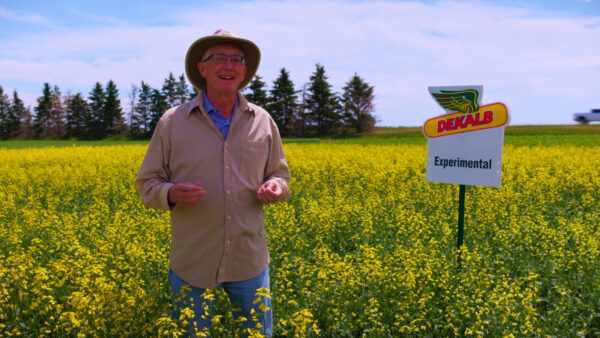
Jim Dyck breeds oats for a living, which in Western Canada makes him unusual. He is one of a handful of private breeders working on the crop. He works out of Saskatoon with his wife Laura-Lee and their four children under the name Oat Advantage, now 18 years into a program built around milling oats and forage oats.
He talks about the plants the way other people talk about a trade they love. “Working with oat plants is a relationship. It’s very creative,” he said. “The exciting part of it is that we can make changes in oats that will last generations.”
At Ag in Motion near Langham, Sask, Dyck stood in front of a feed oat still years away from a farm. It is the beginning of a family bred for digestibility, protein and kernel consistency. The package, he said, “incorporates high protein and oat kernel uniformity, which is a package that allows for optimal growing, feeding, and milling kinds of opportunities.”
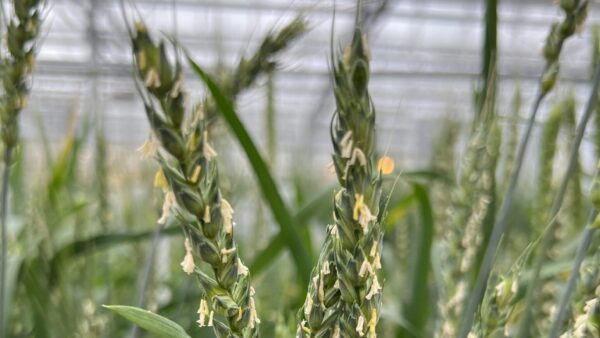
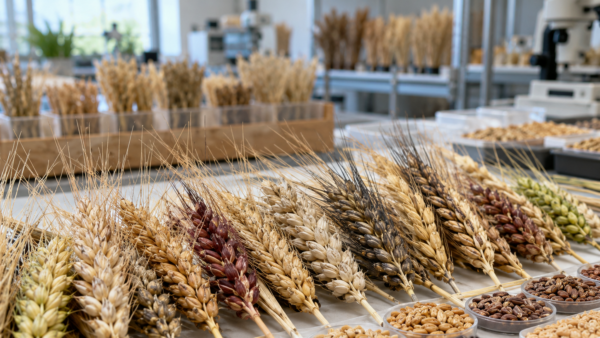
The trait list keeps going: kernel density, kernel quality, plant architecture, shattering resistance. “There are so many things that we can work with in oats that it’s easy to get up in the morning and be in a field of oats,” he said.
A 15-year project with nothing coming in
The hard part is not the science. It is the wait.
“Oat breeding, like other breeding, is a 10- to 15-year project,” Dyck said. “We don’t see monetary value for a long time.”
His answer is a variety use agreement on ORe BOOST, a variety he already has in the ground. A VUA works like this. A grower buys certified seed, plants farm-saved seed of that variety in a later year, declares those acres and is invoiced a per-acre fee set back when the certified seed was purchased. Seeds Canada runs the platform. It lists ORe BOOST at a maximum of $2 an acre, credited to James Dyck of Oat Advantage. A second Oat Advantage oat, ORe RUMINATOR, is listed at $2.50, with certified seed due in the fall of 2026.
Dyck does not present the fee as a toll. “If you see value in what we’re doing in plant breeding, then a VUA is a way of becoming a partner with us and investing in our plant breeding work and your future,” he said.
He is just as clear about the alternative. Breeding runs on momentum, he said. You move a line from one stage to the next, then the next. Any worry about funding makes a breeder draw back, slow projects down, shelve a few.
Two oats, one breeder
That is the part growers never see. A shelved project produces no announcement and no registration. It shows up as an absence, not an event.
The private base carrying that risk is thin. More than 30 varieties from seven breeding organizations now run under the VUA model, according to Seed World Canada’s July reporting. Two of them are oats. Both are Dyck’s.
Public oat breeding continues at Agriculture and Agri-Food Canada and at the University of Saskatchewan’s Crop Development Centre, paid for by appropriation rather than by the acre, and new public lines are still advancing. Private oat breeding in Western Canada is a shorter list. For a family company with no public funding line, whatever keeps cash moving is also what decides which lines reach a registration trial and which get parked.
Dyck is less interested in the size of the fee than in the horizon it buys. “We’re at a point where we can add value that’ll be lasting for Western Canada,” he said.
Whether that holds is partly a genetics question. It is also a cash-flow one.
Subscribe To On The Brink
On the Brink is a cross-country storytelling project about plant breeding in Canada. The goal is to spark an open, multi-perspective, ongoing conversation about what’s possible, what’s at stake, and how to seize opportunities ahead. On the Brink releases new episodes every Wednesday. Watch Episode 6 featuring Andrew Campbell and subscribe to have future episodes delivered directly to your inbox.
More Episodes
Be Part of this Conversation
We need your help to grow and evolve this conversation!
- Nominate individuals you think should be part of the On the Brink video series. Know someone who would add to the conversation? Email us at OnTheBrink@seedworldgroup.com
- Help expand the conversation by liking and sharing weekly episodes across LinkedIn, Instagram, X, and Facebook.