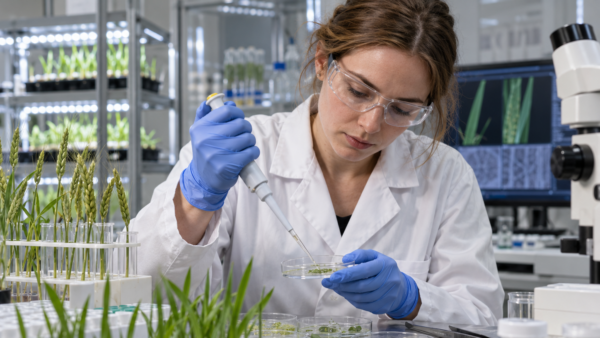
The Horizon Europe-funded COLiBRI initiative brings together 17 organizations to develop a shared roadmap for crop breeding research, investment and collaboration.
A new Horizon Europe project has launched with the goal of improving coordination in crop breeding research and innovation across Europe.
COLiBRI, short for Collaborative Crop Breeding Research and Innovation for a Green Europe, brings together 17 organizations representing research institutions, plant breeders, farmers, research infrastructures, European networks and policy groups.
The project officially began during a kick-off meeting held July 8–9 at the Julius Kühn-Institute in Berlin, Germany.
Partners Set Priorities for 30-Month Project
During the two-day meeting, consortium partners reviewed project plans, coordinated activities across different work areas and began developing the collaborative process that will guide the initiative over the next 30 months.
Participants also exchanged views on the challenges and opportunities facing crop breeding research in Europe, according to a press release.
Crop breeding is expected to play an important role in addressing climate change, biodiversity loss, food and nutrition security, and the long-term competitiveness of European agriculture.
However, research activities, infrastructure and funding opportunities remain fragmented across countries and institutions.
Roadmap to Guide Future Research and Investment
COLiBRI will work to better align research priorities with the needs of plant breeders, farmers, policymakers and funding organizations.
One of the project’s main objectives is to develop a European Plant Breeding Research and Innovation Roadmap. The roadmap will be accompanied by an implementation strategy and recommendations for future funding and coordination mechanisms.
The project partners say these tools could help establish a more coordinated European crop breeding research and innovation system.
Stakeholders Discuss Policy Priorities
The kick-off meeting included an interactive session on stakeholder engagement and network development, as well as a workshop examining how plant breeding research and innovation can support European policy objectives.
Participants identified policy areas relevant to plant breeding, discussed how breeding research could contribute to future European goals and considered the conditions needed to support stronger research coordination.
The discussions marked an initial step in developing a shared vision for crop breeding research and innovation in Europe.
“Europe needs a stronger and more coordinated approach to crop breeding research and innovation if we want to respond effectively to climate, food security and competitiveness challenges,” said Ralf Wilhelm, Project Coordinator at the Julius Kühn-Institute. “COLiBRI will bring together the perspectives of researchers, breeders, farmers, policymakers and funders to help shape a shared roadmap for future action and investment.”
Industry and Research Groups to Contribute
Stakeholders from across the crop breeding value chain will be invited to participate throughout the project through surveys, consultations, workshops and networking activities.
Their input will be used to identify current research needs and emerging opportunities across Europe’s agricultural regions and production systems.
The project is expected to run until November 2028.
About COLiBRI
COLiBRI is a Horizon Europe Coordination and Support Action funded through Cluster 6 – Farm2Fork.
The project runs from June 2026 to November 2028 and is coordinated by the Julius Kühn-Institute in Germany. Its 17 partner organizations will develop a European Plant Breeding Research and Innovation Roadmap, an implementation strategy and recommendations for future coordination and funding mechanisms.
Consortium Partners
Julius Kühn-Institut, Federal Research Centre for Cultivated Plants, JKI — Germany
Plants for the Future European Technology Platform, Plant ETP — Belgium
European Plant Science Organisation, EPSO — Belgium
Euroseeds, EURS — Belgium
Aarhus University, AU — Denmark
International Plant Genetic Resources Institute, IPGRI — Italy
Research Centre for Cultivar Testing, COBORU — Poland
Romanian Farmers’ Club for Performant Agriculture, FAPPR — Romania
Institute of Food Biotechnology and Genomics of the National Academy of Sciences of Ukraine, IFBG — Ukraine
French National Research Institute for Agriculture, Food and Environment, INRAE — France
National Institute of Biology, NIB — Slovenia
Hungarian Research Institute of Organic Agriculture, ÖMKi — Hungary
Polish Seed Trade Association, PIN — Poland
Graz University of Technology, TU Graz — Austria
Wageningen Plant Research, WR — Netherlands
Wageningen University, Department of Plant Sciences, WU — Netherlands
Mediterranean Agronomic Institute of Zaragoza, part of the International Centre for Advanced Mediterranean Agronomic Studies, CIHEAM Zaragoza — Spain