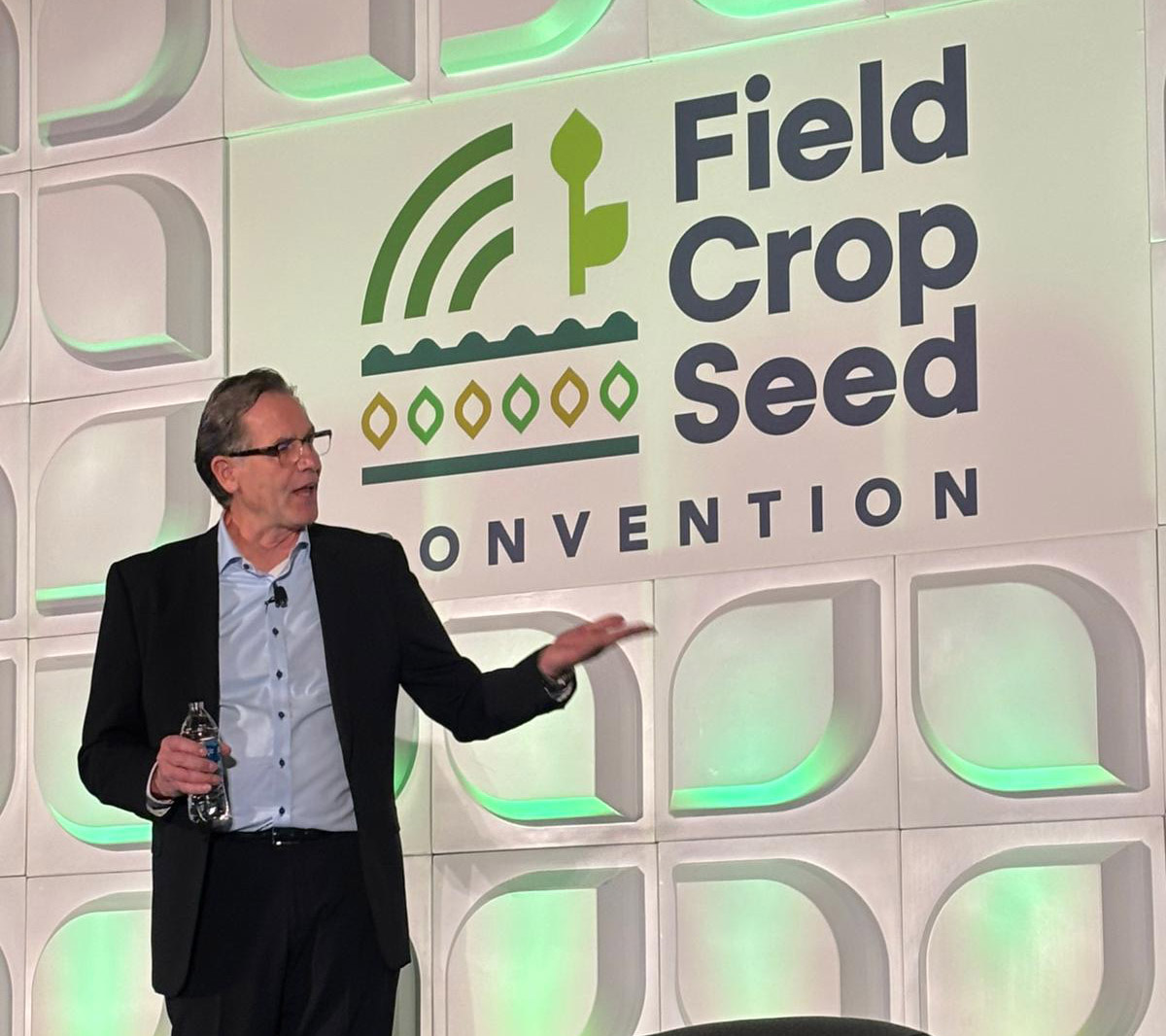
At the ASTA Field Crop Seed Convention, longtime economist Dan Basse tells seed leaders that global grain supplies are at record highs, demand is flattening and American farmers are becoming the high-cost producer.
The path forward, he says, will hinge on biofuels, policy and a world realigning around two competing power centers.
At the ASTA Field Crop Seed Convention, longtime economist Dan Basse tells seed leaders that global grain supplies are at record highs, demand is flattening and American farmers are becoming the high-cost producer. The path forward, he says, will hinge on biofuels, policy and a world realigning around two competing power centers.
The World Is Changing Faster Than Anyone Can Track
Dan Basse opened his 13th ASTA keynote with a simple truth. Markets are shifting fast, crop yields keep climbing and global forces are reshaping agriculture at a pace that feels almost impossible to follow.
“I can’t wake up in the morning anymore and not have something that just jumps out at me,” he says. “AI can’t come fast enough, because my staff can’t process all the changes that are happening in the world.”
For Basse, this isn’t a future scenario. It’s the economic backdrop farmers and seed companies are operating in right now.
A World Awash in Grain with Demand That’s Running Out of Steam
Basse walked the room through record global output driven by good weather, rising yields and aggressive expansion in South America and the Black Sea.
“This year, the world produced an extra 91 million metric tons of supply, or the equivalent of 3.3 billion bushels of grain. It was a record.”
Yet demand is no longer matching that growth. Wheat consumption is leveling off. Per capita corn use has flattened. Even China, which powered soybean growth for decades, is no longer increasing imports.
“China structurally is now what we would call a mature market for agricultural products,” Basse says. “We believe their import demand has plateaued.”
Without a new driver, he says global demand is not keeping pace with global output.
The United States Is Becoming the High Cost Producer
Basse then delivered one of the most sobering observations of the morning.
“Today, American farmers are at the place of being the least competitive in the world, the high-cost producer,” he says.
Comparative research shows U.S. farmers surpassing Brazil, Argentina, Russia and Ukraine in operating and overhead costs. Meanwhile, Brazil continues to expand acreage, yields, crush capacity and infrastructure.
“Modeling would show that somewhere in the next four to five years, Brazil will reach 200 million metric tons of soybeans,” Basse says.
For U.S. seed companies, this shift affects long-term product positioning, farmer profitability and demand for hybrids and varieties that deliver performance under tightening margins.
Brazil’s Growth Is Shaping the Competitive Landscape
Basse notes that Brazil’s soybean yield now outpaces the U.S. average and that its investment in rail lines, export channels and inland crush plants is accelerating. The nation plants roughly 300 million acres and often captures two or even three crops per acre. For seed companies, that scale and efficiency reset global reference points for productivity.
As Brazil races forward, farmers weigh seed value through a sharper lens. Genetic packages must deliver more yield stability and efficiency to stay competitive in a market where every extra bushel matters.
Global Trade Is Realigning Around Two Power Centers
Beyond cost and supply, Basse warned that trade flows are being reshaped by geopolitics as much as economics. He described a global landscape coalescing around Washington and Beijing, with other regions pulled into the gravity of those competing agendas.
For the seed industry, that realignment could influence germplasm movement, phytosanitary access, research partnerships and long-term market potential. It adds another layer of uncertainty for companies that depend on predictable, cross-border collaboration.
Basse addressed today’s tariff-driven environment directly.
“I would like to tell all of you in the room that tariffs are working for American agriculture, but at least at this point in our data sets, we can’t see that happening,” Basse says.
U.S. export share has slipped from 52% of global grain trade in 1979 to 16% today. Tariffs may help chip away at some non-tariff barriers, but the broader trade landscape is not swinging back toward the United States.
Without a Demand Driver, Margins Stay Flat
Basse showed long-term revenue patterns for corn and soybean farmers. Profitability only spikes when a demand engine arrives.
“I don’t have that demand driver today,” he says. “If we look for the next cycle, we need to have a demand driver behind the markets to have that happen.”
Today, there’s only one area with enough scale to matter.
Biofuels Are the Only Meaningful Outlet for Growth
Basse was clear about where he sees the opportunity.
“I don’t see another way for the US government to do anything but burn it,” he says. “Biofuels are our best aspect going forward.”
Renewable diesel continues to expand. Crush demand remains strong. And E15 represents one of the few policy levers that can materially shift corn markets.
“E15 would increase US corn demand about 2.6 billion bushels annually,” Basse says. “It would give us another three to five years of demand pull.”
Even so, scaling requires time, certainty and political alignment.
The Corn Belt Is Moving, and Product Strategy Must Move With It
Basse highlighted another trend with big implications for seed companies. The center of U.S. corn production is shifting west. Wetter cycles, agronomic pressure and changes in yield performance are pushing more production into the Plains.
That shift affects breeding priorities, trait packages and agronomic support. Heat tolerance, water use efficiency, standability and disease profiles look different west of the traditional Corn Belt. He says seed companies may need to recalibrate placement and R&D strategies as the geography of U.S. corn evolves.
The Market Already Sees What’s Coming
Basse ended with one of the most striking visuals of the morning. Corn and soybean futures for 2026, 2027 and 2028 all trade at nearly identical levels.
“They’re the same,” he says. “The market sees the same structure that we just talked about.”
With global supply heavy and demand stagnant, the market is signaling three straight years of break-even pricing.
“The market knows… it’s giving farmers for the next three years a break even price that is unchanged,” he adds.
Basse didn’t offer easy answers, but he offered clarity. Oversupply is real. Competitors are expanding. Policy will matter as much as agronomics. Biofuels offer the clearest path to renewed demand. And global agriculture is reorganizing in ways that will shape seed markets for years.
For seed companies, the message is direct. Product development, pricing strategy and farmer support must reflect an environment where margins are thin, global rivals are aggressive and certainty is rare. The next decade will reward those who plan early, adjust quickly and build resilience into every part of their business.