
The seed industry has spent the last decade talking about gene editing as a scientific turning point. But the conversation is shifting.
The technology is no longer a promise on the horizon or a set of tools still waiting for a market. It is already moving through field trials, regulatory systems and early commercialization pathways across multiple regions.
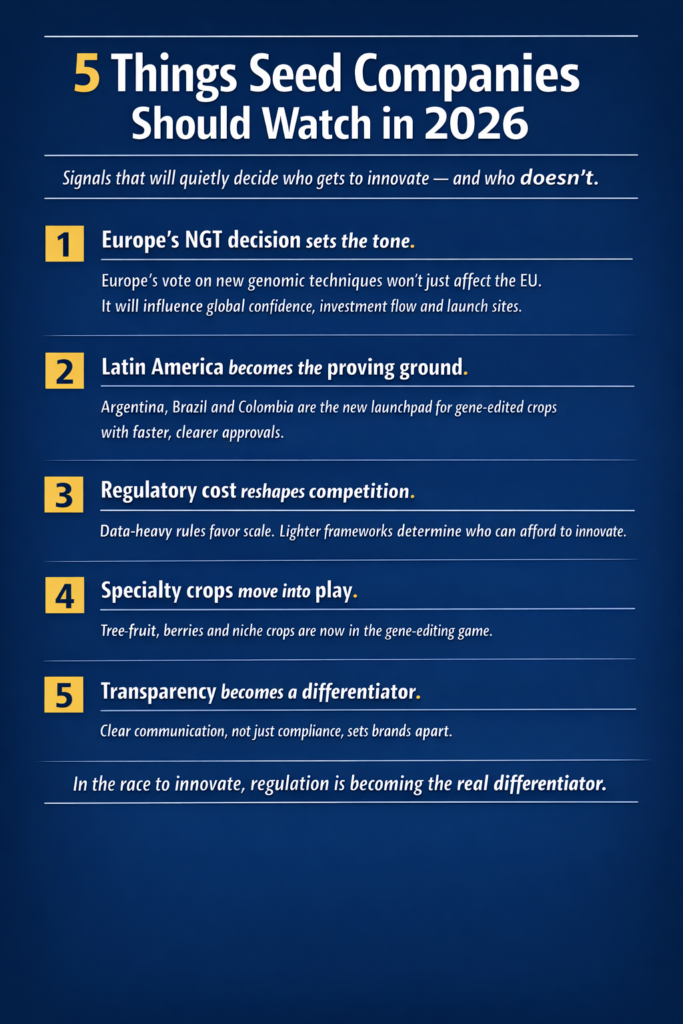
The new question is less about whether gene editing works and more about what happens next. Will regulatory frameworks create space for broad innovation across crops and companies, or will they quietly narrow the playing field to only those who can afford the longest and most expensive path to market?
“Good policy really fosters investment,” says Daniel Jenkins, Pairwise vice president, regulatory and government affairs and a veteran leader in agricultural regulatory strategy. “That’s what’s happened in Colombia, and that’s what’s happened in Argentina and other places.”
Jenkins delivered the message during a recent Council for Agricultural Science and Technology (CAST) and Society for In Vitro Biology (SIVB) webinar. It wasn’t about a single crop or a single company. It was about the next decade of plant breeding and the policy choices that will determine its shape.
Speed Changes The Breeding Equation
In plant breeding, time has always been one of the most unforgiving constraints. Even with modern tools, moving traits through development pipelines has traditionally been measured in years or decades. Gene editing compresses that timeline, not by replacing breeding, but by accelerating what breeders can test, refine and deploy.
“One of the biggest powers that this technology has is the speed at which you can get things done,” Jenkins says.
That speed is not theoretical. Jenkins pointed to examples in corn where edits allowed developers to explore trait outcomes with a level of precision and iteration that conventional breeding simply cannot match at the same pace. Instead of waiting through long breeding cycles, breeders can test multiple outcomes quickly and identify what works best in the field.
“We were able to make all of these different varieties with 16 rows or 18 or 20 or 22 all the way up to 32,” he says. “We could make all those varieties and then take them to the field and test them and figure out which one gave you a yield increase without decreasing the weight of those kernels.”
The point, Jenkins emphasized, is that gene editing changes the rhythm of innovation. Seed companies can move faster, learn faster and respond faster to breeding challenges that are only intensifying as climate volatility, input costs and supply chain pressures reshape agriculture.
“That’s pretty incredible,” he says.
The Science Is Advancing. Regulation Is The Constraint.
As gene editing accelerates, Jenkins argues the seed sector is running into something more complex than technical difficulty: regulatory frameworks still anchored in older assumptions. Too often, gene editing is approached through the same lens used for transgenic GMOs, even when the underlying biology and risk profile are fundamentally different.
“There’s a fundamental challenge here globally with respect to gene-edited products,” Jenkins says. “It’s a GMO mindset.”
That mindset becomes more than an abstract policy problem when it turns into data demands that accumulate quickly across crops, traits and breeding lines. Gene editing enables breeders to work across multiple varieties simultaneously, but regulatory systems are not always structured to handle that reality.
“Even really light data requirements will lead to overwhelming a system when it comes to these genome-edited plants,” Jenkins says.
He points to the compounding questions developers face as they move from concept to field.
“Do we have to generate data for every guide that we used to reach a target and edit it? For every line within a variety? For every crop?” he asks. “That adds up really fast.”
For large multinationals, those burdens may be manageable. For smaller seed companies, independent breeders and startups, Jenkins notes, the weight can be existential.
“A smaller company will be less able to handle that than a big one,” he says.
Policy Design Is Shaping Who Gets To Innovate
Jenkins returned repeatedly to the idea that regulation is not a neutral backdrop. It actively determines who innovates, where development happens and how concentrated the marketplace becomes.
“You can see what the effects these different policy approaches have on market concentration,” he says. “Which sort of innovation curve do you want to be on?”
Frameworks that add cost, delay and uncertainty naturally advantage scale. The danger for the seed sector is that gene editing, a tool that could democratize breeding progress across crops and regions, instead becomes concentrated among the few players most able to carry regulatory weight.
In that sense, gene editing regulation is not just a scientific question. It is a market structure question.
A Blackberry Case Study With Global Implications
To make the stakes tangible, Jenkins turned to an example that might seem far removed from the world of corn, soy and major row-crop pipelines: blackberries.
“You probably don’t care that much about blackberries,” he told the webinar audience. “But I hope that you do by the end.”
What Jenkins meant was not that blackberries are suddenly the center of seed innovation. It was that specialty crops can reveal, in a practical way, what gene editing makes possible when regulation allows breeding progress to move efficiently. The blackberry story becomes less about fruit and more about what innovation looks like when barriers are lower and breeding goals focus on agronomic efficiency.
Developers have used gene editing in blackberries to create more compact plants, enabling higher-density planting and potentially reducing input needs while increasing productivity.
“We can do up to about three times the density,” Jenkins says. “We can get up to maybe a 50% yield increase or more.”
In an era when labor availability, water constraints and supply chain durability are shaping breeding priorities, those kinds of improvements matter, especially beyond the traditional biotech spotlight.
“It’s very reasonable to assume that it really can reduce the amount of water or other inputs to produce a lot more berries,” Jenkins adds.
The larger signal is that gene editing is increasingly being applied to architecture, resilience and production efficiency, not just the blockbuster traits that defined earlier biotech eras.
Latin America Is Quietly Leading The Way
While much of the global conversation focuses on Europe, Jenkins argues that some of the most pragmatic regulatory momentum is happening elsewhere. Latin America has emerged as a region where gene editing policy is often more clearly aligned with product-based principles.
“Argentina came out first in 2015 with really good policy,” Jenkins says. “It fundamentally comes down to showing that you have a lack of a transgene.”
That interpretation has created room for a broader range of developers, crops and traits.
“What you see is a real flourishing of diversity in the marketplace,” Jenkins says.
Countries such as Colombia have adopted similar approaches, offering faster determinations and clearer early-stage navigation for gene-edited plants. For seed companies weighing where to invest and trial next-generation traits, Jenkins’ message was implicit: geography is no longer just about climate. It is increasingly about regulatory feasibility.
Europe’s Reset Could Reshape Global Alignment
Europe’s earlier decision to regulate gene-edited crops as GMOs slowed investment and created years of uncertainty. Now, Jenkins says, the EU may be moving toward a different framework.
“The EU is really doing a great job of turning the ship around,” he says, pointing to proposed rules that would exempt certain gene-edited crops from GMO classification.
Because Europe remains a major market and a global regulatory signal-setter, its stance has consequences far beyond its borders. Exporters, breeders and trait developers watch Europe not only for access but for precedent.
“If Europe moves forward, then maybe South Africa will also,” Jenkins says.
For global seed trade, alignment matters as much as approval.
Transparency Is Becoming Part Of Commercialization
Consumer response to gene editing has often been framed as an obstacle waiting to appear. Jenkins suggested the evidence so far tells a different story.
“We monitor worldwide media uptake and sentiment,” he says. “What we’ve seen has been really surprising and very positive.”
Rather than treating gene editing as something to obscure, some developers are choosing transparency as part of trust-building and differentiation.
“We think it’s an opportunity to talk about the benefits of the product,” Jenkins says. “Not only that this is the technology, but what the impacts are that these kinds of products can bring to the world.”
In gene editing, communication is increasingly part of the pathway to market, not an afterthought.
The Next Question Isn’t Can We Edit. It’s Who Gets To.
Jenkins sees the global direction moving toward lighter-touch regulation focused on the absence of foreign DNA.
“The global trend is very much toward low-burden regulation,” he says.
But flexibility is essential, he argues, because gene editing does not fit neatly into old models built around one-time trait approvals and slow introgression pathways.
“Regulations have to be flexible,” Jenkins says. “They have to allow early-stage submissions with multiple traits across multiple lines and crops.”
At stake is not simply how fast gene editing advances. It is whether innovation becomes broadly distributed across the seed sector or concentrated among those most able to carry regulatory weight.
“Like products should be treated in like ways,” Jenkins says.
Gene editing will not ultimately be limited by what is possible in the lab. It will be limited, or enabled, by what is possible on paper. In the race to innovate, policy may be the most important breeding environment of all.