The pressure building across the produce system isn’t starting in the field anymore. It’s starting earlier — at the level of genetics, trait selection and what the seed industry decides to prioritize next.
Consumer expectations are shifting. Retail is consolidating and moving faster. Growers are absorbing rising costs, climate volatility and labor shortages. Each force originates in a different part of the value chain, but all of them are pushing upstream.
Toward seed.
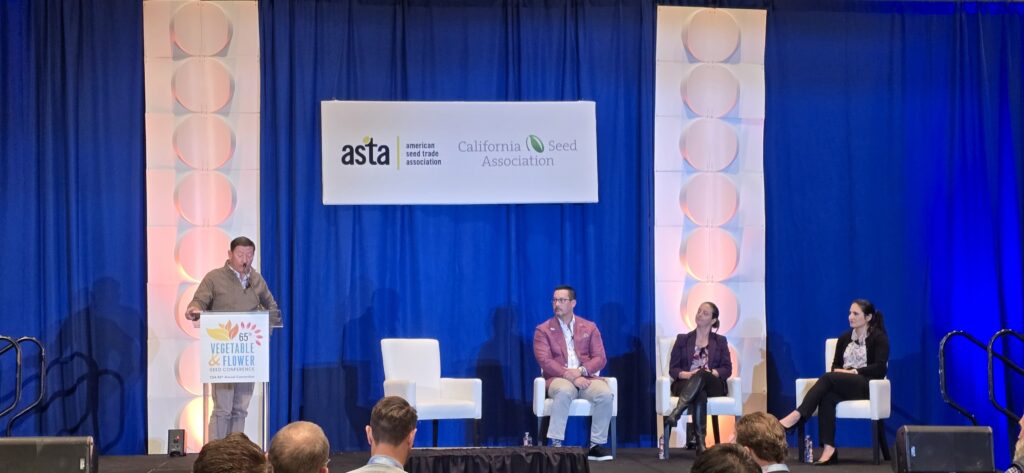
At the American Seed Trade Association (ASTA) Vegetable and Flower Conference in San Diego, a panel featuring Randy Riley of Golden Sun Insights, Alicia Rihn of the University of Tennessee and Jeana Cadby of Western Growers made one thing clear: the industry is no longer reacting to downstream signals. It’s being asked to anticipate them.
And increasingly, the ability to do that begins before anything is planted.
The Consumer is Reshaping the Starting Point
Alicia Rihn, University of Tennessee agricultural economist who studies consumer behavior in horticulture, says the pandemic didn’t just create a temporary surge in plant interest — it permanently altered who is participating in the market and why.
“We had 16 to 18 million new people start gardening during the pandemic. That was a huge bump to our industry, and what’s notable is that a fair number of those people stayed engaged after that initial spike,” Rihn says.
The motivation behind those purchases looks different than it did even a decade ago.
“The number one thing people told us was driving them to garden and interact with plants was mental health. The second was participating in a personal, enjoyable activity,” she says. “That tells you this isn’t only about aesthetics or production. It’s about how people feel.”
Those motivations are especially pronounced among younger consumers.
“These are sticky trends, particularly among millennials and Gen Z, and those groups are our future buyers,” Rihn says. “They’re prioritizing wellness, sustainability, biodiversity and local connections in ways that are shaping purchasing decisions.”
But she cautions that intention and action don’t always align.
“There’s so much variability among consumers,” Rihn says. “They’ll say they value something — local production, sustainability, pollinator support — but when they’re standing in front of a product at a certain price point, the decision becomes more complex. Do they buy? Do they substitute? That’s the tension we’re trying to understand.”
And that tension matters upstream.
“Ultimately, the end consumer doesn’t know unless we tell them,” Rihn says. “If we don’t communicate the value of what’s being produced, it’s difficult for that value to be recognized at the point of purchase.”
Retail Moves Faster Than the Value Chain
If the consumer is setting the tone, retail is setting the tempo.
Randy Riley, Golden Sun Insights, says the structure of grocery retail alone should change how the seed sector thinks about its role.
“If you take number one through five and add all their share together, these five retailers represent more than 50% of all of the share in America,” he says. “Twenty years ago, that same chart, those top five were less than 15%, so things are shifting dramatically at retail.”
That consolidation has created an environment where speed, differentiation and alignment matter more than ever.
“Retailers are probably in the most competitive environment they ever have been in the last 20 to 30 years. Typically, chaos is followed by behavioral change,” Riley says.
At the same time, he says younger shoppers are fragmenting loyalty and shopping across channels, adding complexity to an already pressured system. Retailers are responding by pushing for innovation, efficiency and products that give them an edge.
“You can help them meet the consumer expectations, and you can certainly help them with competitive advantages… where there seems to be misalignment is their desire to go fast and your inability to match that,” Riley says.
His broader point lands squarely on alignment.
“How do we put the consumer in the middle of the conversation? How do we understand what they want, and then how do we all take a seat at the table to satisfy those challenges?” Riley asks.
Growers Carry the Pressure
If retail is moving quickly, growers are holding the system steady under mounting strain.
Jeana Cadby, Western Growers director of environment and climate, says the economic reality facing producers is stark.
“The cost of compliance for fresh produce has gone up over 63%… and that’s all while the farm gate prices are relatively stable,” Cadby says. “That means growers are absorbing a lot of that cost.”
Layer on labor shortages, climate variability and global competition, and the margin for adaptation narrows.
“Labor is a significant challenge for fresh produce,” she says. “One of the fastest changes we’ve been able to see are things like laser weeders and automation tools becoming accessible.”
Climate pressure is reshaping production environments as well.
“We also anticipate more pest pressure in areas that we have never seen before… that minimum temperature for pests to be productive is going up,” Cadby says.
The long-term question is existential, not operational.
“How do we keep California farmers farming? How do we make sure they can still do that 10 or 20 years from now?” Cadby says.
For many growers, the answer increasingly depends on what arrives upstream — disease resistance, climate tolerance, compatibility with automation and varieties designed for shifting production realities.
Sustainability Collides with Reality
Few issues highlight the tension between aspiration and execution more clearly than sustainability.
Consumers express strong support. Policymakers push for change. Retailers build strategies around it. Growers try to implement it. But outcomes often hinge on economics and practicality.
Cadby regularly sees that disconnect.
“Consumers can say all day what they want… do they actually want it? I don’t know,” she says, describing the gap between stated preferences and purchasing behavior, particularly around packaging and sustainability claims.
Price sensitivity remains a decisive factor.
“We live in a price-sensitive society,” Riley adds, noting that sustainability initiatives often gain traction only when they align with affordability and performance.
The challenge isn’t interest. It’s implementation. And implementation frequently circles back to genetics, production systems and the capabilities embedded at the seed level.
Automation Rewrites Expectations
Automation is no longer a future concept. It’s already influencing how crops are grown, harvested and managed.
Cadby points to the growing role of robotics, machine learning and digital tools in reducing labor dependence and improving efficiency.
“We’re seeing tools that can identify pests or diseases, inject microdoses of nutrients and reduce passes in the field,” she says. “Automation is huge.”
Each of those technologies carries implications for plant characteristics — uniformity, architecture, resilience and compatibility with mechanical systems.
The seed sector sits at the beginning of that redesign.
“If we know climate change is coming… how do we have more heat-tolerant crops, more cool-temperature-tolerant crops and anticipate those challenges now?” Cadby says.
Automation isn’t just about efficiency. It’s redefining what performance looks like in the field.
Where the Value Chain Reconnects
Across the conversation, one theme kept resurfacing: misalignment.
Retail wants speed. Growers need stability. Consumers want value, sustainability and affordability all at once. And the seed industry operates on timelines measured in years, not quarters.
Riley sees the friction clearly, and the opportunity that comes with it.
“At some point in time, we have to quit talking about being frustrated. We have to sit down and start to work through all of these solutions,” he says.
The solutions won’t come from one part of the chain alone. They’ll come from collaboration, earlier alignment and a clearer understanding of what success looks like at every step — from genetics to shelf.
The seed sector sits at that intersection.
Not just as the beginning of the product, but as the starting point for how the system adapts to what comes next.