
Developers are stacking speed, transparency and value chain buy-in to move gene edited traits from pipeline to commercialization without repeating the baggage of past biotech fights.
Gene editing has reached a point the seed industry once described as a breakthrough moment.
Proof of concept is no longer the barrier. CRISPR works. Developers can knock out genes, fine tune sequences and stack edits with precision. They can move from target identification to field testing in a fraction of the time conventional programs once required.
But as gene editing matures, another reality has come into focus. The science accelerates. Commercialization does not.
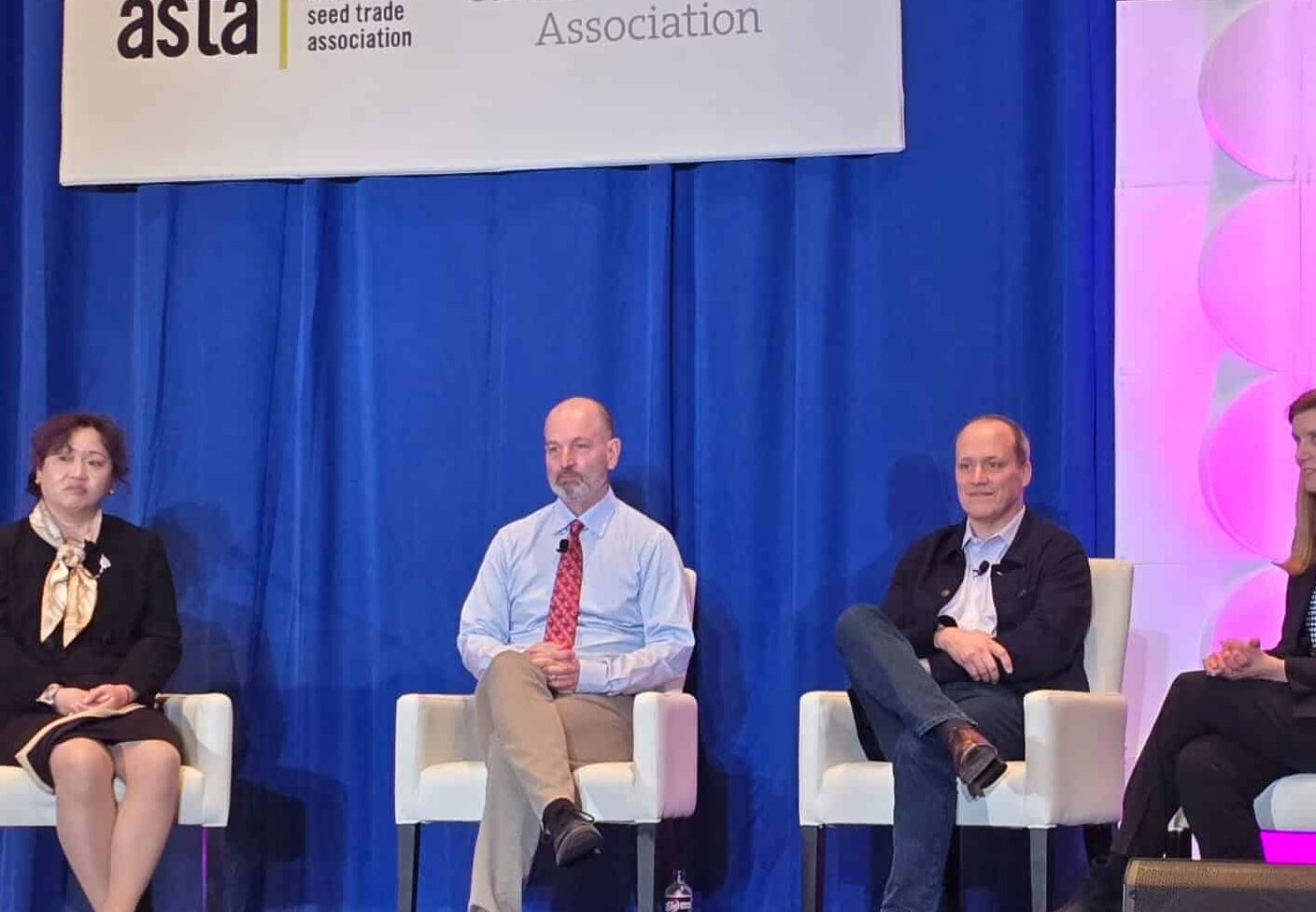
That tension surfaced during a discussion at the American Seed Trade Association Vegetable and Flower Conference on the road from concept to crop. The message was clear: speed in the lab does not automatically translate to speed on the shelf.
The real work begins after the edit. A panel at the 2026 American Seed Trade Association (ASTA) Vegetable and Flower Seed Conference addressed the road from concept to crop to market.
CRISPR Speeds Breeding. It Does Not Replace It
Pairwise vice president of regulatory and government affairs Dan Jenkins says says gene editing accelerates breeding, but it does not replace it.
“One of the important points about CRISPR that isn’t always mentioned is that you’re still doing whatever you’re doing in a breeding program,” Jenkins says. “This just helps it go faster, makes it more efficient. Those costs lower barriers to doing the kinds of things that you want to do.”
He points to projects where his team identifies a target, generates multiple edited variants and advances them into the field quickly enough to evaluate yield, quality and stability within three years.
That compressed timeline matters in crops facing mounting pressure from labor shortages, supply chain volatility, food security concerns and consumer expectations around flavor and quality.
“We’re trying to address a lot of these challenges that we face right now, food security, human health, labor supply, supply chain,” Jenkins says. “We feel that plants have all the information that we need to make these things happen, but it’s up to us to deploy.”
Still, speed does not eliminate the need for multi season validation, regional testing and commercial scale proof. A faster edit does not remove the requirement for durable performance.
Breeding remains breeding. CRISPR simply gives breeders sharper tools.
The New Bottleneck Is The System
If the science has advanced, the commercialization pathway still demands strategy.
Lark Seed Technology director of seed technology yao luo focuses on how smaller companies can use gene editing without absorbing the cost structures of larger biotech developers. She describes efforts to design editing systems that avoid foreign DNA and simplify regulatory review, particularly in processing tomato where disease pressure and post harvest losses erode margins.
Her broader point resonates beyond tomatoes. If gene editing remains expensive, complex and duplicative across regulatory agencies, only the largest players will use it widely. If developers can streamline submissions and align with regulatory guidance early, more companies can participate.
The regulatory landscape itself, Jenkins says, is not as restrictive as many assume.
“Generally speaking, the gene editing regulations are in a really good place,” Jenkins says. “I don’t consider them to be much of a burden at all in most of the places we are.”
The challenge is not whether a gene edited plant qualifies for exemption or review. The challenge lies in navigating multiple agencies, timelines and markets while building a coherent commercialization story.
That story must satisfy regulators, retailers and consumers at once.
Transparency Is Part Of The Commercial Strategy
Consumer acceptance continues to shape boardroom conversations, but developers describe a more nuanced reality on the ground.
Pairwise places QR codes on its packaging that link to product benefit pages. Jenkins says the company prioritizes transparency but focuses messaging on outcomes rather than technical detail.
“We think that’s an opportunity not to try to explain to the public the details of molecular biology and genome,” Jenkins says. “It’s to explain the benefits of the product itself.”
Then he adds a revealing data point.
“The number of people that have scanned that QR code is remarkably low,” Jenkins says. “It’s not really an issue so much if you give it a great experience.”
The implication carries weight. Consumers respond first to taste, freshness, price and performance. They value transparency as an option, but few dig into molecular explanations before placing produce in a cart.
That does not diminish the need for openness. It reframes it. Transparency supports trust. It does not replace product quality.
Value Chain Alignment Still Determines Success
Simplot Plant Sciences director of regulatory affairs Gary Rudgers says commercialization succeeds when every segment of the value chain sees a reason to participate.
“Engaging with the value chain along the whole process is very important,” Rudgers says. “Having a story of why the farmer, processor, the retailer and the consumer wants these products is very important, because everyone wants a piece of the pie.”
Simplot’s experience with genetically modified potatoes provides a long-term case study. The company develops varieties with reduced bruising and disease resistance. Farmers see fewer losses in storage. Processors see higher quality inputs. Retailers see less shrink. Consumers see fewer black spots and better appearance.
The same logic guides new gene edited strawberries that extend fruiting windows and shelf life.
“If you ever buy strawberries that look good and have no flavor, that’s not what we want,” Rudgers says, describing varieties that produce fruit longer and maintain taste and shelf life, which reduces waste across the chain.
He said the technology itself does not close the sale. The aligned value proposition does.
Rudgers says early engagement with regulators also smooths commercialization.
“We found that talking to the agencies about our products before we submit the notification really streamlines the process,” he says.
Over time, agencies become familiar with the technology. Review times shorten. Developers gain clarity.
But that efficiency only emerges when companies invest in education and communication up front.
The Industry Must Leave Old Fights Behind
Gene editing still carries the shadow of earlier biotech battles. Jenkins argues that the industry itself sometimes perpetuates outdated narratives.
“A lot of times, industry is in its own way too,” Jenkins says. “We all have some of these battle scars from the past and bring that into regulatory discussions.”
He urges companies to treat gene editing as what it is.
“It’s just another tool to achieve a breeding outcome,” Jenkins says. “That’s all it is.”
That framing shifts the conversation away from ideology and back to agronomy, quality and performance. It encourages companies to present gene editing as a refinement of plant improvement rather than a disruptive break from it.
From Concept To Crop Requires More Than A Successful Edit
Gene editing has compressed timelines and expanded what is technically possible. Developers can move from idea to field in record time. They can stack traits, reduce waste, extend shelf life and strengthen resistance with surgical precision.
But commercialization still runs at the speed of systems. Regulatory pathways require coordination. Retailers require confidence. Consumers require value. Supply chains require alignment.
Gene editing may be getting faster. The road to market still demands patience, collaboration and strategic clarity.
For seed companies, the takeaway is not to slow down innovation. It is to build commercialization muscle alongside it. The edit may take months. Trust, alignment and adoption still take years.
And in today’s plant breeding landscape, both timelines matter.