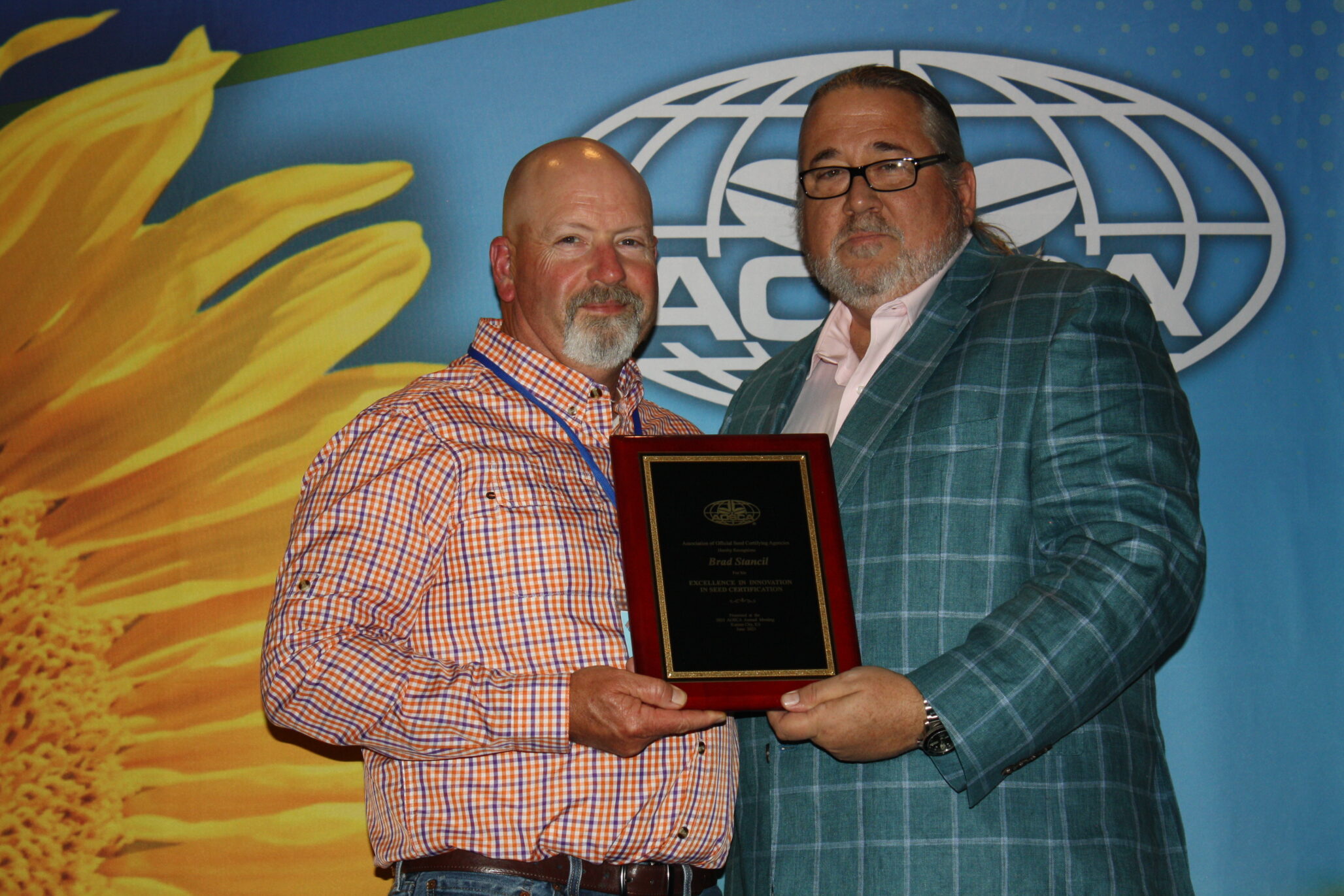
AOSCA’s Excellence in Innovation recipient talks working inside certification and regulatory systems that are evolving alongside changes in seed technology, ownership and on-farm decision-making.
Brad Stancil’s role connects regulatory programs with seed certification, putting him in a position where fieldwork, compliance and logistics intersect every day. He manages inspectors who handle both fertilizer and seed responsibilities, a structure that reflects how tightly those systems are linked in practice.
“We have inspectors that do dual duties, so they do their fertilizer inspectors as well as seed inspectors or seed certification inspectors do the day to day… administrative work to handling putting out fires, okay, anything in between,” he says. “Our view is just always trying to find a way to make it better for the guys, better for what they do, easier for what they do… make it more efficient.”
That focus on efficiency comes from watching where systems break down in real time. Rather than changing the work itself, much of his effort has gone into reducing the number of steps it takes to get that work done.
Simplifying Systems Without Changing the Work
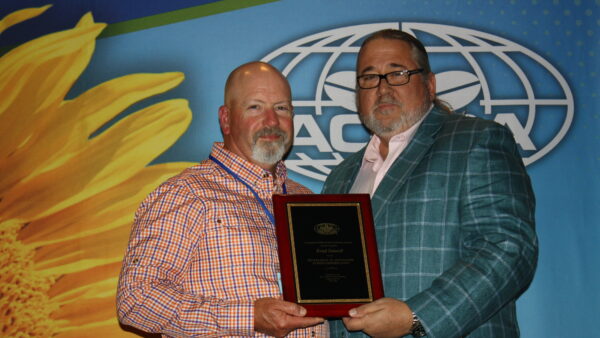
That approach led Stancil to develop a new inspection entry system. That work earned Stancil the 2025 Association of Official Seed Certifying Agencies (AOSCA) Excellence in Innovation award. Inspectors reshaped the tool based on how they actually used it, rather than the original design.
“The reward was for creating… an app, that is now really just a website,” Stancil says. “The guys didn’t like the app, so we converted it… so they could enter all of their fertilizer inspections and seed inspections all in one place.”
Before that change, inspectors were navigating multiple systems just to complete routine tasks.
“There was several logins… VPN, databases, complicated forms,” he says. “Now they’re very simple web forms and it’s pretty easy for them.”
The process itself didn’t change, but the friction around it did.
Adapting to Changes in Seed Technology
As seed technology has advanced, Stancil says certification programs have had to adjust, particularly as more traits move into private systems.
“I think the biggest gap is with seed technology and the lack of public breeders. Certification has diminished as more breeding has become private.,” he says. “The private companies have chosen not to use seed certification as part of their seed production systems.”
That shift has changed how certification fits into the broader system.
“That’s the biggest issue… trying to figure out a way that we can provide a service to those companies,” he says. “It may not be traditional certification, but if we can… ensure that farmers are getting what they pay for, then I’m all for that.”
Subhead: Tracking Seed from Production to Use
One area where certification continues to play a defined role is traceability. Stancil points to the ability to track seed from origin through planting as a key function that remains relevant.
“I think that we have a great opportunity to provide value… by being able to track their seed from breeder seed to wherever it’s planted,” he says. “That gives great value to protect their intellectual property.”
In South Carolina, turfgrass is a major part of that system.
“We have a lot of acres certified turf grass, about 7,000 acres now,” he says. “We can always keep track of what’s going on with a variety.”
Biologicals And Regulatory Pressure
Beyond seed, Stancil says biological products are adding complexity to regulatory programs, particularly when it comes to verification.
“The biologicals are a strain on us,” he says. “I’m not a microbiologist, and it’s hard to keep up with all the strains of bacteria… are they in there? Are they not in there?”
Methods for confirming product claims are still limited, which makes evaluation difficult.
“There’s not very good methods to determine whether they’re a good product or not,” he says. “It’s also a strain for farmers as they wonder ‘is this going to make me money?’”
That question continues to anchor decision-making at the farm level.
The Role of Certification Programs
Stancil says certification programs are designed to support consistency, even if they are sometimes viewed as barriers.
“I think sometimes there is a belief that as regulatory agents we make things more difficult, but we are here to level the playing field for businesses and here to protect consumers and add value to products with certified tags,” he says.
That role is tied to verification and identity.
“We know where it came from. We know what it is. We know that it is this variety… and it has a tag on it,” he says. “If you meet those thresholds, then you really have a good product.”
Adaptability Is Becoming Central
Over time, Stancil has seen certification shift from a rigid system to one that is more responsive to industry needs.
“When I first started, it was pretty rigid,” he says. “And now it’s almost a 180 — hey, what can we do?”
He believes that shift is shaping how certification may evolve in the future.
“I think that being adaptable now is the big key. Being able to provide a service that somebody needs is valuable,” he says. “There will be an eventual shift more to DNA testing… more drones, maybe even AI.”
At the same time, he notes that demand for certified seed has changed over time.