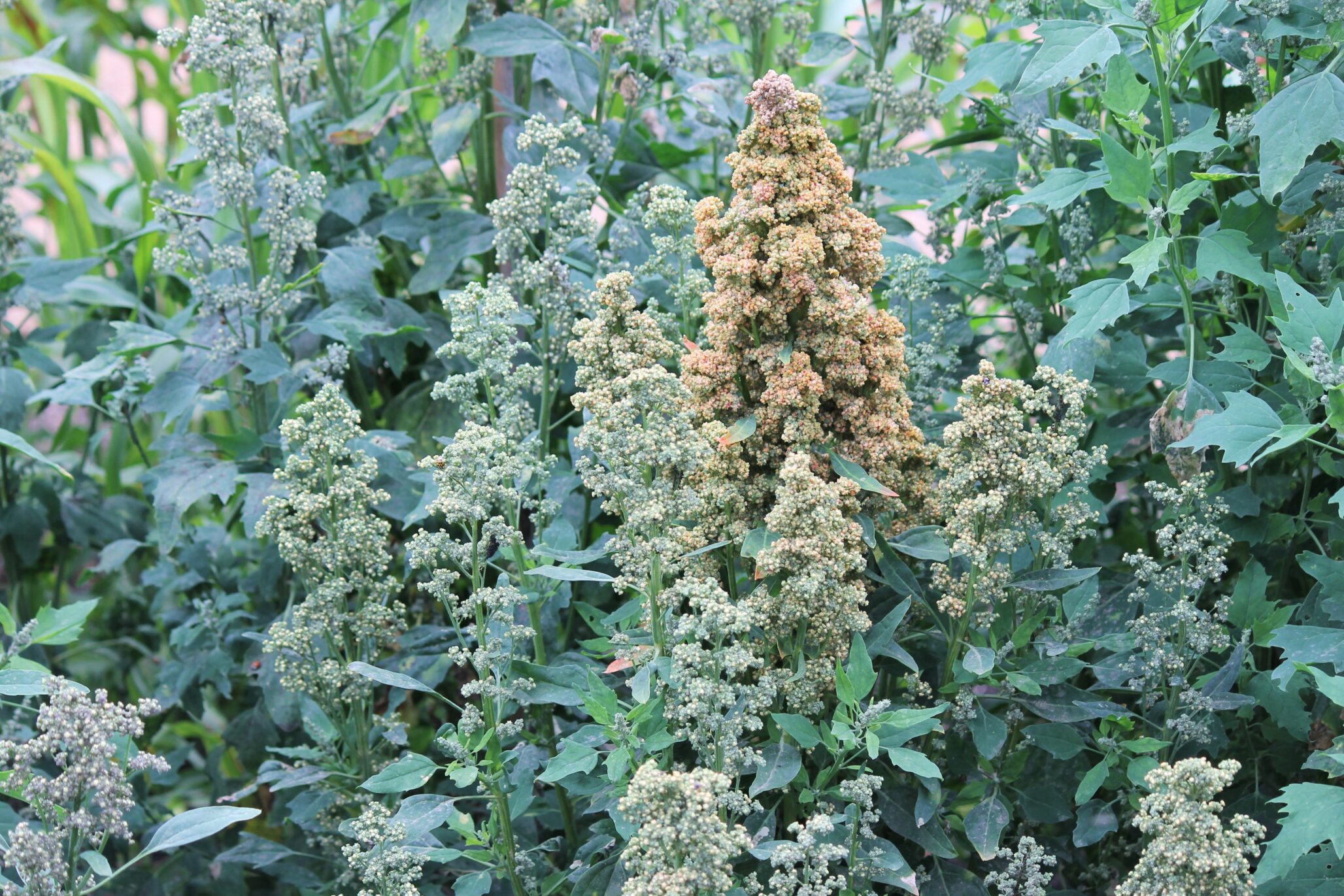
Quinoa is gaining ground as a productive option in the Cuyo region, and INTA has taken an important step toward its consolidation. Research conducted in San Juan found that the crop can complete its cycle and achieve competitive yields using only half the water suggested by international benchmarks. The finding is strategic: it provides, for the first time, locally generated and precise data on quinoa’s water requirements under irrigation—an essential input for production decisions in the region.
According to Nadia Bárcena, a researcher at INTA San Juan, the study evaluated quinoa’s response to different irrigation regimes to determine how much water it truly needs to reach its productive potential under local conditions.
“What we are seeing regarding the different treatments applied in terms of water use, is that with 50% of the total required according to the bibliography we achieve good potential yields, with about 1700 kilos per hectare,” Bárcena explained. This handling is equivalent to a cumulative sheet of between 260 and 290 millimeters during the crop cycle, a value significantly lower than that taken as a reference from data from countries where quinoa is native.
The outcome is significant. Under this irrigation level, quinoa completes its development with a yield reduction of only 10–20% compared with the theoretical maximum, without major losses and while maintaining good grain quality, according to a press release.
“In addition to not registering significant drops in performance, we observe adequate quality, although the size of the grain can be slightly affected,” the researcher detailed.
The study already accumulates three consecutive campaigns and is carried out with the Morrillos INTA variety. Throughout that period, the team evaluated the behavior of the crop against different water contributions, with a system that allows measuring and adjusting each variable. Drip irrigation is a centerpiece of the experience.
“The application is localized and uniform, which further increases the natural efficiency of quinoa. In turn, it is the most appropriate way to precisely control the amount of water applied,” Bárcena said.
Quinoa is a hardy crop that can develop in arid environments, but it is highly sensitive to excess water and prolonged waterlogging. For that reason, precise irrigation management is critical to avoid problems during the growing cycle. In furrow systems, irrigation must be handled with extreme care and is strongly limited by soil drainage, while drip irrigation allows more accurate control of both application rates and timing.
“This leads us to have greater water savings, which is a very important factor for the province and for the region, because we can know and control how much water is needed to complete the crop cycle,” said the INTA specialist. This concrete knowledge is precisely one of the main contributions of the work.
Until now, Argentina lacked its own data on quinoa water use under irrigation. In northern provinces such as Salta and Jujuy, production is largely rainfed, supported by fallow management to store moisture in the soil profile. In Cuyo, by contrast, cultivation relies on pressurized or gravity-fed irrigation systems, making locally generated, reliable parameters essential.
Against this backdrop, INTA San Juan’s work provides a strong foundation for producers, advisors, and technicians considering quinoa. With field-measured data, adapted varieties, and clearly defined irrigation practices, the crop gains predictability and emerges as a practical option to diversify the region’s production matrix.