New genetic tools and germplasm insights are positioning allergen reduction as a commercial trait in peanut seed.
Peanuts rarely anchor conversations about breakthrough innovation in the seed sector. The crop delivers consistency, dependable acreage and well-understood breeding priorities. Yield drives decisions. Oil profile shapes markets. Disease resistance anchors variety development. Allergens rarely enter that discussion.

That is starting to change as breeders look toward consumers and begin targeting the proteins that trigger allergic reactions while protecting agronomic performance and end-use quality. Clemson University associate professor of molecular breeding Sachin Rustgi has spent years building a pipeline that treats allergen reduction as a breeding objective rather than a downstream food-processing problem.
“We started with the evidence-based premise that naturally occurring peanut genotypes exist with deficiencies in one or more of the major immunogenic proteins,” Rustgi says. “If variation already exists, breeding can harness it.”
Where Natural Variation Changed the Starting Point
Rustgi’s team began by searching for variation across global germplasm rather than attempting to immediately engineer it. The program screened the U.S. peanut mini-core collection, international accessions, historical varieties from multiple decades and wild relatives. The goal focused on identifying where allergen proteins naturally accumulate at lower levels.
“These screenings enabled us to identify genotypes, particularly among wild peanut relatives, with reduced levels of one or more immunogenic proteins,” Rustgi says.
That discovery allowed the team to begin combining those naturally lower-allergen traits through traditional breeding. By crossing lines that each lacked certain allergen proteins, they worked to bring multiple reductions together in a single peanut line.
“We used these genotypes in crossing programs with the objective of stacking their effects into single lines to develop genotypes with combined reductions in allergenic proteins,” he explains.
The team moved quickly from observation into genetic mapping. They analyzed seed protein composition, linked it with molecular signatures and identified genomic regions that regulate allergen accumulation.
“We analyzed these populations for seed protein composition and examined their correspondence with molecular patterns to identify genomic regions associated with these traits,” Rustgi says. “This allowed us to identify both cis-regulators and trans-regulators controlling allergen protein accumulation and to develop molecular markers to track key regulators.”
Markers give breeders leverage. They allow programs to select for a biochemical trait early in development rather than relying solely on repeated laboratory assays.
The team also tested a long-standing assumption about peanut allergy trends.
“Breeding and domestication processes are not responsible for the increase in peanut allergy cases observed over the past two decades,” Rustgi says.
That clarity reframes breeding’s role. Modern programs did not create the problem. But, they now have tools to address it.
Building A Multi-Gene Editing Platform
Alongside conventional breeding, Rustgi’s group developed a multi-gene editing platform to target several allergen genes simultaneously.
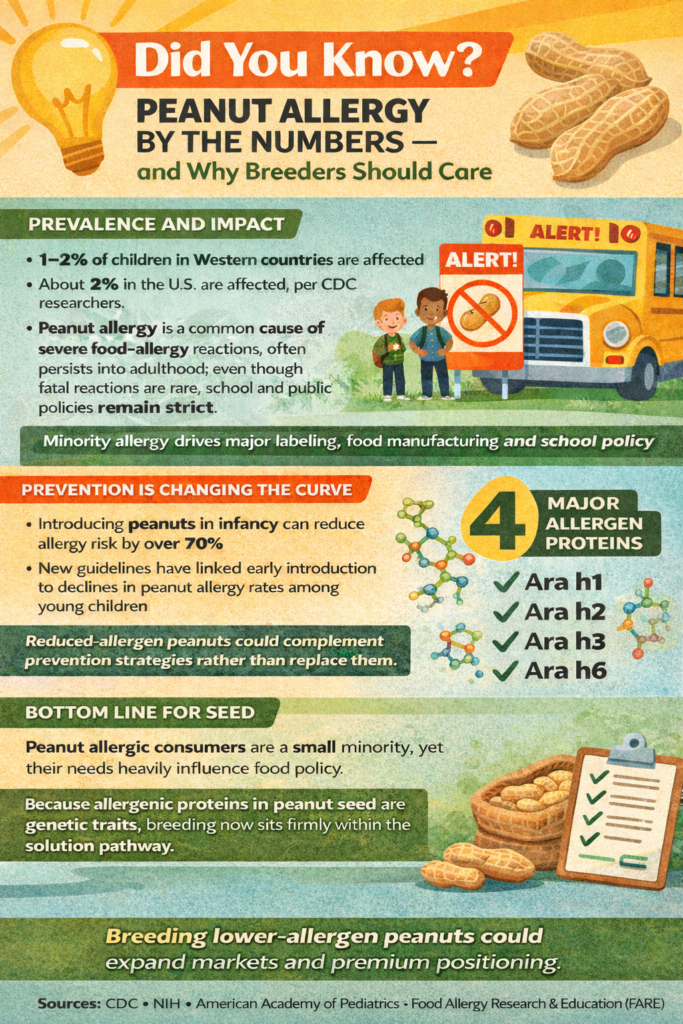
“We developed a multi-gene editing platform in peanut and evaluated different gene-delivery methods,” Rustgi says. “Guide RNAs were designed to target the major allergen genes Ara h1, Ara h2, Ara h3 and Ara h6.”
The team first tested their gene-editing tools in isolated peanut cells. They then introduced those edits into young plant tissue, grew full plants from that material and followed the changes over multiple generations. Finally, they confirmed that the edits actually reduced allergen levels through allergy-focused testing.
“We confirmed reduced allergen content in edited peanut genotypes using Western blotting with IgE from peanut-allergic individuals and basophil activation tests,” Rustgi says.
Researchers also evaluated how environmental conditions influence the trait.
“Heat stress during pod filling leads to reduced allergen content,” he notes.
Environmental sensitivity adds complexity and underscores the need for multi-location agronomic testing before release.
From Discovery to Validation
Today, the work sits between discovery and commercialization.
“This research has reached the validation phase,” Rustgi says.
The team has done most of the lab work and allergy testing. A few more steps will show whether the peanuts are ready for release. He says the team needs additional human cell line–based assays are to confirm reduced immunogenicity.
“We must evaluate these genotypes through feeding trials using humanized rodent models and through human skin-prick testing, followed by agronomic evaluations and quality assessments,” he explains.
Those milestones will signal whether reduced-allergen peanuts can move from experimental lines into production systems. Rustgi sees clear commercial relevance emerging as validation continues.
“These materials will serve as a premium product suitable for use in public spaces such as schools and airlines,” he says. “They reduce the risk of triggering an immune reaction and can also serve as an affordable source of oral immunotherapy.”
Existing infrastructure supports that transition.
“These genotypes can be processed using the same shelling and processing facilities currently employed to separate high-oleic peanuts from regular peanuts,” Rustgi says. “The existing production stream used for peanut-free products can also be leveraged.”
When Will Farmers See Usable Varieties?
Barriers remain. Testing these traits costs money. Preventing mix-ups requires extra care. And government approval can take time.
“Breeding for biochemical traits is challenging due to the associated phenotyping costs,” Rustgi says. “Additionally, such traits require approval from the U.S. Food and Drug Administration, which slows down potential release.”
Rustgi believes reducing allergens will become just as important as heat tolerance, pest resistance and food safety in peanut breeding over the next decade. He also says breeders need to pay attention to deeper genetic issues that affect long-term performance.
“One critical trait that has largely been overlooked is genomic stability,” Rustgi says. “Maintaining genomic stability involves suppressing recombination between the two peanut subgenomes, which can otherwise lead to unwanted genetic diversity or instability in released genotypes.”
In polyploid crops, stability influences uniformity, reliability and grower confidence. The path forward is simple to track: test them in the field, confirm the allergy results and move through approval. That’s when reduced-allergen peanuts become a commercial reality.
“Further evaluation in agronomic trials and immunological analyses, including feeding trials with humanized rodents and human skin-prick tests, will indicate readiness to seek approvals for release,” Rustgi says.
Breeders built peanuts around yield and quality. Now they are also reshaping them around protein composition and consumer response.