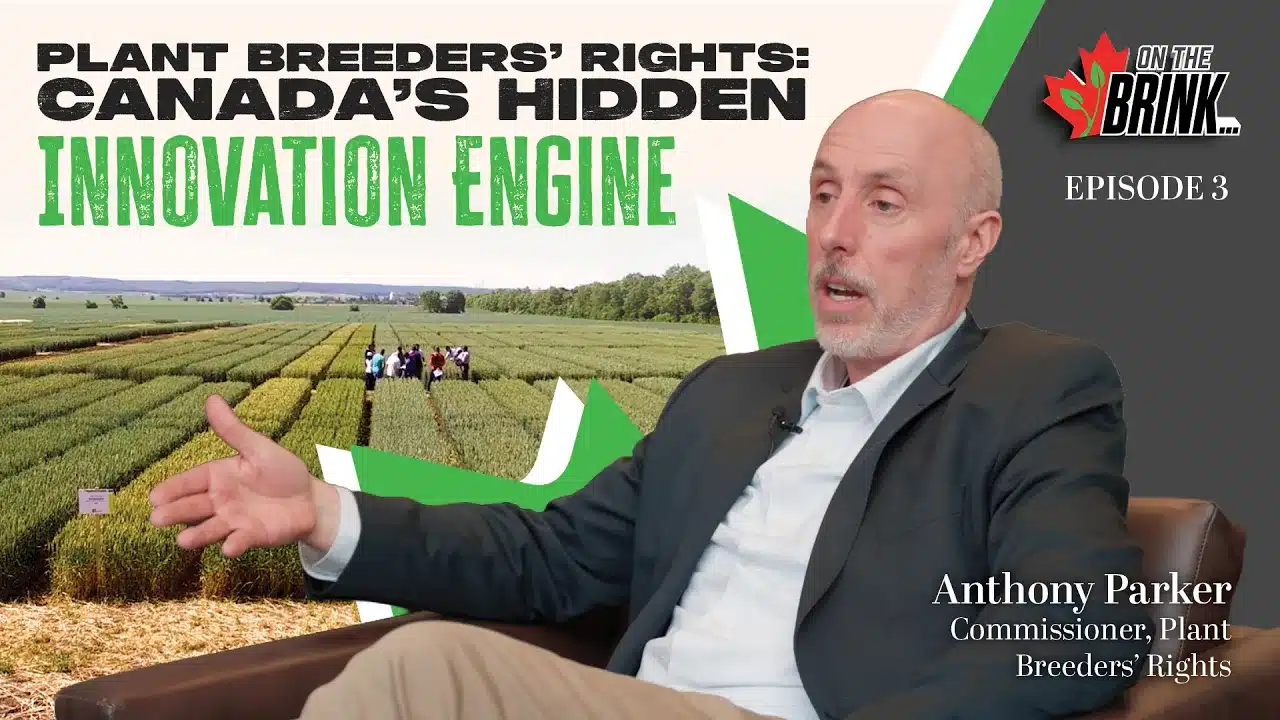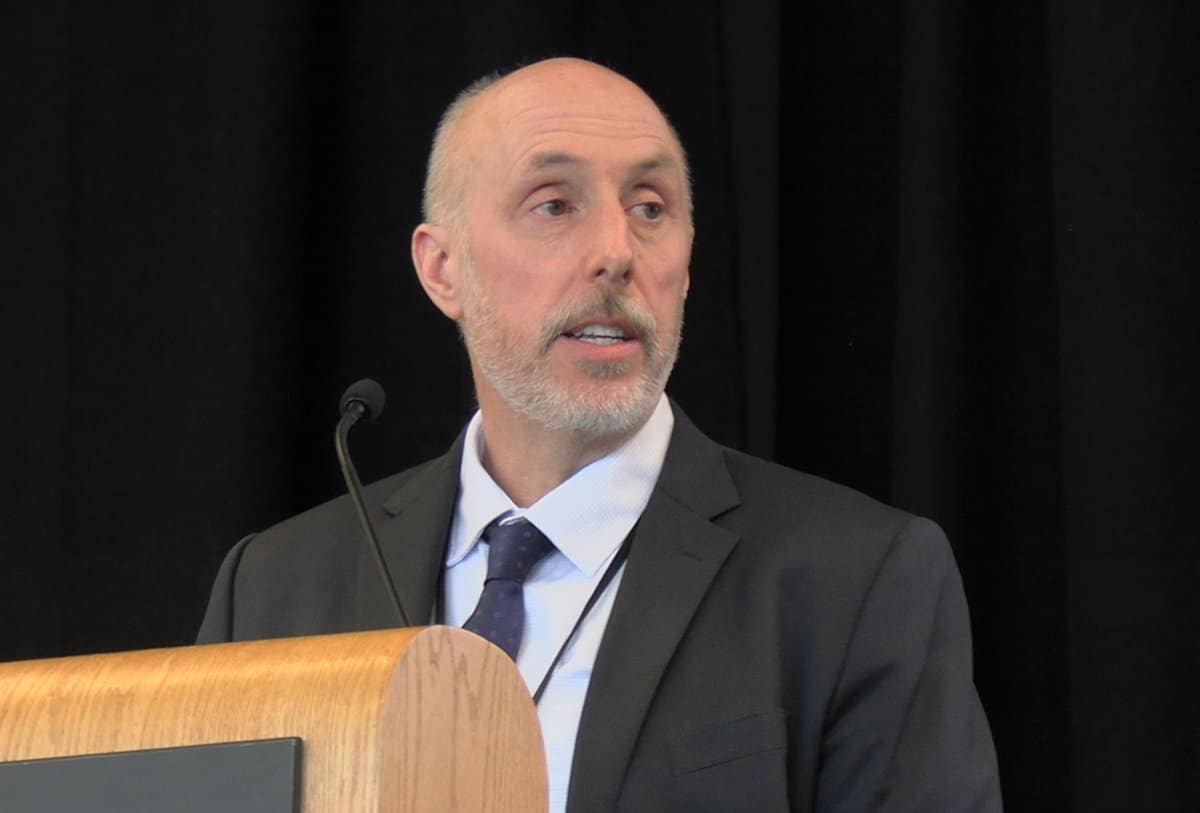
Plant Breeders’ Rights Commissioner Anthony Parker says collaboration between producers, public breeders and private companies will determine the future of crop innovation in Canada.
When Anthony Parker stood before the room at the Prairie Grain Development Committee meeting in Banff, Alta., yesterday, he began with a serious question that has hovered over Canadian agriculture for years: how should plant breeding be funded in the future?
Canada’s experience over the past decade offers both warnings and inspiration. And the recent announced cuts to Agriculture and Agri-Food Canada staff and research stations adds new urgency to the issue: plant breeding rarely makes headlines, but it quietly underpins the productivity of modern agriculture.
“Plant breeders’ rights are a form of intellectual property protection, no different than copyright or patents,” Parker explains. “We give creators special economic rights for a limited time because otherwise they would not create or innovate.”
Breeding new crop varieties requires enormous up-front investment. Years — sometimes decades — of work go into developing a variety before a single seed reaches farmers.
“Plant breeding is a long-term, expensive, resource-intensive activity,” Parker says. “All the costs are up front, and you expect to make back what you put out afterwards.”
That economic reality is why Canada joined the international system governing plant variety protection.
In 1991, the country became a member of the International Union for the Protection of New Varieties of Plants (UPOV), though it took another 24 years to modernize its legislation and align with the stronger UPOV ’91 framework.
The road there wasn’t easy.
“It took us three attempts in Parliament to bring a PBR Act into force,” Parker recalls.
What ultimately pushed Canada across the finish line in 2015 wasn’t bureaucratic effort — it was farmers and the seed industry working together.
“The people who moved this over the finish line were producers with the seed industry and the seed growers joining together and saying, ‘We need this to happen,’” Parker says.
“You’re the ones who made it happen. It wasn’t us.”
The Results: A Decade of Innovation
Ten years later, the impact of stronger PBR is measurable.
Overall filings for PBR in Canada have risen 35% since the country adopted UPOV ’91.
Some sectors have surged even further.
Fruit and vegetable breeding filings jumped tremendously, reflecting new investment and global collaboration.
One of the clearest examples is Canada’s greenhouse vegetable sector.
“There seemed to be a strong correlation between the moment we opened things up to innovation and a doubling of growth in that greenhouse sector,” Parker says.
Today, greenhouse production contributes $2.3 billion to the Canadian economy, driven largely by tomatoes, peppers and cucumbers — and increasingly by crops like strawberries.
These sectors operate with a highly competitive model: seed companies from around the world bring new genetics, and growers quickly test and adopt the varieties that work best.
“It’s really an open model for competition,” Parker says. “You come in, you try it out. Producers have choice. If it works, it works. If it doesn’t, you move on.”
And contrary to long-standing fears, international companies do breed specifically for Canada.
“One of the myths you’ve heard over the years is that a foreign company will not breed for a domestic market here,” Parker says. “That is not the case.”
Producer-Led Breeding: When Farmers Take Control
Other sectors have taken a different approach: farmers owning the breeding system themselves.
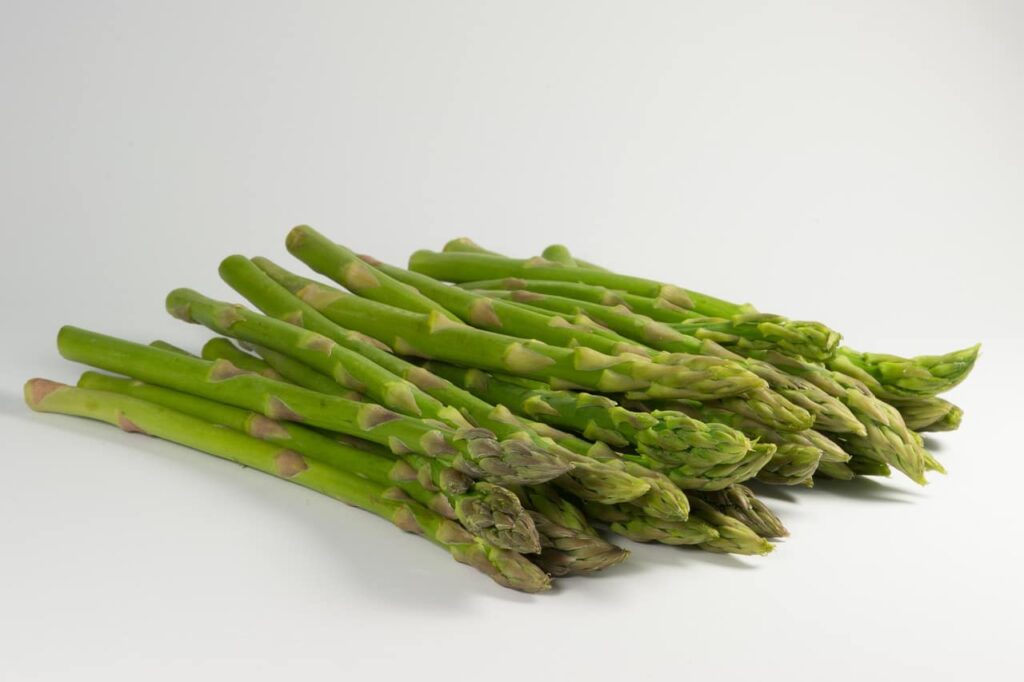
One standout example is Ontario’s asparagus industry.
In the late 1980s the sector was on the brink of collapse. Yields were low and varieties weren’t suited to Canada’s climate.
Growers partnered with the University of Guelph and hired breeder David Wolyn.
Twenty years later, the breakthrough came. The variety Guelph Millennium revitalized the industry, followed by even higher-yielding successors.
To commercialize the innovation, growers formed a for-profit company called Fox Seeds, now responsible for breeding and distributing asparagus genetics worldwide.
“They are a global powerhouse,” Parker says. “All the temperate asparagus varieties grown in Europe, the United States and Ontario come from Fox Seeds. They are number one.”
The model allows Canadian growers to receive new varieties first — while international markets help pay for the research.
Global Success from Canadian Orchards
Fruit growers have also developed innovative funding models.
In British Columbia, the Summerland Varieties Corporation manages licensing and commercialization of varieties developed by Agriculture and Agri-Food Canada.
The organization aggressively markets Canadian cherries worldwide.
Despite Canada having only about 6,000 acres of cherry production, Parker said the impact has been massive.
“Globally, 75% to 80% of cherry varieties now grown come from Summerland varieties,” he noted.
Again, the strategy is to give Canadian growers early access before licensing internationally.
“Canadian growers get the best innovations first,” Parker said. “Then they start licensing the varieties globally — so other countries are paying for our competitive advantage.”
Innovation with Community Impact
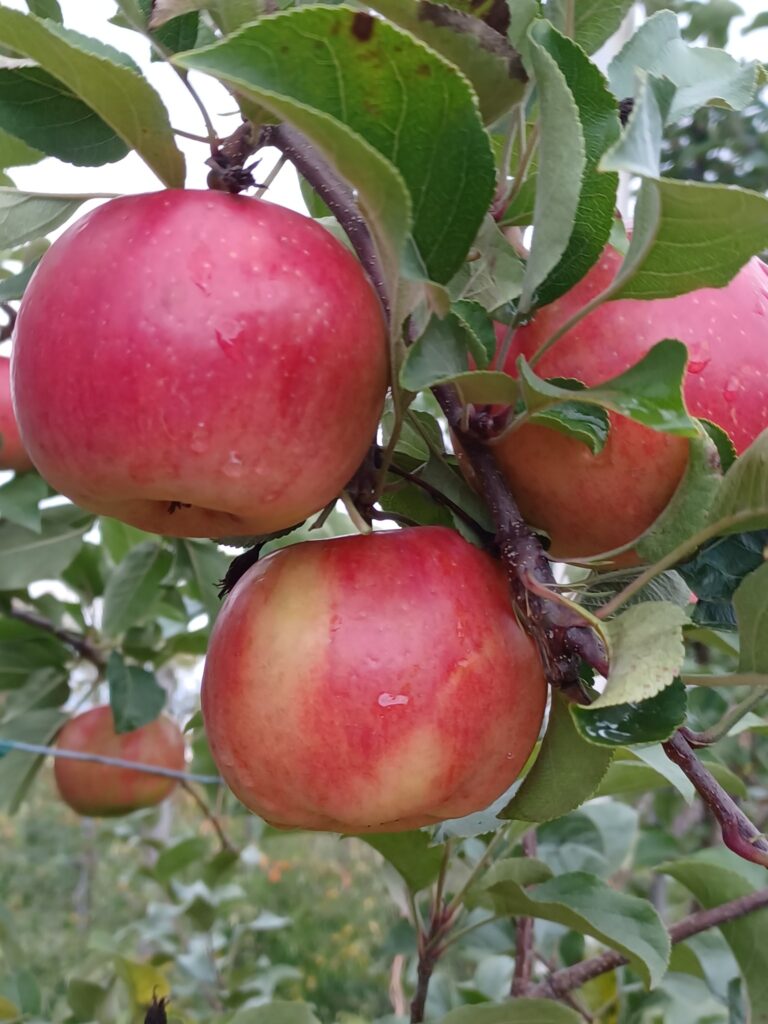
Perhaps the most remarkable example comes from Quebec’s La Pomme de Demain — “The Apple of Tomorrow.”
The producer collective funds its own breeding program and has released several successful apple varieties.
Their breeder has made more than 6,000 crosses in his lifetime. But his latest variety carried a deeper meaning.
The apple, named Ó:iase, was developed near Oka — a region known for historic tensions between local communities and the Mohawk Nation.
La Pomme de Demain’s breeder invited the Mohawk language centre to name the apple and pledged a share of royalties to support language revitalization.
The Mohawk language has only about 700 speakers left, Parker notes.
The program now supports students learning the language — funded by the success of a Canadian apple.
A Warning from the Cereals Sector
Despite success stories in other crops, Parker warned that Canada’s cereal sector may be facing a turning point.
Following the adoption of UPOV ’91, cereal variety filings initially rose over 50%. Private investment in particular increased dramatically.
But recent data suggests momentum may be slowing.
“From 2023 onwards, we’re starting to see the number of public varieties seeking protection sinking, and private varieties dropping off as well,” Parker says.
“Two negatives don’t make a positive.”
The decline raises a critical question: how should breeding in major crops like wheat be funded in the future?
According to Parker, Canada already has several working examples. Each crop sector can choose its own path.
“There is no one-size-fits-all solution,” he says.
Possible models include:
- Open private competition: Similar to greenhouse vegetables, where companies worldwide compete to provide new genetics.
- Producer-owned breeding companies: Like Ontario’s Fox Seeds, where farmers directly fund and control breeding.
- Public breeding with commercialization partners: The model used by Summerland Varieties Corporation.
- Producer cooperatives funding breeders directly: Similar to Quebec’s apple breeding initiative.
“PBR is not a solution in and of itself,” Parker says. “It is simply a tool. It’s you who decides what outcome you want.”
Perhaps the most important lesson from the past decade is that innovation systems only work when stakeholders work together.
“You need public, private and producer collaboration,” Parker says.
And while debates over plant breeding often become emotional, progress depends on cooperation.
“Cooperation allows you to move forward. Conflict and controversy get you stuck.”
Yet Parker remains optimistic.
Across the industry, stakeholders increasingly recognize that the current system may need to evolve.
“I’m really encouraged that these conversations are happening again,” he says. “At least there is now a recognition that there’s a problem. And that’s a good place to start.”