I’ll be honest, I did not really know what agrovoltaics were until recently.
I came across a new study out of the University of Illinois Urbana-Champaign, and it intrigued me. Not because the concept felt far off, but because it didn’t. It felt like something that could show up in our industry and change the rules without much warning.

Agrovoltaics is the idea of growing crops under solar panels, producing food and energy on the same acre. It sounds efficient, even logical. But when you start digging into what that actually means for plant performance and farm profitability, the picture gets a lot more complex.
The study, published in the Proceedings of the National Academy of Sciences, looks at what happens when solar arrays are introduced into working farmland across the Midwest. The researchers did not just model energy production. They built out a system that tracks plant growth, soil conditions, water dynamics and economics over time. What they found is not a clear yes or no, but something more familiar to agriculture–it depends.
In the humid eastern Midwest, reduced sunlight becomes a limiting factor. Less light means less photosynthesis, and that shows up quickly in yield. But in more water-limited regions, the equation shifts. That same shade can reduce heat stress and conserve moisture during critical parts of the growing season, allowing crops, particularly soybeans, to perform better than expected.
It’s tough to ignore the contrast.
“In the humid eastern Midwest, solar shading reduced photosynthesis, reduced maize yields by 24% and soybean yields by 16%, lowering farmers’ profits. In contrast, in the semi-arid Midwest, shading alleviated water stress, moderating maize yield losses and increasing soybean yields by 6%,” research scientist Mengqi Jia said in the UIUC news release.
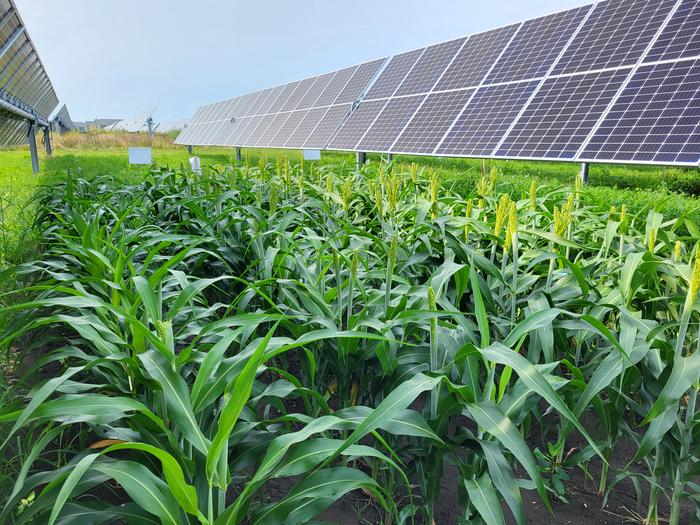
Same system. Same crops. Completely different outcome depending on environment. That is where this moves from an energy conversation into something much more relevant for the seed industry.
For decades, we have been designing products around a fairly stable assumption. Crops grow in full sunlight, and the job is to protect yield from stress, whether that is drought, disease or nutrient limitations. Agrovoltaics introduces a different baseline. It is not occasional shade from a tree line or a cloudy week. It is a structural change to how much light reaches the plant, how heat is distributed and how crops use water throughout the season.
That matters because plants respond to those conditions immediately. Photosynthesis, canopy development, transpiration, root growth, all of it shifts. And right now, we are not breeding specifically for that environment.
What makes this more than a theoretical exercise is that the opportunity is already taking shape. The study points to soybean-based systems in semi-arid regions as one of the few scenarios where both farmers and solar developers can economically benefit.
“We identified ‘win-win’ opportunities where soybean-based agrivoltaics in the semi-arid region produce economic benefits for both farmers and solar developers, highlighting the necessity for region-specific designs tailored to local climate conditions,” crop sciences professor Bin Peng said in the UI news release.
That is not broad adoption. It is not a sweeping change across the Corn Belt. But it is a signal. Agriculture does not shift all at once. It moves in pockets, in places where conditions line up and something new starts to make sense.
We have seen this pattern before. Different maturities for different geographies. Hybrids designed for high population systems. Varieties built for dryland versus irrigated acres. Each shift creates a slightly different version of the same crop, and over time those differences become meaningful.
Agrovoltaics may be introducing another one of those shifts, not from the soil up, but from the canopy down.
There is a reason it has not quickly scaled. The economics are not simple. To grow row crops under solar panels, those panels must be installed higher, which increases costs and reduces the financial advantage compared to stand-alone solar systems. Without policy support or market incentives, most developers will continue to choose traditional solar installations.
That slows adoption, but it does not eliminate it. Markets, weather patterns and land values will determine where this shows up first and how far it goes.
What stands out to me is how agrovoltaics introduces a new growing environment. And every time agriculture creates a new environment, the seed is a foundational part of the conversation.
I don’t think most growers are asking for products designed for partial shade. Not yet. But if systems like this begin to expand in water-limited regions, who knows? Forward-thinking companies will be ready for it.