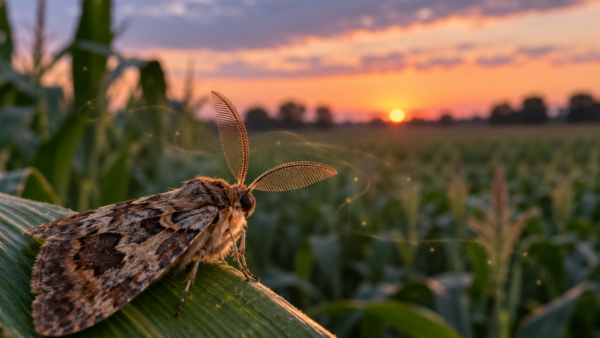
By starting with insect smell receptors rather than the pheromone itself, researchers have developed a reverse engineering approach that could accelerate monitoring and mating disruption tools for crop and seed production.
Scientists have identified the sex pheromone of the lily moth by starting with the insect’s scent receptors, demonstrating an approach that could accelerate the development of pheromone-based pest management.
Sex pheromones help insects locate mates. In crop protection, these chemical signals can be used to disrupt mating or attract insects to traps for population monitoring and control.
Identifying them, however, typically requires access to live insects, precise knowledge of when pheromones are released and extensive testing to determine which compounds attract a mate.
Working Backwards from the Receptor
The research team reversed the traditional process. Instead of beginning with chemicals released by the insect, scientists examined the olfactory receptors that detect them.
Using genetic information from the lily moth (Spodoptera picta) and comparisons with related species, researchers selected two candidate receptors. They then used artificial intelligence to predict the receptors’ three-dimensional structures and computer modelling to identify molecules likely to bind to them, according to a press release.
Laboratory tests confirmed that the receptors responded to the predicted compounds. Further chemical and electrophysiological testing established that female moths released the identified pheromone and males could detect it.
Behavioural experiments confirmed that the pheromone attracted males and triggered sexual behaviour.
Potential for Targeted Pest Management
The lily moth is not found in mainland France, but it is a significant pest in many parts of the world, particularly in private gardens, public parks and botanical gardens. Restrictions on pest-control products in these settings make pheromone-based approaches a potential management option.
The study provides proof of concept for identifying insect pheromones through their corresponding receptors. Researchers suggest the approach could speed up the identification of previously unknown pheromones in current, emerging and invasive crop pests.
The findings could also deepen understanding of insect evolution. Sex pheromones serve as chemical signatures that help distinguish species and maintain reproductive isolation.