Aphanomyces root rot can compromise crop health, reduce yield potential and create long-term challenges for pea and lentil growers. Early diagnosis and preventive practices, including fungicide seed treatments, can help suppress the disease and, in some cases, control it.
For Canadian pea and lentil growers, aphanomyces root rot can persist beyond a single season. Caused by the soil-borne pathogen, Aphanomyces euteiches, this destructive disease attacks root systems, limiting plants’ abilities to take up water and nutrients when they need them most.
Severe infections can cause yield losses of 60-84%* in peas and lentils. Some reports suggest annual losses in Canadian sales and exports could reach $1.5 billion. Proactive management starts with knowing whether fields are infested or at high risk. That kind of impact underscores the need for proactive disease management.
Scout Symptoms and Assess Field Conditions
Scout low-lying, poorly drained field areas and places where plants appear uneven or stressed. Aphanomyces thrives in warm, moist soils and needs free water to reach and infect roots, making waterlogged areas especially vulnerable.
Aphanomyces root rot can be difficult to diagnose early because damage begins underground, compromising crop establishment before symptoms appear above ground. That makes root inspection essential.
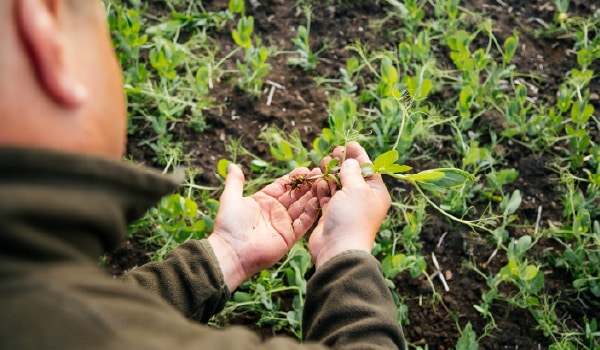
Carefully dig up symptomatic plants rather than pulling them from the soil. Gently wash the roots and look for soft, water-soaked tissue that turns brown to black as the disease progresses. Compare affected plants with healthy nearby plants, looking for fewer lateral roots and nodules. Because symptoms overlap with other root rots, soil and tissue testing can help confirm the pathogen.
As the disease progresses within the roots, the plants may develop nutrient or drought stress and begin to show above-ground symptoms that include yellowing, wilting, stunted growth and even premature plant death.
Worse, the threat persists after harvest. Aphanomyces produces resting spores that survive in soil for many years, even during rotations with non-susceptible crops. In-season management options are limited in infested fields, making prevention essential.
Include Seed Treatments in a Broader Root-Health Strategy
Certain seed treatments suppress aphanomyces during the vulnerable seedling stage. Depending on the product, they also may protect against fusarium, pythium and rhizoctonia, supporting establishment when conditions favor disease.
Consider Rancona® Trio fungicide seed treatment, from UPL Corp, which combines three powerful fungicides that work together to provide both contact and systemic activity for more consistent disease suppression.
Designed to help maximize seed investment and yield potential in pulse crops and cereals, Rancona Trio protects against a broad spectrum of seed and seedling diseases. Its advanced-generation application technology delivers exceptional coverage and adhesion, keeping more active ingredient on the seed for consistent protection across a wide range of conditions.
Rancona Trio alone suppresses aphanomyces. Combined with Belmont® 2.7 FS fungicide seed treatment, it is the only solution that offers early season control of aphanomyces root rot, adding protection as disease pressure increases.
Be Proactive and Stay Profitable
Before the coming season, assess field risk through scouting and accurate identification, especially in fields with a history of wet conditions. Use those findings to select a proven seed treatment that provides early protection and supports strong emergence.
Managing aphanomyces requires a long-term approach. Combine strategic scouting, field-risk planning and appropriate seed treatments to strengthen early-season protection and support long-term profitability.
To learn more, contact your local ag retailer or UPL representative.
*Source: Saskatchewan Pulse Growers Association
Always read and follow label directions. UPL, the UPL logo, Belmont and Rancona are trademarks of a UPL Corporation Limited Group Company. ©2026 UPL Corporation Limited Group Company. UPL AgroSolutions Canada Inc. is the Canadian affiliate of UPL Corporation Ltd. (UPL Corp) 26-UPL-2410 11/26