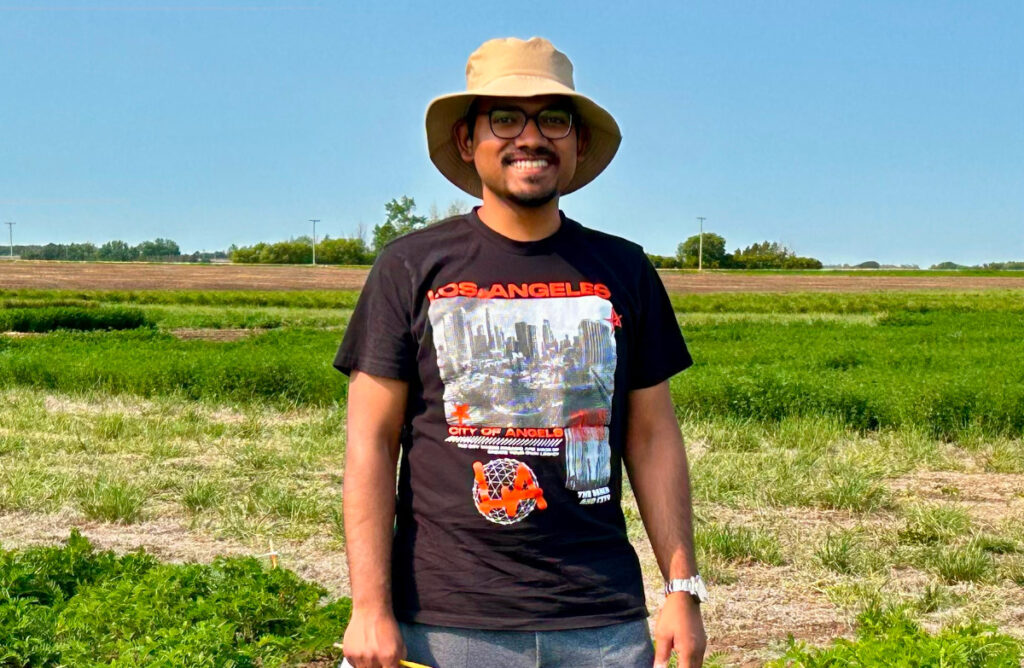
From rural West Bengal to Saskatchewan’s leading agricultural research programs, he’s helping build the genomic foundations that could shape the future of crop improvement.
At 25, Anirup Sengupta is already thinking in decades.
Not because he is moving slowly. Quite the opposite. The University of Saskatchewan plant scientist has published papers, presented internationally, won awards, and has now earned a 2026 Canadian Plant Breeding Innovation Scholarship.
But Sengupta’s work is aimed at a much longer horizon: the future of crop improvement in a world where agriculture has to move faster, become more precise, and adapt to climate pressure, emerging disease and the constant demand for more sustainable food systems.
His PhD research brings together three powerful tools in modern plant breeding: reference genome development, genetic diversity analysis and genomic selection. The crop at the centre of that work is cicer milkvetch, a perennial forage legume valued for its nutritional quality and its ability to avoid the frothy bloat problems that can affect ruminants. Its promise is significant. Its challenges are equally clear: low germination, poor seedling establishment and limited genomic resources.
For Sengupta, the starting point is simple: before breeders can improve a crop quickly, they need a map.
“Without a reference genome,” he says, “breeding is a bit like trying to assemble a massive puzzle without seeing the picture on the box.”
That reference genome — the crop’s first complete genetic blueprint — would allow researchers to identify genes linked to key traits such as seedling vigour, forage yield, disease resistance and stress tolerance. From there, genetic diversity analysis helps breeders understand which plant populations are truly different from one another. That matters because diversity is the raw material of crop improvement. When breeding programs rely too heavily on closely related material, progress slows.
The third piece is genomic selection, one of the tools Sengupta sees as most transformative. Instead of waiting several growing seasons to evaluate which plants perform best in the field, breeders can use DNA marker information and computational models to predict future performance much earlier. That can save time, reduce costs and accelerate genetic gain.
Together, the three approaches create what Sengupta calls a pipeline for faster, smarter crop improvement — one that can apply not only to vetch, but to many crops that remain underdeveloped compared to global staples.
From Observation to Prediction
Traditional plant breeding has delivered enormous gains over the past century. Sengupta is careful not to dismiss it. Field observation, breeder intuition and multi-season testing remain essential.
But he believes the biggest shift underway is that plant breeding is becoming more predictive.
“Instead of looking only at what we can see in the field, we can also look directly into the plant’s DNA,” he says.
That change is being driven by genomics, bioinformatics, artificial intelligence, machine learning, drone-based phenotyping and environmental data. These tools allow researchers to analyze huge volumes of genetic and field information, revealing patterns that would be impossible to detect manually.
The result is not a replacement for breeders. It is an upgrade to their decision-making.
That distinction matters. In agriculture, a model is only useful if it connects back to the field. Sengupta has seen how easy it can be for young researchers to become excited by new technologies and lose sight of the real biological or agricultural problem.
“Sometimes that can lead to a situation where we almost have a solution looking for a problem,” he says.
The better path, he argues, is to begin with the question: What challenge are farmers, breeders or food systems actually trying to solve? Technology should serve that objective, not become the objective itself.
Sengupta’s own training reflects that balance. His resume spans plant breeding, genetics, plant pathology, genomic data analysis, GIS, statistics, R, Python and field and greenhouse experimentation. His master’s work at the University of Manitoba focused on genome-wide association studies and genomic selection models for leaf rust resistance in winter wheat.
That work has already earned notice from colleagues. Brent McCallum, a research scientist with Agriculture and Agri-Food Canada at the Morden Research and Development Centre, worked closely with Sengupta during the 2023 and 2024 field seasons and saw him evaluate wheat lines for rust disease resistance in both field and greenhouse conditions.
McCallum says Sengupta “has rapidly learned the knowledge and skills to conduct and complete this research program” and describes him as “a strong student, a diligent and dedicated researcher who will make significant contributions to this field.”
His research has already taken him to major scientific gatherings. In 2024, he presented work on GWAS and genomic selection for leaf rust resistance at the 3rd International Wheat Congress in Perth, Australia, where he received a Best Poster Award. He has also presented at Plant Canada, the Plant Science Graduate Student Symposium and the Canadian Wheat Symposium.
That combination of hands-on agricultural understanding and computational fluency is where Sengupta believes the next generation of plant scientists will have to live.
Sengupta grew up in West Bengal, India, where agriculture was not an abstraction. It was part of the landscape, the economy and the rhythm of daily life.
He saw how farming families could be affected by drought, disease or changing environmental conditions. That human connection stayed with him. Agriculture, he realized, was not only a scientific discipline. It was one of the world’s most essential industries — economically, environmentally and socially.
His interest in plant breeding sharpened during his undergraduate studies at Bidhan Chandra Krishi Viswavidyalaya in West Bengal, where he completed a B.Sc. Honours in Agriculture with first-class distinction.
He came to Canada in 2022 to begin his master’s degree at the University of Manitoba, working in wheat breeding with Curt McCartney and collaborators including McCallum and Colin Hiebert. After that, he moved into his PhD work with Dr. Bill Biligetu and Andrew Sharpe, connected to the Crop Development Centre and the Global Institute for Food Security in Saskatchewan.
The through-line has been mentorship. Sengupta repeatedly points to supervisors, collaborators and senior scientists as a major reason for his growth.
“Good mentors can accelerate our growth a lot,” he says.
The Canadian Plant Breeding Innovation Scholarship is made possible by Alberta Grains, the Canadian Seed Growers’ Association, FP Genetics, HyTech Production, Richardson, SaskWheat Development Commission, SeCan, Seeds Canada, Seed World Canada, and Warburtons.