The retiring AAFC plant pathologist says curiosity, collaboration, and staying connected to farmers are what drive meaningful research.
There’s a moment in nearly every agricultural career when science stops being abstract.
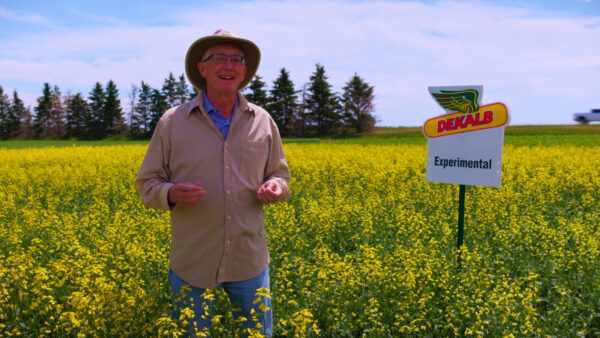
For Dr. Kelly Turkington, that moment happened in a canola field.
Long before he became one of Western Canada’s most respected plant pathologists with Agriculture and Agri-Food Canada in Lacombe, Alta., Turkington was a university student discovering a world hidden beneath the visible symptoms of disease — a microscopic universe of fungal spores, infection cycles, and crop interactions that most people never notice.
“I would have to go back to undergrad agriculture at the University of Saskatchewan,” Turkington says. “I took an introductory course in plant pathology from Robin Morrall, and he was so passionate about pathology. I just so enjoyed the class.”
At the time, he wasn’t necessarily a standout student in the discipline.
“I did okay,” he says with his characteristic modesty.
But something about the subject captured him completely.
“You can see the symptoms in the crop or the plants,” he says, “but when you get down to that dissecting scope level, or microscope level, looking at the cultures of the spores — it’s a whole other different world.”
That curiosity soon evolved into something much larger: a career that would span more than 40 years and help shape disease management strategies across the Prairies.
But Turkington’s story isn’t really about pathology, at least not entirely.
It’s about how a scientist stays grounded while spending decades inside systems that often reward distance, specialization, and certainty. It’s about remaining connected to the people whose livelihoods depend on the work.
And above all, it’s about never forgetting where you came from.
Science Begins in the Field
After taking Morrall’s class, Turkington joined Agriculture Canada and then the University of Saskatchewan Biology Department as a summer student working with on some of the early research into fungicide applications for sclerotinia management in commercial canola fields. The work was gritty and physical. Researchers spent hours in the Melfort and Meadow Lake areas crawling through crops, scouting for apothecia (tiny mushroom-like structures that signal disease risk).
“We spent a lot of time on our hands and knees,” Turkington recalls. “That connection to the farm really was something that was very interesting for me, and I found very rewarding.”
That early exposure shaped the rest of his career. Morrall wasn’t simply passionate about science; he was deeply engaged with producers and focused on solving practical problems farmers faced.
Turkington noticed. And because farming already ran through his family history, the work felt personal.
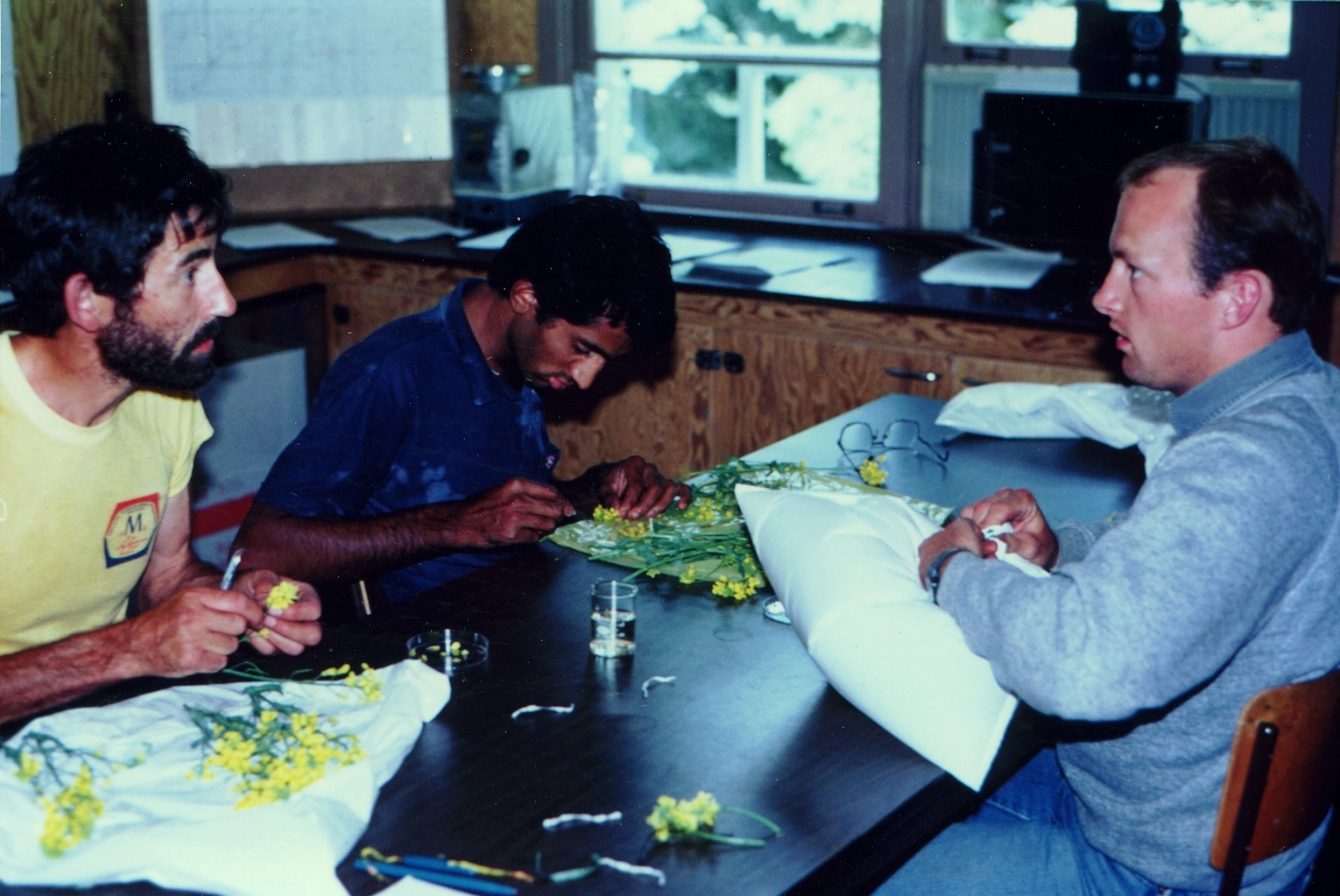
His father farmed at Daylesford near St. Brieux, Sask. One summer during Turkington’s master’s studies, while he was working in a temporary lab at AAFC Melfort testing canola petals for sclerotinia, his father stopped by with friends Bobby and Delbert Folden after what Turkington jokingly suggests may have been a less-than-essential “parts run” into town.
“They were in pretty good spirits,” he says.
Then came the conversation he still remembers decades later.
“Bobby looked at me, and he was dead serious,” Turkington says. “He said, ‘Kelly, when you’re in your ivory tower, don’t forget where you come from.’” Kelly notes Bobby’s words were a bit more colourful.
It became a guiding principle. Throughout his career — whether working in Ottawa, Beaverlodge, Lacombe, or traveling across Western Canada — Turkington carried that advice with him.
He never viewed science as something separate from farming. The two were inseparable, and that perspective would eventually distinguish him in a field where technical expertise can sometimes drift away from practical realities.
The Anti-Expert Expert
Turkington spent decades studying plant disease systems, collaborating with researchers, agronomists, technical specialists, and industry groups across the Prairies. Yet he remains uncomfortable with the label of “expert.”
“People often look at you, ‘Well, you’re the expert. You know everything,’” he says. “I don’t know everything, and I’m not an expert. I have experience.”
It’s a subtle distinction, but an important one.
Experience, in Turkington’s view, is collaborative and comes from listening.
“I always found it so valuable to listen to people,” he says. “Whether it was a farmer or a crop consultant, a fellow researcher, the technical staff I work with.”
In agriculture, information rarely flows in one direction. Farmers notice patterns long before researchers do. Agronomists see trends emerging across regions. Technicians understand field variability in ways spreadsheets cannot fully capture.
Turkington embraced that ecosystem of shared learning rather than positioning himself above it.
“It’s so important to learn from them and to be mentored by them,” he says. “I’m always looking at learning from and having an understanding of the environment and the concerns and issues that are at that farm level.”
That mindset earned him trust. And in agriculture, trust matters almost as much as data.
Because the reality is that producers don’t adopt practices simply because a research paper exists. They adopt them when they believe the person delivering the message understands their operation, their risks, and their constraints.
Turkington understood that instinctively, because perhaps more importantly, he found collaborators who made the work enjoyable.
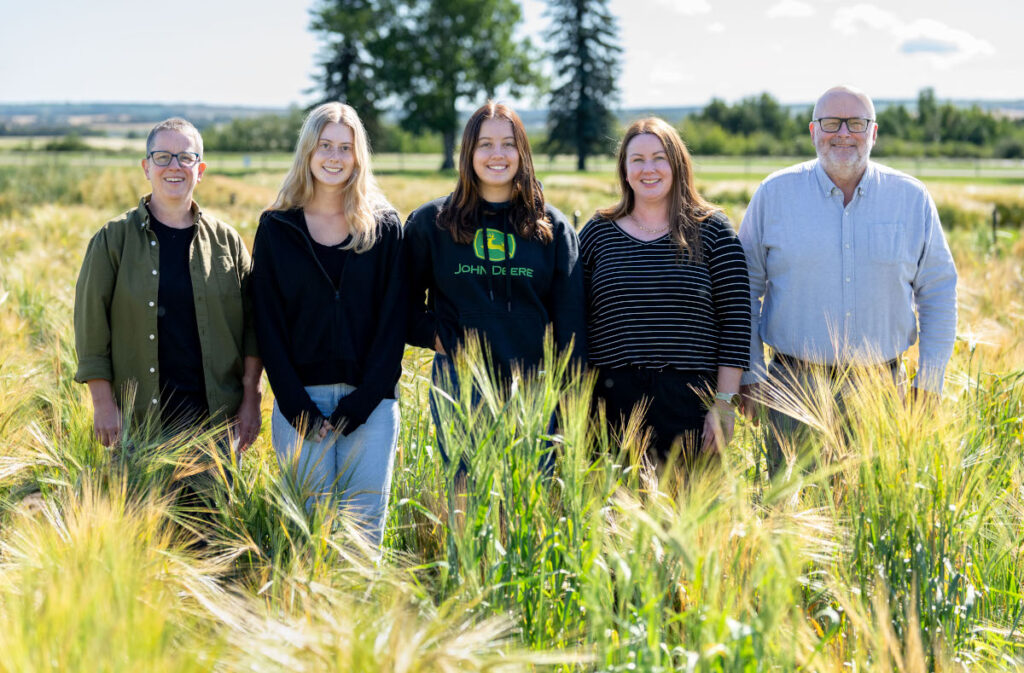
At Lacombe, he began working closely with researchers George Clayton and Neil Harker. The trio became known informally as “The Three Amigos” — or, depending on the mood, “The Three Stooges.”
“We liked to make fun of ourselves,” Turkington says. “We weren’t trying to be serious scientists.”
The humour mattered. Agricultural science can be highly technical, bureaucratic, and increasingly administrative. But Turkington and his colleagues found ways to keep it human.
Ask Turkington what mattered most about his career, and he becomes emotional surprisingly quickly.
“I kind of get a bit choked up about this,” he says. “But it’s the people you work with.”
The Prairie crop disease committees. The oat, barley, wheat, and triticale recommendation groups. The extension staff. The consultants. The producers. The fellow scientists who became lifelong friends.
“It’s that network that makes the work you do fun,” he says. “It engages you, and it helps you get through the more routine and challenging aspects.”
Motorcycles, Family History, and What Comes Next
Retirement won’t mean inactivity. Turkington plans to spend more time with family scattered across Saskatchewan, Alberta, and Idaho. He hopes to reconnect with relatives, visit nieces and nephews more often, and enjoy longer trips with his wife.
There’s also the motorcycle.
Former AAFC canola breeder Kevin Falk sold Turkington a 1995 BMW K75 RT — though, as Turkington jokes, Falk neglected to mention how much work it needed, although he Turkington a good price.
He’s spent countless hours tinkering with it, sometimes successfully, sometimes less so. Eventually, he hopes to ride it through Idaho’s Lolo Pass and the scenic roads north of Boise.
But perhaps the most revealing retirement project is quieter. Turkington has become the family genealogist. Boxes of old family slides and photographs dating back to his great-grandparents sit waiting to be digitized. Preserving those memories for his children and grandchildren has become increasingly important.
“As you get older,” he says, “some of these things become much more important, and you want to know a bit more about your history.”