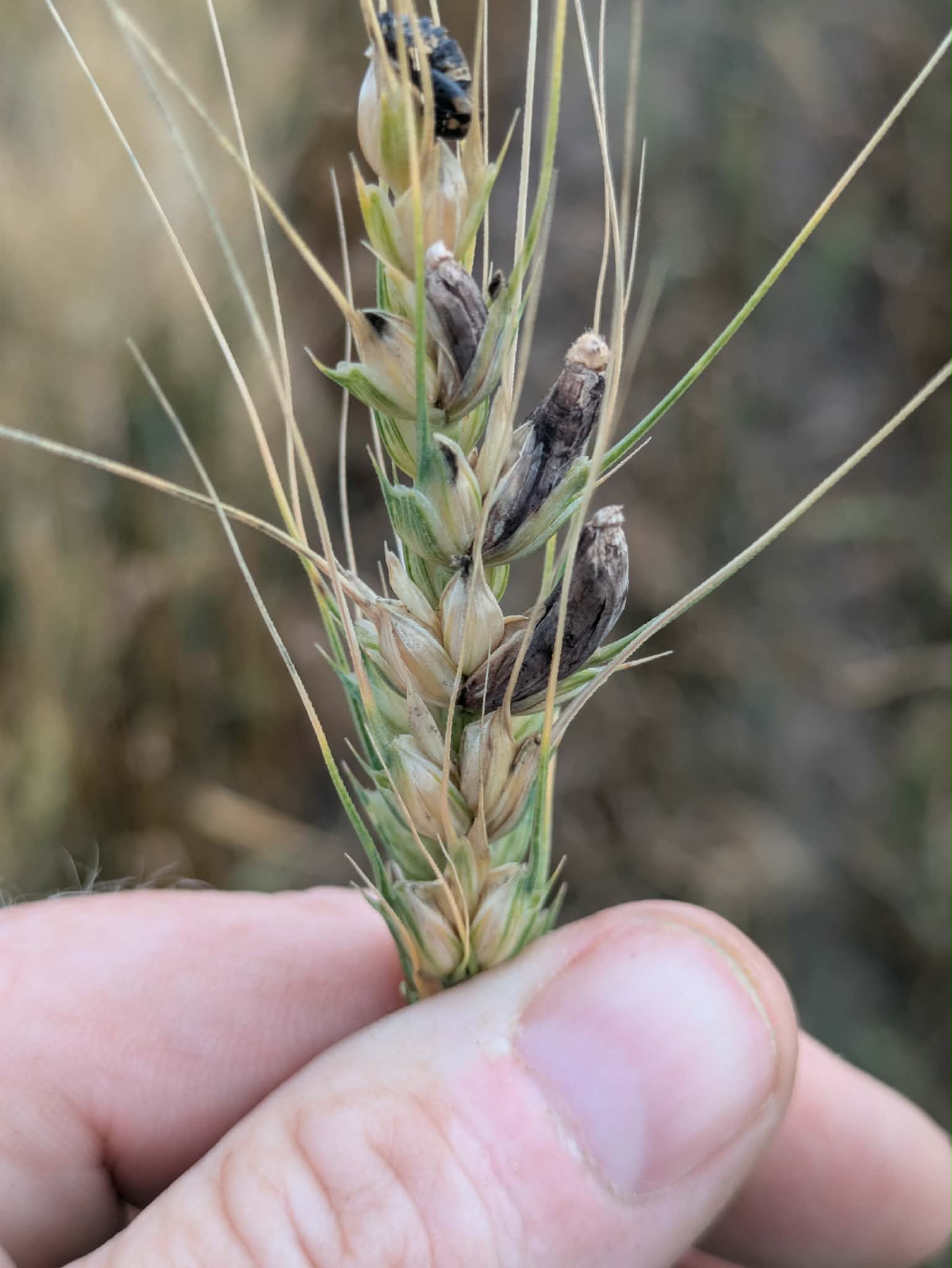
One of our staff — agronomist and accredited seed analyst, Shauna Sereda — took a photograph this year I wish we hadn’t had the opportunity to take: a bouquet of wheat with an extraordinary amount of ergot in the heads.
After a couple of dry summers, some growers had more pressing things to worry about than seed-borne disease. Fusarium testing requests had slowed, people weren’t finding much, and I understand how a problem that isn’t causing trouble moves down the list. Unfortunately, the fungus hadn’t lost interest in us.
This summer, heat and moisture arrived together, and some fungal pathogens had a very good year. That photograph has plenty of company in the results coming through our lab, particularly Fusarium graminearum in cereals and Ascochyta in pulses, along with more smut than we’d like.
The results from these lots are concerning enough I’d encourage anyone making seed decisions this fall to look beyond purity and germination. A reassuring germination number can bring a conversation to a close rather quickly, even when there’s a disease problem that deserves a few more questions.
I like to start with what someone needs to decide. If you’re choosing which lots to keep and clean, disease results may change your preferences. They may also leave you uncertain, which is when I’ll often suggest testing a second representative sample collected from the lot.
It’s an important step. Repeating the original submission helps establish consistency within that sample. Another properly collected sample gives us a further look at the seed you’re going to use. If a result could determine whether a lot stays in your seed inventory, it’s worth being clear about which question we’re answering.
There’s judgment involved, of course. When infection is already extremely high, another test may confirm something we know well enough to act on. I’d rather not spend someone’s money to reach the same decision twice. But where the answer could change the lot’s future, a little more investigation can be money well spent.
It also helps to understand what the test measures. With Fusarium graminearum, a presence-or-absence PCR test detects the pathogen’s DNA. A plate test tells us the percentage of seeds producing viable fungus under the test conditions. That infection level becomes particularly useful alongside the crop, field history, and other quality results.
The other piece is what disease is doing to germination. We’re seeing primary infections interfere with normal seedling development, and an appropriate seed treatment may improve performance in those cases. If the embryo has been damaged by frost or machinery, though, a fungicide won’t undo that injury. Knowing the cause saves us from asking a treatment to do a job it was never designed for.
Comparing treated and untreated samples can help inform a discussion with an agronomist or treatment supplier about a suitable, labelled product. Some lots have a practical way forward. With others, I’d rather see someone put their money into different seed than keep adding expense to a problem we haven’t adequately addressed.
I appreciate that someone running a lab is well placed to recommend more testing. But set that cost beside cleaning, treatment, fuel, and labour, and finding out what you have becomes a relatively modest investment. We should be able to explain how the result helps you make that investment wisely.
There’s encouraging news in some of this fall’s tests, too: poor early germination can reflect dormancy, which we’ll talk about in the next article. That’s why I want room for a conversation after the report. Someone deciding what to keep needs to understand whether we’ve found a manageable problem, a lot worth reconsidering, or good seed whose first impression has done it a disservice.